
 Vinyl Nostalgia
Anyone who has ever flipped over an Italian Odeon, Columbia or Parlophon LP from the 1970s has spotted that little circular stamp on the label: the letters SIAE inside a ring, sometimes red, sometimes blue, sometimes green. The topic is rarely discussed in collector circles outside Italy, which is a pity, because it happens to be one of the sharpest dating tools an Italian-pressing hunter has at hand.
Despite what occasionally turns up on forums, the SIAE marking has nothing to do with any specific label. It is an Italian state-mandated identifier that publishers were required to apply to every record manufactured in Italy from 1970 onwards. Anyone collecting Italian Beatles pressings has seen it many times, usually without paying it much attention.
What is SIAE?
SIAE (Società Italiana degli Autori ed Editori) is the Italian collective rights management organisation, founded in Milan in 1882. It was originally known as SIA (Società Italiana Autori) and took its present name in 1927. It is the Italian counterpart of the British PRS, the French SACEM, the German GEMA or the Belgian SABAM. From 1 January 1970, SIAE took over from SEDRIM (see the glossary below) the exclusive mandate over so-called mechanical reproduction rights, which is to say everything pressed on a physical carrier.
Before SIAE turned up on Italian labels, two other markings did the job: BIEM (the Bureau International des Sociétés Gérant les Droits d’Enregistrement et de Reproduction Mécanique, an international body whose acronym appeared on Italian, French and Dutch records) and the shorter D.R. for Diritti Riservati, meaning rights reserved. Both BIEM and D.R. were in use from late 1966 to early 1970, although italianprog.com places the changeover from BIEM to D.R. closer to 1968 or 1969.
Three types of SIAE stamp
In 1970, SIAE first appeared as a printed mark on the label, sometimes inside a rectangular box, sometimes as a free-floating piece of text. Only later, once EMI Italiana and other producers realised that a standardised marking would make life easier, was a mechanical circular stamp introduced, applied to the finished label. This is where the three-type classification, familiar to every Italian-vinyl collector, begins.
Type one (around 1970-1975)
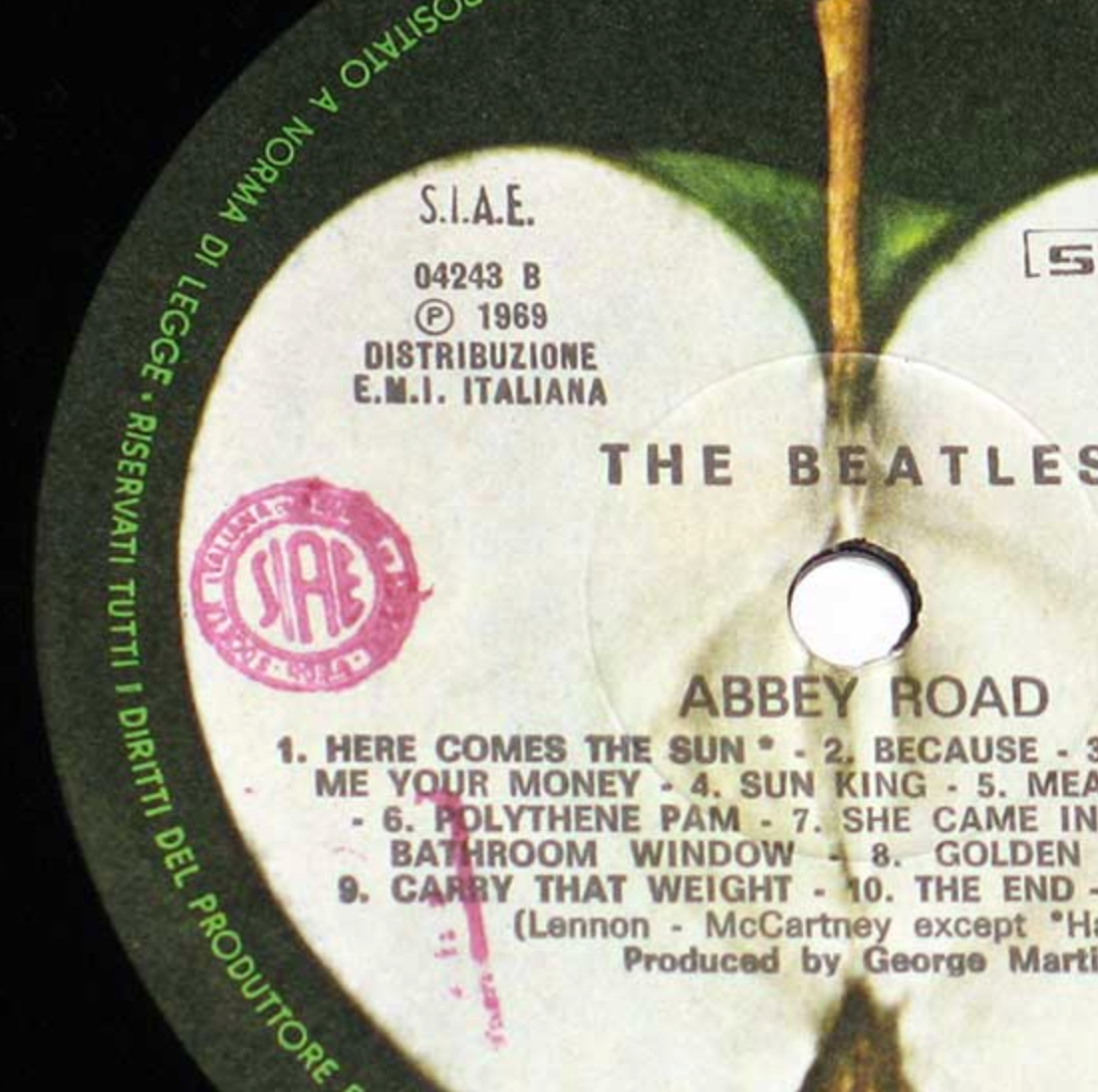
The smallest of the three, around 12 to 13.5 mm in diameter. Inside the circle, the letters SIAE; around the rim, the full name SOCIETÀ ITALIANA DEGLI AUTORI ED EDITORI – ROMA, set in capitals. The ink came in several colours: blue, purple, red, green, occasionally gold. Red was by far the most common. This is also where the first significant source disagreement turns up. Italianprog.com, citing the trade magazine Musica & Dischi, gives 1 February 1971 as the start date and early 1975 as the end. Augusto Rossi’s research, published on pinkside.it, points to spring 1970 as the start and autumn 1975 as the end. The safest bracket is type one running from 1970 or 1971 at the start to 1975 at the close.
Type two (1975 to 1978/79)

Bigger, around 15 mm in diameter. The central SIAE wordmark stays the same, but a small star sometimes appears next to the letter S. The S in Società is rendered as a mirror image, and the A in Autori drops to lower case rather than capital. The two main sources disagree on the closing date: italianprog gives 1975 to 1978, while pinkside extends the range from mid-1975 through to spring 1979.
Type three (autumn 1978 to 1996)
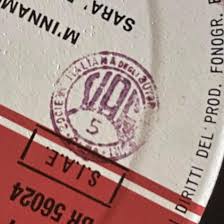
Same dimensions as type two, but the SIAE lettering is set in a heavier, bolder typeface and does not fill the central circle, leaving a blank space underneath. That space usually carries a single digit, occasionally a pair of digits. On Pink Floyd pressings, digits running from 1 to 12 have been documented. What they actually mean remains unclear. Some collectors speculate that they identify the stamping machine inside the pressing plant, others that they refer to the year or to a specific batch run. Type three exists in two diameter variants: the dominant 15 mm and a less common 13.5 mm.
From around 1996 onwards, the stamp was replaced by adhesive labels, first paper ones in red and white, later silver plastic stickers with a hologram (on CDs these also carried the importer’s name). In parallel, from the second half of the 1980s, foreign-manufactured carriers sold in Italy (CDs and cassettes) started to receive a rectangular Import fono sticker.
The Beatles thread
Up to 1967, distribution of Parlophone and Odeon in Italy was handled by Carisch of Milan. The firm itself has a curious backstory: founded in 1887 as a musical instrument shop, it moved into the recording business only in 1949. And it was Carisch that became the first Italian publisher to issue Beatles records. The classic Parlophon-Carisch singles with the QMSP prefix (such as QMSP 16346 Please Please Me / Ask Me Why, or QMSP 16352 Twist And Shout / Misery) were pressed on a rotating cast of label colours: olive green, dark blue, light blue, black, depending on when in the run they came off. These pressings predate SIAE entirely and instead carry the older BIEM or D.R. markings.
One more subtlety worth knowing in connection with Italian pressings: on Pink Floyd albums and other Western artists drawn from the British EMI catalogue, EMI Italiana pressings carried an additional identification feature in the dead wax. Alongside the matrix number, you find a cutting date in day-month-year format, plus a Roman numeral indicating the lacquer number. According to the recollections of Francesco Frangipane, a technician from the EMI Italiana plant in Caronno Pertusella (quoted in September 2022 on pinkside.it), the date refers to the moment the lacquer was cut, while the Roman numeral identifies which lacquer in sequence it was. It is a more granular system than what you find on British pressings, where the standard shorthand was simply A1/B1.
Dating Italian pressings: caveats
The stamp is a useful indicator, but rarely the final word. Both italianprog and pinkside flag a handful of pitfalls.
First, the absence of a stamp does not make a record a bootleg. Many copies were simply never stamped, and white-label promos almost never carried one in the first place.
Second, the presence of a stamp does not guarantee a legitimate release. Plenty of Italian bootlegs (especially pirated live LPs released only on the domestic market) carry SIAE stamps or stickers, because the publisher dutifully paid the SIAE fee and settled the tax even though the underlying record had no proper licence.
Third, on certain label types (lacquered RiFi, dark-coloured labels) the stamp is barely visible. It usually takes a strong light or a sharp angle to spot it, recognisable as a faint golden glint against the black surface.
Fourth, the three types overlap. Old and new stamps coexisted side by side for several months at each transition. Pinkside documents types 1 and 2 in concurrent use from mid-1975 through autumn of that year, and types 2 and 3 from autumn 1978 through spring 1979. A type 1 stamp on a 1975 record is therefore not necessarily a mistake. On the contrary, it can be entirely correct.
And finally, there are documented cases of two otherwise identical pressings (same publisher, same catalogue number, same matrices, same dead-wax dates) that differ only in their stamp type. The likely explanation is mundane: labels were stamped in batches and applied to the records later, not always in the order they were stamped.
For the collector, paying attention to SIAE markings is practical for two reasons. It helps separate an early Italian pressing from a later reissue when the label looks identical and the matrices give little away. And it offers a quick sanity check that a copy actually came out of Italy, even when the sleeve is damaged, torn or missing its back panel.
Since the first SIAE stamps did not appear on Italian pressings before 1 February 1971, an Abbey Road being sold to you as an „original 1969 Italian pressing” tells its own story. For anyone hunting Italian Beatles or Pink Floyd pressings, knowing the three stamp types and their date ranges is the first level of literacy. It will not tell you everything, but it will give you a basic read on what is in your hands.
| Stamp type | Period (per italianprog / per pinkside) | Diameter and colours | Identifying features | Example |
|---|---|---|---|---|
| Type 1 first | 1971 (italianprog) / spring 1970 (pinkside) to early 1975 | 12 to 13.5 mm. Blue, purple, red, green, occasionally gold | SIAE letters in the centre, with the full name „SOCIETÀ ITALIANA DEGLI AUTORI ED EDITORI – ROMA” in capitals around the rim | Pink Floyd, Atom Heart Mother (3C 062-04550), first EMI Italiana pressing |
| Type 2 second | 1975 to 1978 (italianprog) / mid-1975 to spring 1979 (pinkside) | 15 mm. Most often red, also blue | Mirrored „S” in „Società”, lowercase „a” in „Autori”, sometimes a small star next to the „S” | Pink Floyd, Animals (3C 064-98434), Italian pressing 1977 |
| Type 3 third | autumn 1978 to 1996 (both sources) | 15 mm (dominant) or 13.5 mm. Most often red | Bold „SIAE” lettering that does not fill the centre. A digit underneath (documented 1 to 12), meaning unknown | Pink Floyd, The Final Cut (1C 064-7400611), Italian pressing 1983 |
|
Quick check: Type 1 stamp = around 13 mm in diameter. Type 2 = larger (15 mm), with distorted typography. Type 3 = bold SIAE lettering with a digit below. A sticker rather than a stamp = post-1996. Source notes: italianprog.com (Maurizio Fulvi, drawing on Musica & Dischi) and pinkside.it / digilander.libero.it (Augusto Rossi, Stefano Tarquini, Alberto Ziviani, with their findings later folded into the 2014 book Tutte le canzoni dei Pink Floyd. Il fiume infinito, Giunti Editore) part company by a few months on dating types 1 and 2. The safe bracket: type 1 = 1970/71 to 1975, type 2 = 1975 to 1978/79, type 3 = 1978/79 to 1996. Trivia 1: A missing stamp does not necessarily mean an unofficial release. italianprog confirms that not every pressed copy was stamped, and white-label promos never carried one. The reverse holds too: the presence of a stamp is no guarantee of legitimacy. Italian bootleg live albums regularly carry SIAE stamps. Trivia 2: The digit (1 to 12) under the SIAE wordmark on type 3 is still unsolved. The going theory is that it identifies the machine that applied the stamp to labels at the EMI Italiana plant in Caronno Pertusella or similar pressing facilities, but no documentary evidence has surfaced. |
||||
Share Your Opinion