Vinyl Nostalgia
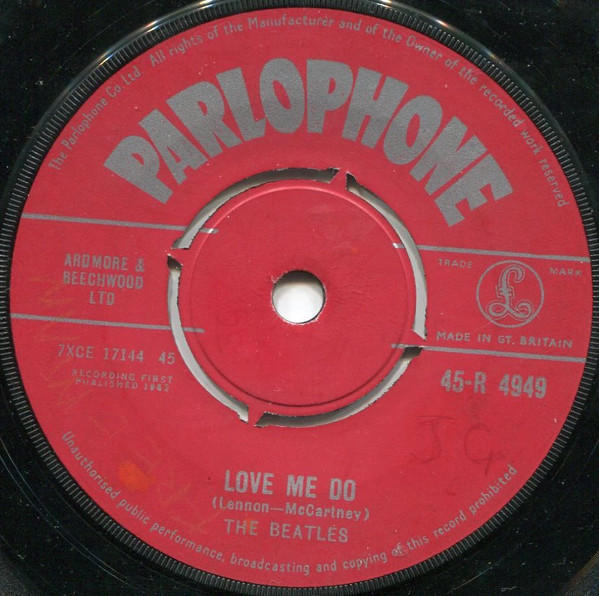
Three sessions, three drummers, one lost master tape, and sixty-two years of pressing variants: this is the full story of the Beatles’ debut single, Parlophone R 4949
It is the single most consequential 45 in the history of British popular music, yet it nearly didn’t happen at all. „Love Me Do” — Parlophone R 4949, released 5 October 1962 — was recorded three times with three different drummers, dismissed by its own producer as commercially unpromising, and pressed from tapes that would later vanish entirely. That it exists at all, and in so many variants, is one of the great accidental gifts of post-war record-making.
Origins: A Song Older Than The Beatles
Paul McCartney wrote the core melody and structure of „Love Me Do” in 1958 or early 1959, while bunking off school in Liverpool. He was sixteen. The Beatles, as a functioning entity, were still a year or two away from existing. John Lennon, characteristically, was blunt about authorship. In a 1972 interview he said that Paul wrote the main structure when he was sixteen, or even earlier, and that he himself thought he had something to do with the middle eight but couldn’t swear to it. By 1980, speaking to Playboy shortly before his death, Lennon expanded: „Love Me Do” was Paul’s song, something he’d carried around since Hamburg, long before they considered themselves songwriters. The original chord progression reportedly leaned on Buddy Holly — a logical touchstone for two teenagers steeped in American rock’n’roll and skiffle. But by the time the song reached the EMI Studios at 3 Abbey Road, London NW8, in mid-1962, the Holly influence had been sanded down and something subtler had taken its place.
Session One: 6 June 1962 — The Artist Test
The Beatles’ first recording session under contract to EMI has long been a subject of scholarly fascination. Ron Richards, George Martin’s assistant A&R man, ran the session; Martin himself arrived late, walking in during the recording of „Love Me Do.” Four songs were attempted: „Besame Mucho,” „Love Me Do,” „Ask Me Why,” and „P.S. I Love You.”
Martin immediately altered the arrangement. The problem was a crossover between Lennon’s harmonica part and the vocal line. Martin’s solution: McCartney would sing the words „love me do” in the chorus, freeing Lennon to wail on the chromatic harmonica. McCartney has described this moment with a mixture of terror and comedy many times since, most memorably at Lennon’s Rock and Roll Hall of Fame induction in 1994, recalling that he was suddenly given an exposed, unaccompanied vocal spotlight on their very first recording and that the shake in his voice is still audible.
The harmonica itself has its own origin story. Lennon had learned to play on an instrument given to him by his uncle George, but the one used at the EMI sessions was nicked from a music shop in Arnhem, the Netherlands, in 1960, while the Beatles were driving to their first Hamburg residency. Martin later said he picked up on „Love Me Do” because of the harmonica sound — it reminded him of the Sonny Terry and Brownie McGhee records he’d been issuing on Parlophone’s jazz and folk catalogue.
Both Martin and Richards found Pete Best’s drumming unsuitable for studio work. The session tape from 6 June was long thought lost, but surfaced in time for inclusion on Anthology 1 in 1995 — making it, belatedly, the third commercially released version of the song.
Session Two: 4 September 1962 — Ringo’s First Day
By August 1962, Best had been replaced by Ringo Starr. On 4 September, the new line-up flew from Liverpool to London, checked into a hotel in Chelsea, and arrived at Abbey Road shortly after midday. A three-hour rehearsal in Studio Three preceded the session proper, during which six songs were run through under Richards’ supervision.
The central drama of the day was the tug-of-war over the A-side. Martin wanted the Beatles to record „How Do You Do It?”, a Mitch Murray composition he was convinced was a hit. The Beatles loathed it. They wanted their own song. Martin, who at that point was entirely unconvinced by their songwriting, later admitted as much: he didn’t think they had any song of any worth and they gave him no evidence whatsoever that they could write hit material. The best they could find was „Love Me Do.”
The group laid down the backing track in approximately fifteen takes, with vocals overdubbed afterwards. This session produced the version that would actually appear on the first UK pressing of the single — Ringo on drums, no tambourine. The absence of tambourine remains, to this day, the simplest way to tell the Starr and Andy White recordings apart.
The session overran by an hour and a quarter. After the Beatles left, both songs were mixed. But Martin still wasn’t satisfied.
Session Three: 11 September 1962 — Andy White and the Tambourine
A week later, the Beatles were back. This time, session drummer Andy White — an experienced Glasgow-born professional — was seated behind the kit. Standard fee: £5 (approx. 7 USD) 15s. Ringo was handed a tambourine.
He was not pleased. In a 2000 interview, Starr recalled arriving ready to play and being told they’d hired a professional drummer. He said he was devastated that George Martin had doubts about him. Martin had apologised several times over the years, but Starr admitted he hated the man for years and still didn’t let him off the hook.
White, for his part, remembered the session warmly. He was struck by the fact that the Beatles were doing their own material — an unusual thing in 1962, when most groups were still working through covers of American songs or Tin Pan Alley material.
This third recording — with White on drums and Starr on tambourine — became the version heard on the Please Please Me LP, the Beatles’ Hits EP, the 1964 US Tollie single, the 1962–1966 compilation, and the 1 collection. It is, by a wide margin, the most widely distributed version of the song.
Let’s summarize: three recording sessions, three versions of the song, three drummers.
| 6 Jun 1962 |
Pete Best — drums Studio 2, Abbey Road · producer: Ron Richards / George Martin Artist test session. Martin arrived mid-recording and altered the arrangement — McCartney took over the chorus vocal so Lennon could play harmonica. Lewisohn called Best’s rhythm change in the middle eight „disastrous.” Recording thought lost until the 1990s. RELEASE Anthology 1 (1995) |
||
| 4 Sep 1962 |
Ringo Starr — drums · NO TAMBOURINE Studio 2/3, Abbey Road · producer: George Martin · engineer: Norman Smith · ~15 takes Version used on the first pressing of the UK single (Parlophone R 4949). Master tape erased per standard Abbey Road procedure; the mixdown master was also subsequently lost. Current master derived from a private collector’s 45 RPM single. UK SINGLE 1962 Past Masters (1988) Mono Masters Now and Then B-side (2023) 1962–1966 expanded (2023) |
||
| 11 Sep 1962 |
Andy White — drums · Ringo: tambourine · TAMBOURINE PRESENT Studio 2, Abbey Road · producer: Ron Richards · engineer: Norman Smith · White’s fee: £5 (approx. 7 USD) 15s Most widely released version — used on the Please Please Me LP, the Beatles’ Hits EP, the US Tollie single, the 1962–1966 and 1 compilations. Ringo recalled: „I was devastated. I came down ready to play and heard, 'We’ve got a professional drummer.'” PLEASE PLEASE ME LP (1963) 1962–1966 orig. (1973) 1 (2000) US Tollie 9008 single (1964) |
||
| How to tell them apart: tambourine present = Andy White · no tambourine = Ringo Starr | |||
Release: Parlophone R 4949
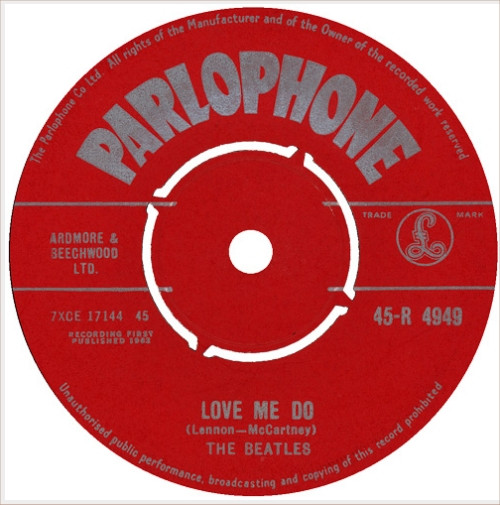
„Love Me Do” / „P.S. I Love You” was released on 5 October 1962. The first UK pressings — red Parlophone label, push-out centre, catalogue number R 4949, matrix 7XCE 17144-1N / 7XCE 17145-1N — contained the Ringo Starr version from the 4 September session.
This is a detail that has caused decades of collector confusion, because Mark Lewisohn shrewdly noted that if EMI issued the 4 September take for the single, they clearly didn’t regard the 11 September remake as a significant improvement.
The single entered the UK charts and peaked at number 17. George Martin, by his own account, was surprised it charted at all. But modest as it was, this chart placing changed everything. EMI gave the group more studio time, Martin’s attitude toward Lennon–McCartney’s songwriting shifted decisively, and the wheels of what would become Beatlemania began, very quietly, to turn.
McCartney, speaking in 1982, put it simply: in Hamburg they clicked, at the Cavern they clicked, but if you want to know when they knew they’d arrived, it was getting in the charts with „Love Me Do.” That was the one. It gave them somewhere to go.
Ringo’s take was more visceral. In 1976 he said that first record was more important than anything else — that first piece of plastic. You can’t believe how great that was.
The Lost Tapes
Here is where the story takes a turn that would give any archivist nightmares.
Standard procedure at Abbey Road in 1962 was to erase the original two-track session tape once the song had been mixed down to the mono master used for pressing. This was the fate of four songs across two Beatles singles: „Love Me Do,” „P.S. I Love You,” „She Loves You,” and „I’ll Get You.” But in the case of „Love Me Do,” the mixdown master tape was also lost at some point — and no backup copies had been made.
By the time anyone noticed, EMI had long since moved on to the Andy White version. They would not have been especially concerned. The 4 September recording was considered obsolete, and nobody anticipated ever needing it again.
For many years, the only surviving copies of the original single version — Ringo on drums — were the red-label Parlophone 45s pressed in the autumn of 1962. Eventually, EMI struck a new master from a 45 in their own archives, but the quality was mediocre. A few years later, a superior copy was supplied by a private collector, and this has served as the official EMI master tape for the original „Love Me Do” ever since.
Think about that for a moment. The master of the first Beatles single — arguably the most important debut 45 in pop history — is derived from a second-hand record pulled from a collector’s shelf.
Pressing History: A Collector’s Chronology
The discographic afterlife of „Love Me Do” is a labyrinth of reissues, mispressings, and format shifts that would fill a chapter of any serious Beatles collecting guide. What follows is a condensed timeline.
| Key releases of „Love Me Do” and chart positions (1962–2023) | ||
| 1962 | UK single #17 UK |
Parlophone R 4949 · 7″ 45 RPM · Ringo version · red label, push-out centre. Demo copies (250 pressed, McCartney misspelt „McArtney”) valued at ~£6,000 (approx. 7,942 USD) per Rare Record Price Guide. |
| 1963 | Canada single | Capitol 72076 · 7″ 45 RPM · Ringo version · ~170 copies pressed. Among the earliest non-UK releases — sales, by Paul White’s own account, were „minuscule.” |
| 1963 | Please Please Me #1 UK · 30 WKS |
Parlophone PMC 1202 (mono) / PCS 3042 (stereo) · LP · Andy White version. Debut album recorded in a single day. White version on all LP releases. |
| 1964 | US single #1 US · BILLBOARD |
Tollie 9008 · 7″ 45 RPM · Andy White version. Topped the Hot 100 on 30 May 1964 — the fourth of six Beatles No. 1s in a single calendar year. Also #1 in Australia and New Zealand. |
| 1973 | 1962–1966 („Red Album”) |
Apple PCSP 717 · 2×LP · Andy White version. Opening track of one of the best-selling compilation albums in music history. |
| 1982 | 20th Anniversary #4 UK |
Parlophone R 4949 (7″) + 12R 4949 (12″) · both versions (Ringo + White). New master struck from a superior-sounding 45 supplied by a private collector — this master has served as EMI’s official source ever since. |
| 1988 | Past Masters Vol. 1 | Parlophone CDP 7 90043 2 · CD · Ringo version. First systematic collection of non-album Beatles material on compact disc. |
| 1992 | CD single | Parlophone · CD single · both versions (Ringo + White) on a single disc for the first time. |
| 1995 | Anthology 1 | Apple 7243 8 34445 2 6 · 2×CD / 3×LP · Pete Best version from the 6 June 1962 session — first commercial release of a recording long thought lost. |
| 2000 | 1 | Apple 7243 5 29325 2 8 · CD / LP · Andy White version. No. 1 hits compilation — over 31 million copies sold worldwide. |
| 2012 | 50th Anniversary MISPRESSING |
Parlophone 45 R 4949 · 7″ · Cock-up: 30,000 copies pressed with the White version instead of Ringo + wrong cat. no. on the B-side (R 4714 — a 1960 Matt Monro release). Run recalled and destroyed; ~200 copies escaped and are now collector’s items. |
| 2023 | Now and Then / Love Me Do #1 UK |
Apple/Capitol/UMe · 7″ / 12″ / CD / digital · Ringo version, new stereo mix. Restored by Miles Showell from two 60-year-old 7″ singles, de-mixed using MAL technology (WingNut Films / Peter Jackson), remixed in stereo and Dolby Atmos by Giles Martin and Sam Okell. Sleeve art: Ed Ruscha. The first and last Beatles single on one release. |
| 2023 | 1962–1966 (2023 Edition) |
Apple/UMe · 2×CD / 3×LP / digital · Ringo version (2023 mix). UK single version opens the expanded compilation with 21 additional tracks. |
What They Said About It
No account of „Love Me Do” is complete without the voices of the people who made it. Their reflections span decades, and the emotional register ranges from raw sentiment to dry self-deprecation.
John Lennon (1972): Paul wrote the main structure of this when he was sixteen, or even earlier. He thought he had something to do with the middle. In a later interview he called it „Paul’s song” — something McCartney had carried around since before Hamburg.
Paul McCartney (1982): In Hamburg they clicked, at the Cavern they clicked, but if you want to know when they knew they’d arrived, it was getting in the charts with „Love Me Do.” That was the one. It gave them somewhere to go.
McCartney (1994, at Lennon’s Rock and Roll Hall of Fame induction): He still remembered doing „Love Me Do,” because John officially had the vocal. But because he played the harmonica, George Martin in the middle of the session suddenly told him to sing the crucial line. And he could still hear it to this day — John going „waahhh wahhhh” and him going „love me doo-oo.” Nerves.
McCartney (undated): He once called „Love Me Do” — with characteristic deadpan — „our greatest philosophical song.”
Ringo Starr (1976): That first record was more important than anything else. That first piece of plastic. You can’t believe how great that was.
Starr (2000): He was devastated that George Martin had doubts about him. He came down ready to play and heard they’d got a professional. Martin had apologised several times since, but Starr said he still didn’t let him off the hook.
George Martin: He didn’t think the Beatles had any song of any worth — they gave him no evidence whatsoever that they could write hit material. The best they could do was „Love Me Do.” Yet he also admitted he picked up on it because of the harmonica sound, which reminded him of the Sonny Terry and Brownie McGhee records he used to issue.
Andy White (1962 session): He was impressed because they were doing their own material, whereas most groups at the time were doing covers of American songs or Tin Pan Alley stuff.
Why It Still Matters
It is easy to patronise „Love Me Do.” To modern ears it can sound slight — a two-minute wisp of harmonica and faltering vocals, almost comically modest next to the orchestral ambitions of Sgt. Pepper’s or the polyphonic intricacies of Abbey Road. But that very modesty is the point. In October 1962, in a British pop landscape dominated by Cliff Richard’s good manners and licensed American cover versions, four young men from Liverpool walked into a recording studio and insisted — against the explicit wishes of their producer — on recording their own song. That act of creative stubbornness is the seed from which everything else grew.
On the Billboard Hot 100, „Love Me Do” was the Beatles’ first entry — and it went straight to number 1. They went on to accumulate twenty chart-toppers, a record that still stands. In November 2023, the song reappeared on a single — paired with „Now and Then,” the last Beatles recording — creating a sixty-one-year arc from first to last, from Parlophone R 4949 to Apple/Capitol/UMe, from a two-track mono session in Studio Two to a de-mixed, Atmos-enabled stereo master built from vinyl.
The master tape is gone. The original stampers were destroyed in 1967. The surviving audio is derived from a collector’s 45. And yet the song endures — in new mixes, on new formats, in new decades. Four words, a harmonica riff, and a nervous vocal from a twenty-year-old McCartney. That’s all it took.
Sources:
Mark Lewisohn, The Complete Beatles Recording Sessions (Hamlyn, 1988) · Beatles Bible (beatlesbible.com) · Record Collector magazine · About The Beatles (aboutthebeatles.com) · The Beatles Story Museum, Liverpool · thebeatles-collection.com · American Songwriter · Billboard · Abbey Road Studios · Discogs
Quotes sourced from: interviews with Paul McCartney (1982, 1994), Ringo Starr (1976, 2000), John Lennon (1972, 1980), George Martin (BBC Desert Island Discs; Billboard, 1998), Andy White (Lewisohn, 1988)