
 Vinyl Nostalgia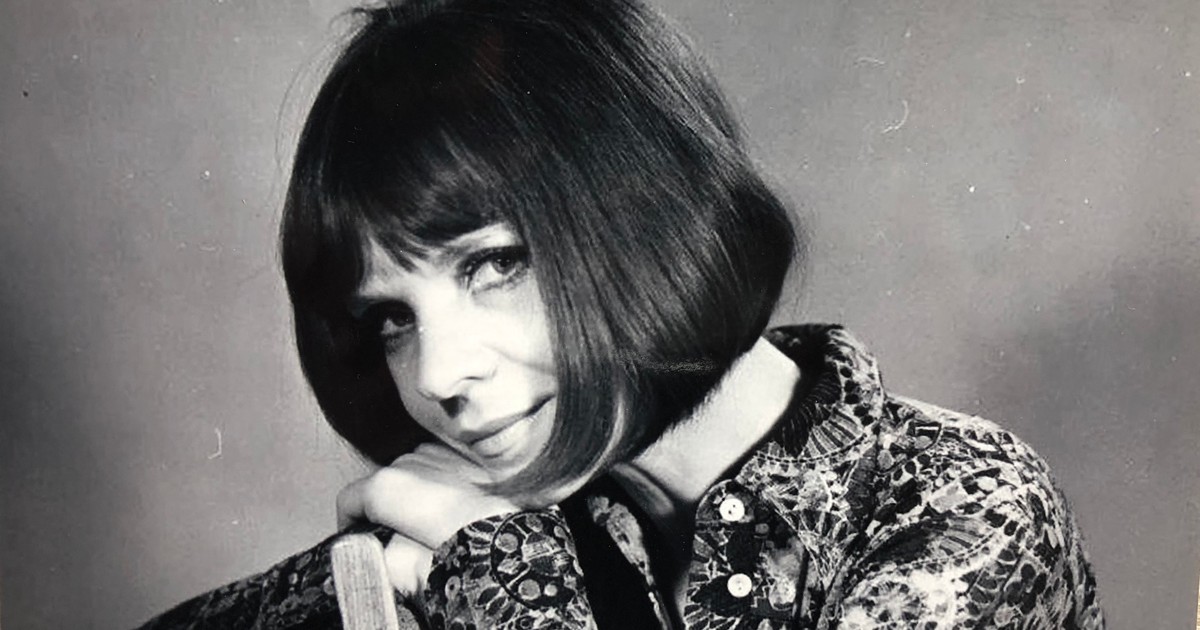
I once bought a record from some online secondhand store, and when the seller shipped it, he threw in a small freebie: a tiny, badly damaged disc with a Veriton label, missing its sleeve. Just an old Polish single, practically worthless. It automatically ended up in my “to check out later” pile and sat there for several years. It finally caught my attention when I realized it was an EP, a record with four tracks, likely from 1963.
There were a great many of these “four-tracks” Veriton’s EPs from the early 1960s on the market. They were printed in runs that, in the days of the Polish People’s Republic, meant tens of thousands of copies. They were sold at Ruch kiosks and in music stores across the country. The one that sat on my shelf had been sitting with someone for over sixty years before ending up unwanted at an antique shop, likely when someone was getting rid of a book collection that’s of little value today. I don’t know how many such copies survived until 2026 in a condition suitable for playback. I think not many. The one that ended up with me was mercilessly worn out, and since it was kept without a sleeve, it suffered additional deterioration in the process.
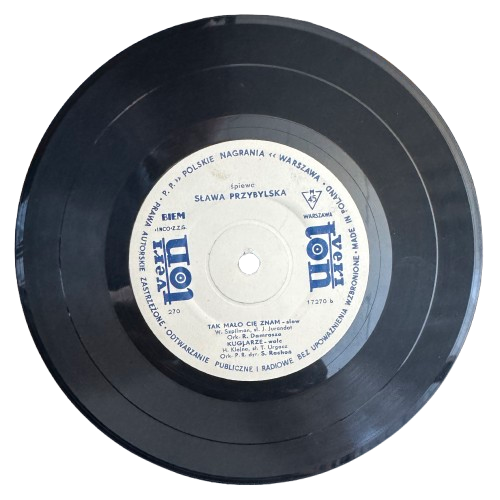
Finally, I picked up the record and took a closer look. A white label, blue print, the distinctive Veriton logo on both sides, a triangle symbol marked “M 45” (mono, 45 RPM) in the upper right corner, and the word “WARSZAWA” in the text at the top. The title “śpiewa SŁAWA PRZYBYLSKA” and no hits on the track list. At first glance, nothing special, and it’s no wonder the antique dealer got rid of it without a second thought. Another forgotten record and that’s reason enough for me to listen to it and learn more about it.
In 1957, Jerzy Waldorff described Sława Przybylska as having “the most beautiful voice on Polish Radio.” A year later, she sang the song “Pamiętasz była jesień” in Wojciech Jerzy Has’s film Pożegnania (though the role was portrayed on screen by actress Anna Łubieńska). The film itself was not a great success, but thanks to the song, Przybylska gained immense popularity. Over time, she became synonymous in Poland with the poetic, reflective, and nostalgic ballad. Her style was the complete antithesis of flashy entertainment. If songs in Poland in the 1950s, 60s, and 70s had a soul, it most often had Przybylska’s voice. Eventually, she was given the nickname “Autumn Girl,” from the title of the song she performed in the Polish Radio and Television competition in 1958. Przybylska became the musical embodiment of an autumnal mood: her songs were full of contemplation on the passing of time, deeply nostalgic. She also sings in Yiddish and is recognized as one of the most important promoters of Jewish culture in Poland.
Side A of my Sława Przybylska EP opens with the song “Siedem strun,” a lovely beguine (a dance originating in the Antilles) by Jerzy Gert with lyrics by Ryszard Sadowski, dated 1960 in the catalogs. The second song on this side, “Nie mów mi nic” with lyrics by Tadeusz Śliwiak, is also a composition by Gert (a tango-beguine), who studied in Vienna, survived three concentration camps, and after the war became the director of the Kraków Orchestra and the Polish Radio Choir.
Side B opens with the slow-fox “Tak mało cię znam” by Władysław Szpilman, with lyrics by Jerzy Jurandot. This is the best-known track on this compilation, released in 1991 in the same performance on the compilation Piosenki Władysława Szpilmana – Tych lat nie odda nikt (Muza SX 3043). The song even received an English-language adaptation by Wendy Lands (“Dancing With Antonio,” 2002).
The EP closes with what is perhaps the most interesting track in terms of lyrics, “Kuglarze,” a waltz by Henryk Klejny with lyrics by Tadeusz Urgacz. This is a song The album closes with what is perhaps the most interesting track in terms of lyrics, “Kuglarze,” a waltz by Henryk Klejny with lyrics by Tadeusz Urgacz. It is a song about the sad members of a traveling circus troupe. The inspiration for this piece was Ingmar Bergman’s film “The Jugglers’ Evening” (Gycklarnas afton, 1953), a story about traveling circus performers living in extreme poverty, traveling through the provinces and making a living from increasingly desperate performances. In this film, Bergman captured the weight of being an artist, the burden of wandering, and the melancholy of people “laughing for show.” It is precisely this Bergman-esque bitter melancholy that Urgacz conveyed in a seemingly cheerful waltz written for Sława Przybylska. In the second half of the 1970s, Jacek Kaczmarski returned to the “jugglers” motif in Polish sung poetry, in his own, much more political version.
I much preferred the second side of this very crackly record, though more as an opportunity to fuel nostalgia for the passing of time and songs and performers fading into obscurity.
Throughout her career, Sława Przybylska released approximately 20 studio albums, 11 EPs, and 16 singles, as well as a dozen or so compilations. Her albums once sold in the hundreds of thousands. In the 1960s, each of her new albums was a nationwide event. The 1964 album *Ballady i piosenki* was pressed and reissued numerous times. Przybylska’s albums were also released abroad, for example in the USSR, where she enjoyed star status on par with Anna German.
On the day I am writing this article, April 24, 2026, the premiere of Sława Przybylska’s new album, “Songs of Jewish Poets,” is taking place. The artist is currently 94 years old, making her one of the longest-recording artists in the history of world music.
Share Your Opinion