
 Vinyl Nostalgia
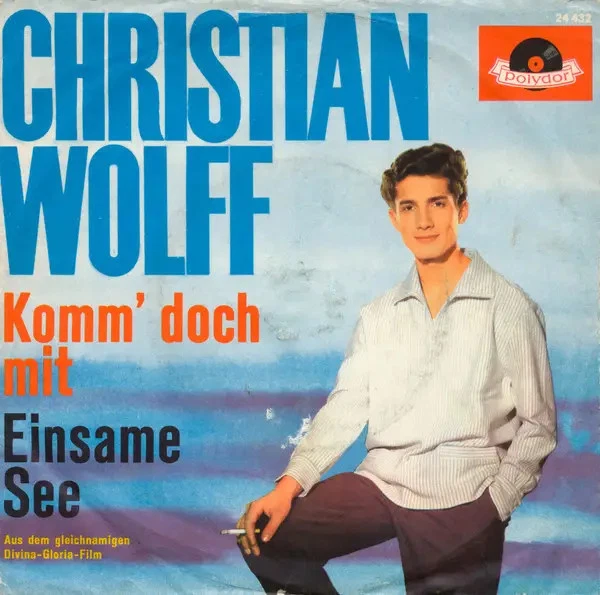
In the history of the German entertainment industry of the 1960s, there was no shortage of actors who tried their hand at singing in the recording studio. Most of them—such as Peter Alexander and Joachim Fuchsberger—built lasting careers on this. Christian Wolff, a young heartthrob of postwar cinema, however, chose a different path. He left behind only one vinyl record—a black disc with the Polydor catalog number 24 432, which I found in a box of free, unwanted records at a vinyl store in Riga, Latvia. The single, with its distinctive orange Polydor label, had no cover, but its visual condition caught my attention—it looked almost completely unworn. It probably didn’t appeal to whoever bought it—perhaps by accident—and ended up on someone’s shelf for over 60 years. I had no idea who the artist was, but I took the record with me. I had no idea that a copy in good condition could fetch as much as 20 euros or more.
I dug through the archives and found out that before Christian Wolff became Germany’s “national forester” in the series *Forsthaus Falkenau*, he was an angry young man who—in accordance with the producers’ dictates of the time—had to prove whether his personal charm would translate into record sales. In this case, it didn’t, and the single in question was his only musical release.
Between James Dean and a Vinyl Debut

The turn of the 1950s and 1960s in West Germany marked the era of the “Halbstarken”—young, rebellious boys in leather jackets. Christian Wolff, thanks to his role in the controversial film Anders als du und ich, became their face. Record labels, led by the giant Polydor, were mass-recruiting handsome actors to satisfy the appetite of the teenage audience, the so-called Backfisch-Publikum. Christian Wolff, born in 1938 in Berlin, was the ideal candidate. After high-profile roles in films such as the aforementioned Anders als du und ich (1957) and Precocious Youth, he was considered Germany’s answer to James Dean—a sensitive, rebellious, yet impeccably dressed young man.
In 1961, at the height of his popularity as a screen star, Wolff entered a recording studio in Hamburg. The goal was clear: to create a hit that would combine the actor’s cinematic charm with the radio potential of the orchestral arrangements that were in vogue at the time.
Bert Kaempfert’s Golden Touch
What sets Wolff’s single apart from dozens of other actors’ attempts is the name of the producer and arranger. None other than Bert Kaempfert was responsible for the record’s sound—a legend of world jazz and pop, the man who would soon write “Strangers in the Night” for Frank Sinatra. That name lends this record historical weight. Kaempfert created arrangements for Wolff that today sound like the very definition of a “classic schlager”.
Two sides of the coin: “Komm doch mit” and “Einsame See”
The single is a textbook example of the music of that era, but with a surprisingly high-quality performance.
- Side A: “Komm doch mit” – An energetic, optimistic track in the tempo of a foxtrot march. Here, Wolff sings with a warm, slightly hoarse voice, almost like Dean Martin. The song was promoted as a theme from a film (often associated with the production *Am Sonntag will mein Süßer mit mir segeln gehn*), though the title “Komm doch mit” itself functioned at the time more as a catchphrase for the new wave of German entertainment cinema.
- Side B: “Einsame See” – This is where Kaempfert’s genius shines through. A melancholic ballad about loneliness at sea, steeped in echoes and soft brass. Wolff doesn’t try to be an opera singer here; his interpretation is more like an actor’s melodic recitation, which makes the song intimate and authentic.
Despite the backing of Polydor’s powerful machine and Kaempfert’s talent, the single did not turn the charts upside down. Christian Wolff, unlike his peers, felt no pressure to pursue a stage career. In interviews from that period, he rarely mentioned his musical ambitions, treating the recording more as a one-off adventure included in a film contract than the start of a new professional path. For the actor, it was merely a stop on the way to a great television career.
Although Wolff rarely revisits these memories, in one of his few statements regarding his “musical career” (made on the occasion of a retrospective of his early films), the actor admitted with his characteristic detachment:
– Back then, if you were successful as a young actor, you immediately became the studio’s property. Agents would say, ‘Christian, you have the face, you have the name, now you need the voice.’ Recording that album with Bert Kaempfert was an adventure, but I never felt like a singer. I felt like an actor pretending to sing. Maybe that’s why it ended with just one single—the forest called to me louder than the stage lights.”
Soon after, Wolff focused entirely on acting, which decades later earned him the status of a German television icon thanks to his role as forester Martin Rombach in the series “Forsthaus Falkenau.” For millions of viewers, he became the face of peace and love for nature, and his brief flirtation with the microphone was forgotten.
The Legacy of a Rare Bird
For today’s listener, this album is more than just a curiosity. It’s a record of a moment when German pop was searching for its identity between American rock ’n’ roll and traditional sentimentality. It is also proof that even “one-hit wonders” could record stylish music, provided they were lucky enough to work with masters like Kaempfert.
The original release of “Komm doch mit / Einsame See” fetches prices in the tens of euros at collector’s auctions, which is an impressive result for a forgotten schlager single. For music historians, it is proof of how powerful the synergy between cinema and phonography was in postwar Germany.
Today, as Christian Wolff enjoys the status of a somewhat forgotten German screen legend, his sole vinyl record remains a beautiful, dusty footnote to the career of a man who apparently knew when to exit the stage.


