
 Vinyl Nostalgia
It is December 1968. Tanks from five Warsaw Pact armies have been stationed in Prague for four months now. Dubček is still formally in office, but everyone in the city knows that the Prague Spring is essentially over. The stores are running out of basic necessities. Censorship is returning overnight. And somewhere in an elegant office in London, two officials from the Czechoslovak foreign trade company Artia are signing a contract with the British corporation EMI. A contract that, nine months later, would result in something completely unbelievable: an original Beatles record pressed in the Czechoslovak Socialist Republic, at a state-owned label with a lion holding a lyre in its logo.
This is a story that cannot be told without context—without Ultraphon from the 1920s, without the Beneš decrees, without Karel Gott, without record clubs, and without that moment when the bureaucracy of real socialism, for a brief moment and on its own terms, opened a window to the West.
From Berlin to Prague: The Prehistory of a Trademark
To understand what Supraphon was, you have to go back forty years before the Beatles. In 1927, a Prague-based company owned by Gustav Sušický, which dealt in electrical equipment, radios, and optical instruments, began selling Avuston gramophones manufactured by the then-little-known Amsterdam-based company Ultraphon. Two years later, Ultraphon’s Berlin office offered Sušický exclusive rights to sell gramophone records, and thus a new company, Ravitas, was founded.
It sounds like a dull footnote in business history, and that is precisely why it is fascinating. Because the entire subsequent, monumental institution—with its lion-and-lyre logo, the Czech Philharmonic under Ančerl’s baton, and annual production runs numbering in the millions—literally grew out of imports to a store selling bedside lamps.
The holding company’s Prague production branch managed the record factory for the entire group; a second plant was located in Paris and had a production capacity of 5,000 records per day. In the early 1930s, few institutions in Central Europe could boast such capabilities.
In Czechoslovakia, domestic products were registered as Ultraphon, while those destined for international markets were sold under the Supraphon brand. This is a key distinction. Supraphon is a name originally derived from an extravagant playback device with two tonearms and two speakers, invented in Berlin by Heinrich J. Küchenmeister, and it was an export brand from the very beginning. A label meant to sound cosmopolitan and modern. A label created to travel across borders. From the perspective of 1969, this is an irony that cannot be overstated.
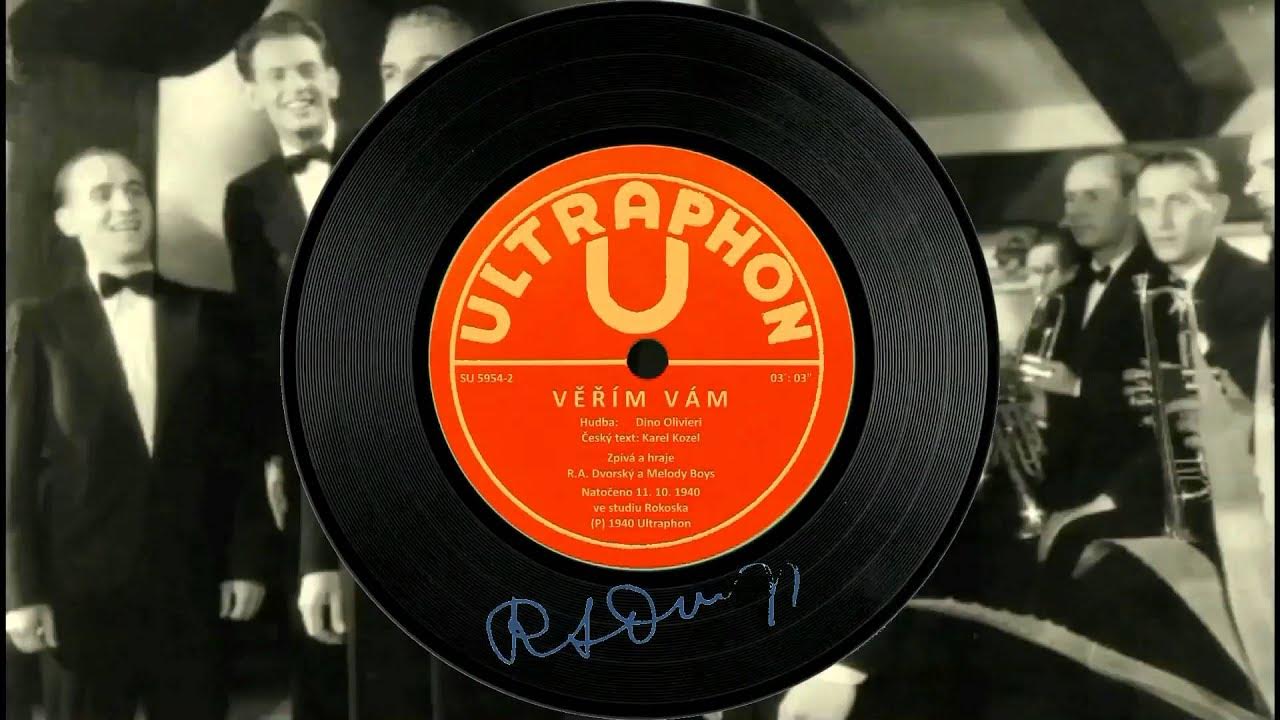
In the 1930s, the label released recordings by popular artists (R. A. Dvorský, Vlado Klemens, Josef Skupa, Karel Vacek, and brass ensembles), and was also involved in classical music, jazz, swing, and spoken word. At the time, Prague was one of the most cosmopolitan cities in Central Europe, and Ultraphon/Supraphon served as its sonic mirror.
Nationalization: How Supraphon Became the State
The war swept everything away. It was followed by President Beneš’s decrees and a new order. After World War II, like another major Czechoslovak record label from the First Republic era, Esta, Ultraphon was nationalized in 1946. Both Ultraphon and Supraphon were used on the Czechoslovak market, while international products were labeled under the Mercury Records brand. The company Ultraphon A.S. was renamed Supraphon A.S.
Supraphon’s logo, the “Lion with a Lyre,” was registered in 1949. It was no longer merely an export brand but, in the rhetoric of the authorities at the time, a national institution of socialist culture. And that is how it was treated. Supraphon was granted a monopoly over the music industry in a way that no Western label had ever experienced. The state served simultaneously as publisher, distributor, sole owner of the factories, and sole payer of royalties.
In 1961, the name was changed to Gramofonové závody Supraphon, and it was not until 1969 that it was simplified to simply Supraphon. In Czechoslovakia, Supraphon was one of three major state-run record labels. The other two were Panton and Opus. Panton focused mainly on experimental music and jazz, while Opus, based in Bratislava, served the Slovak market. But Supraphon was the flagship. It was the one that recorded the Czech Philharmonic. It was the one that exported. And it was the one that had contacts with the West.
The Golden Catalog: Talich, Ančerl, Smetana, Dvořák

Let’s be clear: Supraphon was first and foremost a classical music label—and one of the best in Europe at that time. The Supraphon archives contain recordings of the Czech Philharmonic under the baton of Václav Talich, Karel Ančerl, Karel Šejna, Václav Neumann, and others, as well as recordings by Saša Večtomov and non-Czechoslovak artists such as Sviatoslav Richter, Emil Gilels, Mstislav Rostropovich, Ida Haendel, Henryk Szeryng, Hélène Boschi, and André Gertler. It’s a list featuring half of the Western elite—at the height of the Cold War. How is that possible?
The answer is simple: foreign currency. The socialist state desperately needed hard currency, and Supraphon—with its classical recordings sold in London, Paris, Tokyo, and New York—was one of its most effective sources. Talich’s recordings of Smetana’s *Má vlast* and Ančerl’s recordings of Dvořák’s symphonies were reviewed in *Gramophone* alongside releases from Decca and DG. This was not propaganda. This was “world-class” quality.
Supraphon’s first stereo records were released in 1961, although recordings in this format had been made since 1958. The earliest stereo recordings of popular music were made in 1964. In the 1970s, Supraphon released some albums in four-channel stereo using the quadraphonic (SQ) system. Technically speaking, the Czechs were either on par with the West or lagged behind only slightly.
In the 1960s, Supraphon operated several recording studios in Prague. The oldest of these was located in Strahov and was used primarily for recording pop music albums. Another, slightly newer studio was located in Dejvice. Spoken-word recordings were produced in a specialized studio in Lucerna, in the center of Prague. Classical music was recorded in the superb facilities of the Rudolfinum. In the 1970s, Supraphon built a modern studio at the Mozarteum on Jungmannova Street in Prague 1, intended primarily for recording popular music. Some albums were recorded at the Smetana Theater. Later, a new studio was built in Hrnčíře.
Czechoslovak Big Beat and the First Wave
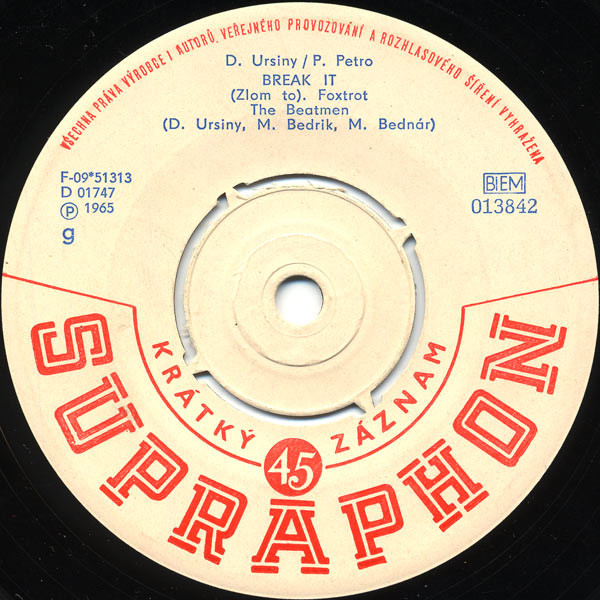
Supraphon was not afraid of popular music. On the contrary, in the 1960s it was the main distributor of a phenomenon known in Eastern Europe as “big beat.” In 1965, the label released two singles by the Slovak band Beatmen: “Safely Arrived” and “Break It.” This Bratislava-based quartet, fronted by Dežo Ursiny, was considered by many Czechoslovak collectors to be the “local Beatles.” Their use of English was almost a political act. At least, that’s how it can be viewed today. Alongside them were The Matadors, who managed to release one album just before the events of 1968.
Czechoslovak popular culture was perhaps the closest to Western culture among all the countries of the Eastern Bloc. In Prague in 1967, you could buy far more Western music than in Warsaw, Budapest, or, even more so, Moscow. And that was no accident. The Prague Spring didn’t begin with Dubček; it began with a generation that grew up on the Beatles. And then August came.
August 1968
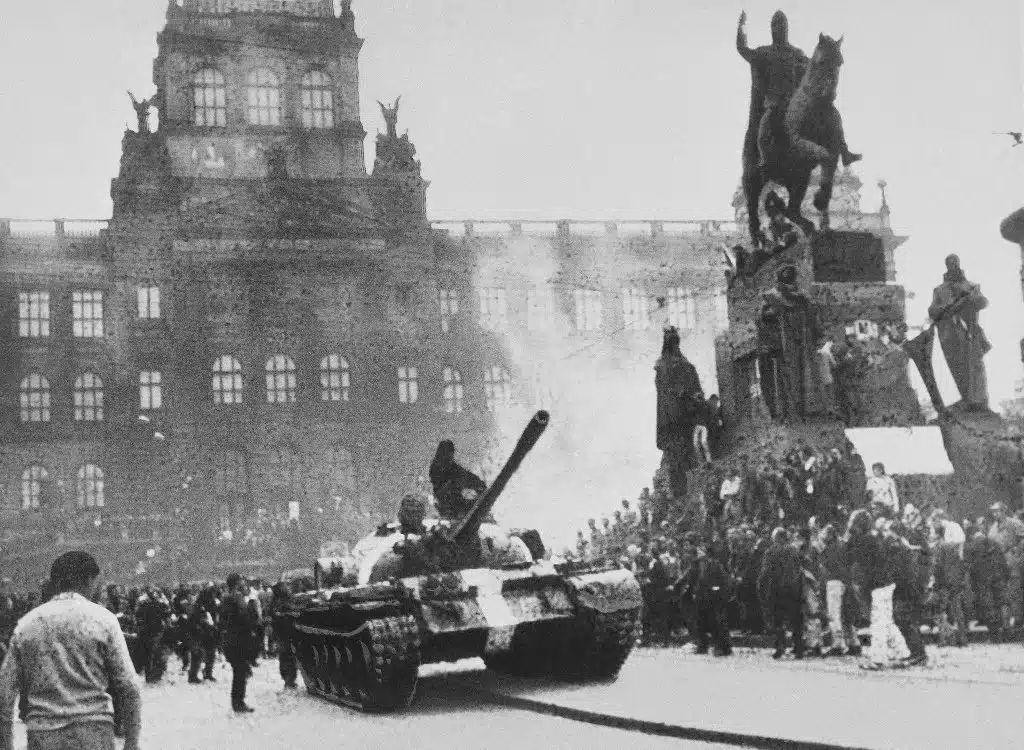
On the night of August 20–21, 1968, approximately half a million Warsaw Pact troops, including Soviet, Polish, Hungarian, Bulgarian, and East German troops. The impact on music was almost immediate. The Soviet invasion of Czechoslovakia on the night of August 20–21, 1968, had a stifling effect not only on politics and literature but also on the rock scene. Rock bands were ordered to switch to soft pop with optimistic lyrics or to disband.
Some musicians fled. In the fall of 1968, some members of The Matadors left to join the production of the musical “Hair” in Munich; the rest formed or joined new bands, such as Blue Effect (Modrý Efekt). English-language lyrics became suspect. Long hair became suspect. For a year or two, no one knew where the new boundaries would be drawn.
And it was precisely in this dark, disorienting, “we-don’t-know-what-will-happen-yet” atmosphere of late fall 1968 that someone from Artii’s management packed a briefcase and flew to London.
Artia: A Monopolist Nobody Knows
To understand why the December agreement was even possible, you need to know about Artia. It is one of the least-documented, yet most important, institutions of socialist Czechoslovakia.
PZO Artia was a Cold War-era state-owned enterprise in Prague, best known for publishing children’s storybooks. PZO (Czech: Podnik zahraničního obchodu, literally “Foreign Trade Enterprise”) Artia was originally founded as a joint-stock company for the import and export of cultural goods, but in 1953 it was transformed into a PZO as the Czechoslovak monopoly on cultural trade.
Artia was one of about forty PZO entities—specialized enterprises that held a monopoly on foreign trade in their respective sectors. Škoda exported machinery through Strojexport, weapons went through Omnipol, and everything with a cover and sheet music went through Artia. In addition to books, Artia also handled the export of magazines, music, records, phonographs, works of art, postage stamps, coins, educational materials, antiques, Czech garnets, silver jewelry, folk art, and cartographic products.
In practice, it worked like this: if Supraphon wanted to send 100,000 copies of *Má vlast* to West Germany, it did so through Artia. If it wanted to purchase master recordings or a license from EMI, it also did so through Arti. The label did not have its own foreign trade department. It did not have its own foreign currency accounts.
Artia was therefore not just a travel agency and a publishing house. It was what in Poland would have been a combination of Pewex, Polskie Nagrania, and the Foreign Trade Center all in one. With all the consequences that entailed—both good (competence, connections, negotiating experience) and bad (slowness, party control, natural caution). And that is precisely why officials from Artia, and not Supraphon, traveled to London in December 1968.
London, December 1968: A Contract That Should Never Have Happened
In December 1968, four months after the invasion, when a quiet, ambiguous “normalization” was already underway in Prague, representatives of Artii signed a licensing agreement with EMI in London. It granted Supraphon the right to release selected albums from the EMI catalog in Czechoslovakia, including those by the Beatles.

The photo above shows a clipping from a British newspaper featuring a photograph capturing the moment the contract was signed. It was a surprising event. On the one hand, Moscow had intervened to suppress any Western deviations; on the other, the Czechoslovak bureaucracy—which was part of the same system—signed a contract that same year to introduce the greatest symbol of Western popular culture to the domestic market.
How did this happen? Three explanations, each partially true.
First, foreign exchange in the other direction. EMI sold a license to Supraphon, and Supraphon sold its classical recordings to EMI. These were barter agreements, and in international trade on this scale, it was always about the balance of payments. Czechoslovakia had been exporting Talich and Ančerl to the West for years; now it was getting the Beatles in return. From the perspective of the Ministry of Foreign Trade, this was a purely accounting transaction that did not need to be consulted with the ideological apparatus.
Second, bureaucratic inertia. Negotiations with EMI must have lasted a good few months. They likely began even before the August invasion, during a period when the Prague Spring was opening Czechoslovakia up to Western cultural contacts. By December 1968, they were already in the final stages. Canceling them now would have meant admitting that something had changed—something the new authorities were very reluctant to acknowledge during the first months of normalization. It was easier to sign the contract and see what would happen next.
In any case, the contract was signed. The machine was set in motion. And nine months later, in September 1969, an album was released at Supraphon’s pressing plants in Prague—an album whose very existence still leaves collectors slightly amazed.
September 1969: A Collection of Beatles Oldies
A Collection of Beatles Oldies (But Goldies) is a compilation originally released by Parlophone in December 1966, during the period between Revolver and Sgt. Pepper. From the perspective of the decision-makers in Prague, it was the safest possible release from the Beatles’ catalog. Just the “safe” Beatles hits from the 1962–1965 era—no psychedelia, no political context, no Indians. Classics that were already classics. “Help!”, “Yesterday”, “Day Tripper”, “We Can Work It Out”, “I Feel Fine”.
The album wasn’t released for general sale in stores—at least not initially. It was distributed by Gramofonový klub (Gramophone Club), the Czechoslovak equivalent of Western mail-order clubs, but with one additional feature: membership served as a filter of sorts. Club members were registered, known, and purchased from a catalog on a made-to-order basis. This allowed for the distribution of a politically sensitive title without running afoul of the official, mass retail market. Such was the Czechoslovak version of a bureaucratic compromise.
Supraphon released the record in two versions: mono and stereo, which in itself was an extravagance given the realities of the Czechoslovak market. The cover for both versions was identical, featuring the original British design by David Christian, supplemented with the Supraphon and Gramophone Club logos. On the back, the text “Edice pop-music Gramofonového klubu” was added. A fold-out insert was also included, featuring commentary on each track: brief but insightful texts by an anonymous Prague critic who was commissioned to explain to Czechoslovak club members why “Yesterday” is significant.
And the record itself hides a few more details that might interest collectors. The first pressing appeared with “incorrect” labels, which lacked the dual Parlophone/Supraphon logo. The lyric insert is quite a valuable artifact, as 90% of the used copies available on the market no longer have it. Interestingly, the mono version was created by converting from the stereo version, bypassing the original 1966 master. All of this is material for a separate post, and that post has already been written: “Supraphon 0 13 0599 / 1 13 0599: A Guide for Die-Hard Collectors.” It’s available on this blog.
“Second” — and what does that mean
This is the point where it’s worth pausing to consider a phrase that often appears in descriptions of this record: “the second Beatles album released in the Eastern Bloc before November 1989.” What exactly does that mean?
The first was Soviet. In 1967, the Melodiya label released a compilation titled *Vokalno-instrumentalnyj ansambl Bitlz*, and this release has its own, equally fascinating context (the phrase “vocal-instrumental ensemble” was a bureaucratic ploy to avoid directly calling The Beatles a rock band). But it was a “podborka” type of record—that is, a selection, a compilation—and partially unauthorized in relation to the original masters.
The 1969 Supraphon release was something else entirely: the first official Beatles album in the Eastern Bloc, licensed by EMI and released under a full-fledged international contract. Hence its special status among Eastern European releases.
And that is precisely why this album is very difficult to find in collector’s condition. Unfortunately, the manufacturer placed the record in a flimsy cardboard sleeve, and finding a copy in NM condition is like looking for a needle in a haystack. A flimsy cardboard sleeve is a typical feature of the Eastern Bloc, linked to the conservation of raw materials—in this case, cellulose. What Parlophone produced as laminated, glossy cardboard was, in Prague in 1969, thin, very low-quality cardboard that, after 80 years, has no chance of being in NM condition.
What Happened Next
*Oldies But Goldies* was not a one-off fluke. The agreement with EMI remained in effect, and Supraphon made use of it, albeit cautiously and with long intervals. In 1972, *Abbey Road* was released in both mono and stereo versions. Later came individual solo albums and compilations. Personally, I have in my collection a stereo copy of *Oldies* with a red Supraphon label (the mono copies had a blue label) and a copy of *Abbey Road* with a blue label (used on the 1972 pressings; the 1976 reissue already had an orange label).
Those releases also have their own stories. The 1972 edition of *Abbey Road* was released three years after the “invasion,” at a time when Husák had already firmly cemented normalization, and Karel Gott had become the official voice of the regime. The fact that *Abbey Road* appeared in this context—and with a full booklet of lyric translations—is almost as surprising as the release of the *Oldies* compilation in 1969.
Throughout the period from 1969 to 1989, Supraphon released relatively few titles by the Beatles and their solo projects. But each of them is now a piece of history for collectors—not just musical history, but also the history of bureaucracy, the Cold War, compromises, and that strange moment when a socialist state acknowledged that John Lennon did not threaten its stability.
After 1989
During the post-Prague Normalization period, Supraphon produced most of the records in Czechoslovakia. The label gained independence from the state after the Velvet Revolution and released works by great names in classical music, such as the Czech Philharmonic, as well as pop stars like Karel Gott and Lucie Bílá.
In January 2025, Sony Music Entertainment announced the acquisition of Supraphon. The lion with the lyre became part of a global corporation. But the archives remained, and that is precisely what the new owner bought: the catalog, the history, and the name.
“Sony Music Entertainment was interested in Supraphon because of the kind of label it is, because of its uniqueness in the world of music, because of the titles it releases, and because of how it presents itself and is appreciated around the world.” “I think we’re expected to continue doing what we do best,” said Matouš Vlčinský of Supraphon in an interview with Radio Prague International.
There’s something to that. Because despite its entire socialist, nationalized, monopolistic history, Supraphon was never just a bureaucratic entity. The best example is the contract signed in London by an Artii official, thanks to which, in September 1969, a Czechoslovak teenager could buy a record with a photograph of the Beatles on the cover from a mail-order club.
In today’s era of endless streaming, it’s hard to grasp the significance of this, but in 1969 in Prague, the chance to get your hands on such a record was quite something.