Vinyl Nostalgia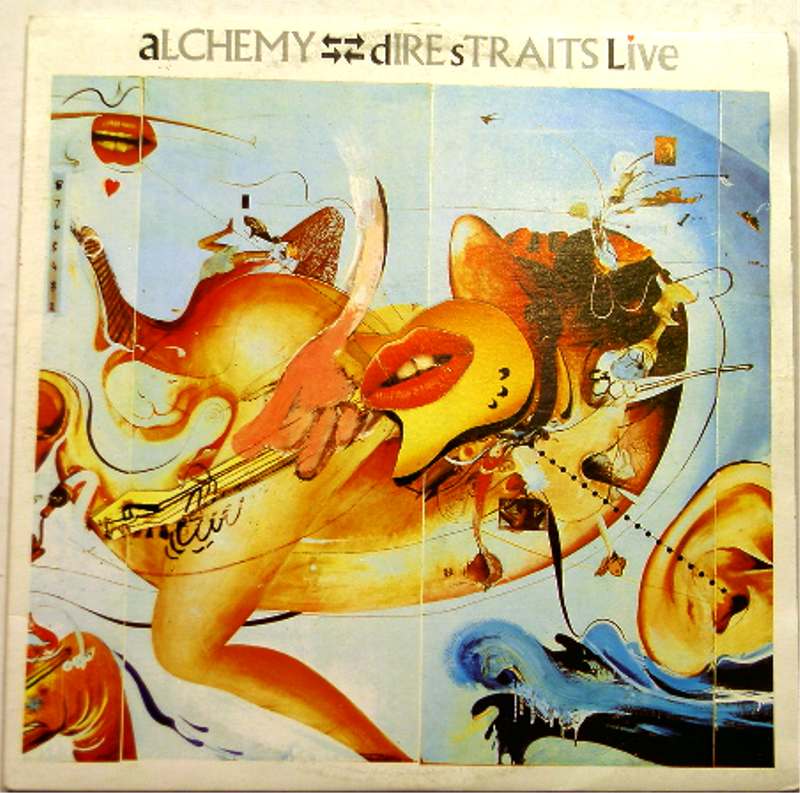
Alchemy: Dire Straits Live is the band’s first live album — a double LP released on 16 March 1984 by Vertigo Records internationally (UK catalogue number VERY 11; European number 818 243-1) and by Warner Bros. Records in the United States (25085-1). It remains one of the finest documents of a British rock band at full stretch, captured at the exact moment they stood on the threshold of global superstardom.
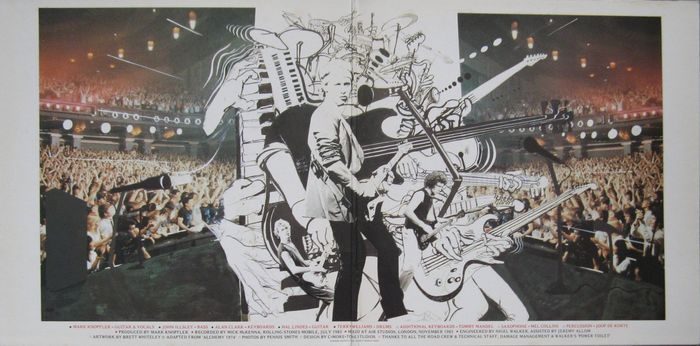
The album was recorded across the final two nights of Dire Straits’ eight-month Love Over Gold Tour: 22 and 23 July 1983 at the Hammersmith Odeon, London. The concerts were recorded by Mike McKenna using the Rolling Stones Mobile unit, with Nigel Walker as recording engineer. The material was subsequently mixed at AIR Studios in London in November 1983. The band made a deliberate decision to release the record without the customary safety net of studio overdubs or re-recorded fixes — an unusual commitment for a major live release of the era. Mixing happened; touch-ups did not.
Three additional songs were captured during the sessions but left off the final running order: „Industrial Disease”, „Twisting by the Pool” and „Portobello Belle”. A shortened version of „Portobello Belle” surfaced in 1988 on the Money for Nothing compilation; all three were finally given their full release in the 2023 box set Live 1978–1992, newly remastered by Andy Walter.
The Cover
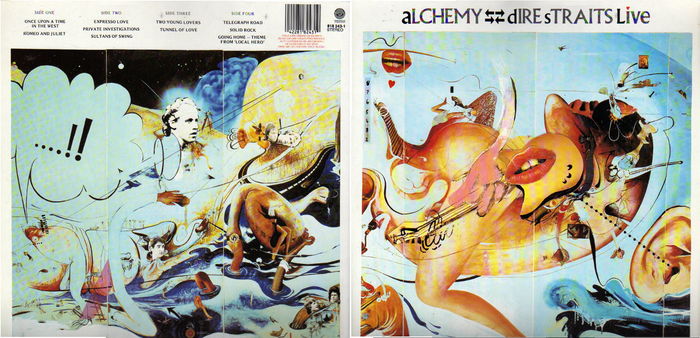
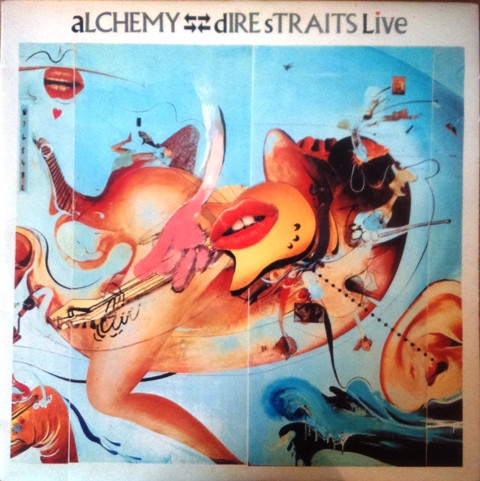
The artwork is one of the most distinctive sleeves in the Dire Straits catalogue — and its origins are worth knowing. The design was adapted from a section of Alchemy 1974, a painting by Australian artist Brett Whiteley. Whiteley was a personal friend of Mark Knopfler and John Illsley, which presumably made the licensing conversation easier. The original painting was created in Sydney between early 1972 and January 1973 — an extraordinary piece spanning 18 wood panels, 203 cm tall and over 16 metres wide, incorporating materials as varied as feathers, a bird’s nest, a glass eye and shell fragments. The album designers adapted a section of the work and added a new element for the cover: a guitar with lips, held by a hand, which in the original composition covers explicitly erotic imagery. Whiteley died in 1992 at the age of 53. The full painting is held at the Brett Whiteley Studio in Surry Hills, Sydney.
The CD Version — What Changed
Buyers of the CD rather than the LP should be aware of several significant differences. „Love Over Gold” — released as a separate single in 1984 — was added to the tracklist; the fade-outs between vinyl sides were removed; several tracks were extended; and „Going Home” gained an additional intro from the Local Hero soundtrack („The Rocks and the Thunder”) not present on the LP. The order of „Romeo and Juliet” and „Expresso Love” is also reversed relative to the vinyl sequence. The 1996 remaster (for most territories outside the US) and the 2001 US remaster further refined the sound, with the 1996 European version widely regarded as the definitive audio presentation.
Catalogue Numbers and Pressing Notes
The gatefold sleeve carries the catalogue number VERY 11 (UK Vertigo) or 818 243-1 (European Phonogram). The individual discs bear separate numbers: Disc 1 is 818 244-1, Disc 2 is 818 245-1. The label is the standard Vertigo Spaceship design in black, with ℗ 1984 Phonogram Ltd.
Matrix codes vary across copies of the first UK pressing — four main variants are documented below. The critical identifiers are the characters either side of the double slash (e.g. A//4, B//3); the digits following the letter Z may differ slightly between individual copies. All runout grooves carry a stamped SOUND CLINIC inscription. One anomalous copy has been noted with Side 2 pressed from matrix 818244 B // 1 — outside all documented standard variants.
| Alchemy: Dire Straits Live (VERY 11 / 818 243-1) — UK first pressing matrix variants | ||
| Variant 1 | ||
| Side 1 | 818244 A // 4 | 818244 A // 4 ▽ 420 Z 1 1 4 5 |
| Side 2 | 818244 B // 3 | 818244 B // 3 ▽ 420 Z 1 1 4 1 |
| Side 3 | 818245 A // 3 | 818245 A // 3 ▽ 420 Z 1 1 4 9 |
| Side 4 | 818245 B // 3 | 818245 B // 3 ▽ 420 Z 1 6 1 1 |
| Variant 2 | ||
| Side 1 | 818244 A // 4 | 818244 A // 4 ▽ 420 Z 1 2 2 2 |
| Side 2 | 818244 B // 3 | 818244 B // 3 ▽ 420 Z 1 2 11 |
| Side 3 | 818245 A // 2 | 818245 A // 2 ▽ 420 Z 1 1 1 4 |
| Side 4 | 818245 B // 3 | 818245 B // 3 ▽ 420 Z 1 7 1 U |
| Variant 3 | ||
| Side 1 | 818244 A // 4 | 818244 A // 4 ▽ 420 Z 1 4 4 1 |
| Side 2 | 818244 B // 3 | 818244 B // 3 ▽ 420 Z 1 4 19 |
| Side 3 | 818245 A // 2 | 818245 A // 2 ▽ 420 Z 1 1 19 |
| Side 4 | 818245 B // 3 | 818245 B // 3 ▽ 420 Z 1 7 1 1 |
| Variant 4 | ||
| Side 1 | 818244 A // 4 | 818244 A // 4 ▽ 420 Z 1 3 4 |
| Side 2 | 818244 B // 3 | 818244 B // 3 ▽ 420 Z 1 3 4 |
| Side 3 | 818245 A // 2 | 818245 A // 2 ▽ 420 Z 1 3 1 |
| Side 4 | 818245 B // 3 | 818245 B // 3 ▽ 420 Z 1 1 1 2 |
| All runout grooves carry a stamped SOUND CLINIC inscription. Digits following the letter Z may vary between individual copies — the critical identifiers are the characters flanking the double slash (A//4, B//3, etc.). One anomalous copy documented with Side 2 pressed from 818244 B // 1. | ||