
 Vinyl Nostalgia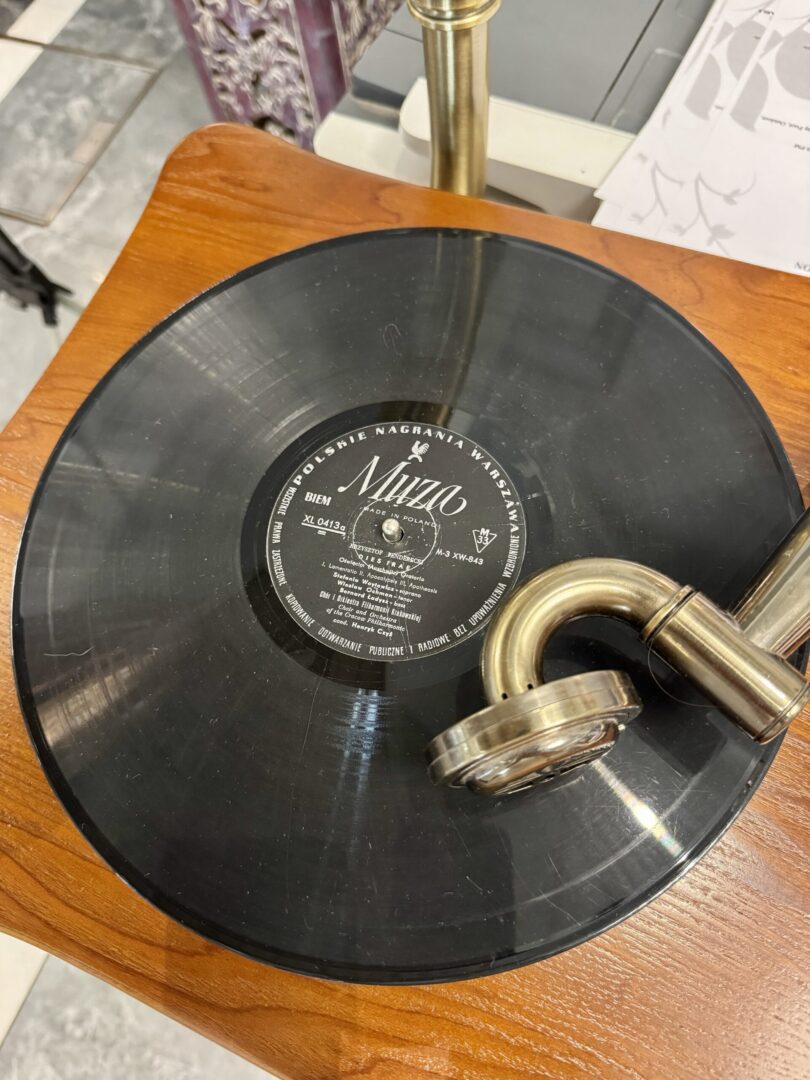
Sometimes—and in my case, quite often—travel intersects with music. That was the case this time as well. When I checked into a small hotel in Hanoi, Vietnam, in March 2026, I noticed a very old record player standing nearby, with an old black vinyl record on it. Anyone who follows me on Instagram knows that I often post photos of vintage record players there, so this time, too, I grabbed my phone to take a picture—and at that very moment, I realized that the black vinyl label bore the name of the Muza label and the mysterious title *Dies Irae*. A record from Poland! Lost somewhere in Vietnam…

The young receptionist couldn’t explain to me how a vinyl record from Poland had ended up there. Let alone one with classical music. A quick inspection confirmed that I was looking at an authentic record pressed in Poland in 1968.
Although I’m not a fan of classical music myself, I dove into the depths of the internet to discover that “Dies Irae – Auschwitz Oratorio” is a monumental choral-oratorio work composed by Krzysztof Penderecki in 1967. It was created as a tribute—a memorial to the victims of the Holocaust, particularly those of the Nazi Auschwitz-Birkenau camp, as indicated by its German subtitle, *Oratorium zum Gedenken an die ermordeten in Auschwitz*. The premiere took place on April 16, 1967, during international commemorations in Oświęcim.
The composition was written for three solo voices, a mixed choir, and a large orchestra, and Penderecki himself selected excerpts from texts (including Psalm 114, the Book of Revelation, Aeschylus, Paul Valéry, Louis Aragon, and Tadeusz Różewicz), translating them into Latin.
The record was likely brought to Vietnam by a classical music lover back in the late 1960s. At first glance, it looked well-worn and heavily used over its nearly 60 years of existence. It seemed, however, that for a long time it had served only a decorative purpose, even though *Dies Irae* is reportedly considered one of the most important religious and commemorative compositions of the 20th century.
The B-side of the record features two other pieces: “Polymorphia,” composed in 1961 for 48 string instruments, and “De Natura Sonoris,” composed in 1966 for orchestra.
The record I found in Hanoi has the catalog number XL 0413 and is a mono version. The stereo version was released in the same year and bore the number SXL 0413. The latter often had blue labels (though not exclusively).
At that time, the Polskie Nagrania “Muza” label was the leading Polish label releasing classical, jazz, and popular music; the company’s origins trace back to the merger of Fabryka Płyt Gramofonowych Muza and the state-owned enterprise “Polskie Nagrania” after 1956.


