
 Vinyl Nostalgia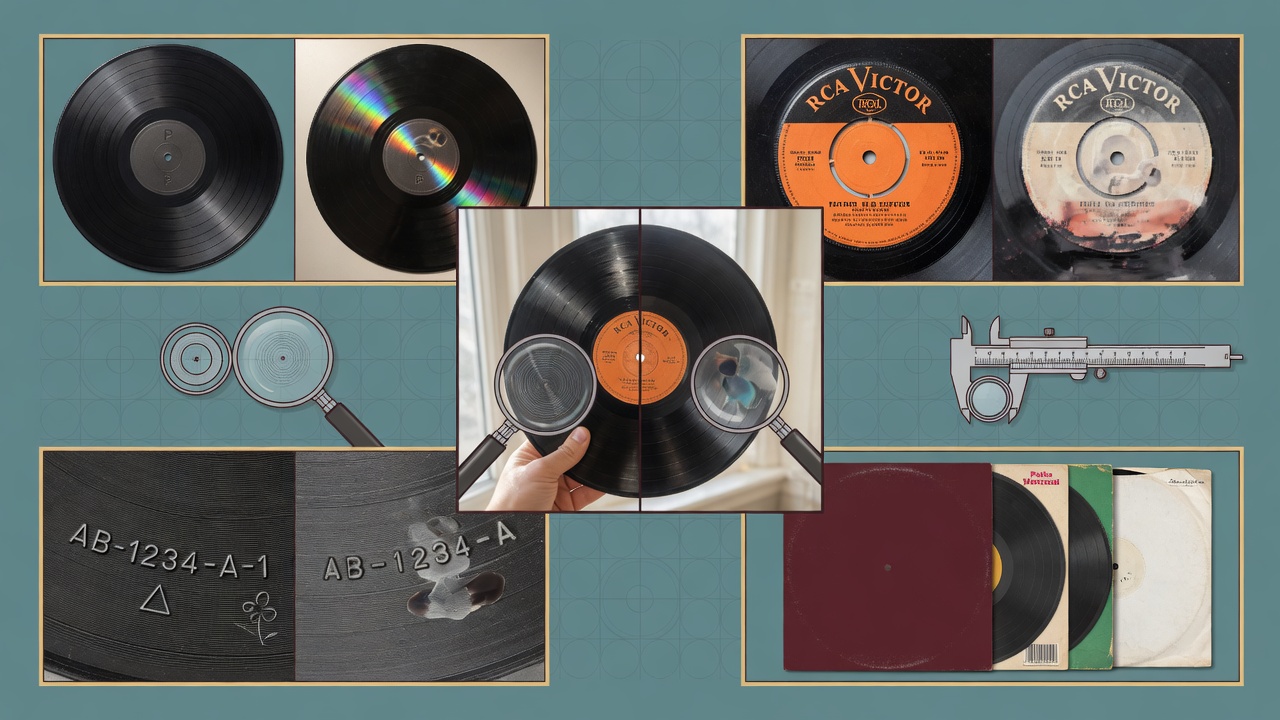
This section matters more than any price table. The counterfeit vinyl market has grown in proportion to the vinyl market itself. Between 2020 and 2022, the British Phonographic Industry removed roughly 43,000 counterfeit vinyl records from sale. A 2024 UK police raid seized 5,000 fakes worth over £1 (approx. 1 USD) million. A man in his 40s sold thousands of fake records online over six years before a buyer’s complaint about terrible sound quality led police back to him.
Counterfeits are not limited to obvious targets. A 2024 UK raid seized fake pressings of Beatles, Pink Floyd, and Oasis LPs. The same manufacturing operations have applied their methods to classic rock broadly, and Dire Straits pressings — particularly Brothers in Arms — are a natural target given the volume of demand and the range of legitimate variants that provide cover.
The matrix — first and most important
Authentic original pressings have machine-stamped or hand-etched matrix numbers. A counterfeit typically cannot replicate a machine-stamped matrix; the numbers on fakes are often shallower and harder to read than on genuine pressings. Check Discogs before you buy: look up the specific release, find the Matrix/Runout section, and compare what you’re looking at in your hand. If the matrix doesn’t match any documented variant — something is wrong.
Because Discogs is a very deep archive where these thousands of records are stored, it can be much simpler for you to use our vinyl ID, where for a few $ our well trained AI agent will check all the world’s largest vinyl record databases in a fraction of a second and with a very high degree of probability will identify the record you have in your hands.
For Dire Straits specifically: if someone is selling you a „UK first pressing” of Brothers in Arms and the runout doesn’t read in a way consistent with the documented pressing variants or our Vinyl ID report, walk away.
Physical weight and rigidity
Counterfeits often feel lighter than 110g, or can feel thick but oddly soft when flexed. In one UK police bust, seized fakes were noticeably lighter and less rigid than authentic pressings. Hold the record by its edge and center hole. If it bends too easily, that’s diagnostic.
Sound quality — the ultimate test
Bootlegs are usually cut from low-resolution digital files — sometimes MP3-quality sources. Pressed on low-grade vinyl, they produce muffled high frequencies, weak bass, and a general flatness that no cartridge upgrade can correct. If you drop the needle on a „first pressing” and it sounds like audio ripped from a 2003 streaming service, you know what you have.
One Discogs community member noted hearing a Mac computer’s volume adjustment chime on a bootleg track — the digital file had been ripped from someone’s computer with the audio on. That’s an extreme case, but the principle holds: counterfeit audio is often sourced carelessly.
Cover and paper quality
Original late 1970s and early 1980s sleeves were printed with oil-based inks that have greater depth and saturation. Post-1970s ink technology shifted away from this. If a record claims to be an original from that era, look for rich, deep colors that don’t look like they came off a desktop printer.
Check ring wear carefully. Genuine ring wear — the circular marks made by the disc rubbing the sleeve — should feel slightly textured under your fingertip. Smooth ring wear marks, reproduced on a cover that was scanned and reprinted, feel completely flat.
Examine the barcode (if applicable, old records don’t have it). Counterfeit sleeve printing often produces slightly pixelated or jagged vertical lines in the barcode area.
Price and seller behavior
If a record is priced dramatically below its typical market value, it is likely a fake. Rare records command high prices because authentic examples are scarce. If scarcity has disappeared, the reason matters.
On eBay: if the seller cannot describe the record’s provenance, if they use stock photos rather than their own photographs of the actual copy, if their feedback history is short — treat this as a significant risk factor.
On Discogs: always read the comments on the release page. The community documents known fakes explicitly. Discogs also permits the listing of unofficial pressings, provided they’re marked as such — it’s your responsibility to read listings carefully. „Unofficial release” and „original pressing” are not the same thing.
Record fairs offer considerably more protection. Counterfeiters rarely infiltrate established fair circuits — the organizers maintain standards that filter them out. Street markets near tourist areas are higher risk.