
 Vinyl Nostalgia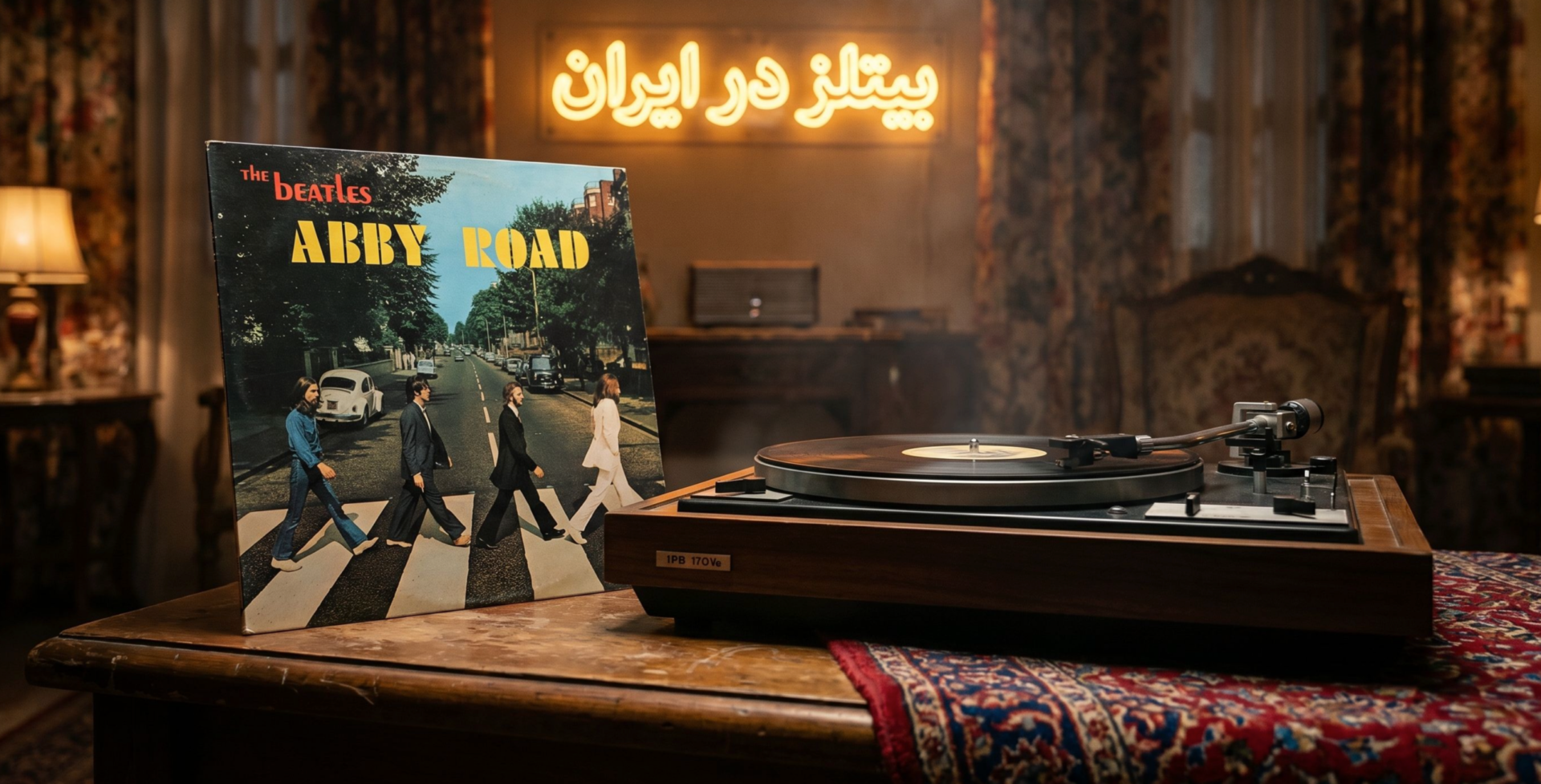
Mehrdad Mehdizadeh was twelve years old the first time he saw their name in a Tehran record shop, spelled out in Persian script. He called them „Beatelha,” and sometimes „Beatles-ha,” tacking a Persian plural ending onto a word that was already plural to begin with. Thirty years later, in 1996, he would describe that jolt of recognition in an essay for the website Iranian.com:
I remember my classmates’ fascination, and the disgust expressed by my parents’ generation. Mehrdad Mehdizadeh, „Beatelha: Rock’s Early Days in Iran,” Iranian.com, January 1996
This was the capital of a different Iran. Tehran in the 1960s, under Shah Mohammad Reza Pahlavi, was growing into a cosmopolitan metropolis where jazz clubs rose alongside mosques, where state television broadcast programmes recorded in studios on Manuchehri Avenue, and where record companies ran at full tilt. Nobody worried much about copyright or publishing rights back then, at least not in Iran. To put it another way: in the Tehran of 1966 you could walk into a record shop and walk out with a seven inch EP that carried, side by side, tracks by The Beatles, Cliff Richard and Manfred Mann. What was flatly impossible in London or New York for licensing reasons was an everyday thing in Tehran.
The number of these strange, badly pressed, yet utterly unique slabs of vinyl is hard even to count today. We know of more than twenty different Beatles EPs pressed by the three main Tehran labels between 1964 and 1969. How many physical copies of each release survived? Nobody knows. In the summer of 1979, a few months after the Islamic Revolution, Ayatollah Khomeini imposed a categorical ban on broadcasting popular music on state radio and television, declaring in public: „Listening to music makes individuals stupid and dulls and inactivates their brains.” The labels were shut down, and the vinyl was burned.
This story is about that time. And about the records that survived the years of erasure anyway.
Beethoven Co. and the factory of copied rock
To understand how Lennon and McCartney ended up on the sleeves of EPs pressed in a factory owned by a company called Taraneh (Persian for „song”), you have to go back to the end of the 1950s. In 1959, Karim Chamanara, a businessman based on Manuchehri Avenue, began importing into Tehran the first seven inch singles (45 rpm) pressed in Germany for a small Iranian label, AHANG. These were recordings by Persian singers. By 1960 more than two hundred had appeared, distributed by the Beethoven Co. concern in Tehran.
In 1964, a new brand split off from the AHANG operation, by then renamed Ahang-e Rooz („song of the day”), aimed exclusively at the market for Western rock music. It was given a plain name: TOP4. The figure „4” referred to the format of four track EPs, onto which the biggest international hits were loaded. These unique mini albums first appeared without printed sleeves (the earliest series, which includes the rare „Love Me Do” from 1964, was distributed in plain company covers), and later with printed jackets that became the label’s defining visual signature.
The first Iranian Beatles pressing is precisely that „Love Me Do” (EX4024) from 1964.
While production of seven inch discs ran at full steam, Iranian LP pressings were a rarity, and when they did appear, they covered only the biggest albums. That is how Tehran came to press almost the entire Led Zeppelin discography, along with The Beatles album Abba Road (sic). That comical misprint on the Iranian pressing of Abbey Road has passed into collecting legend, and it points to something important: the people pressing these records knew neither the English language, nor the artists they were issuing, nor, least of all, copyright law.
Iran in the 1960s and 1970s had no copyright law covering music (and de facto still does not). That absence of a legal framework made possible a singular phenomenon: various artists EP compilations, gathering performers signed to different labels, which had no chance of appearing anywhere else.
First, TOP4 did not have to negotiate licences with EMI, Parlophone, Apple, Decca, Atlantic or any other concern. Second, it could assemble its EPs freely, drawing tracks from different sources, different countries, different artists. Third, retail prices could be kept at a level affordable for Iranian middle class youth. Fourth, the sound quality was nothing to write home about, because Iran did not buy master tapes from the original producers but simply cut its own masters from available Western pressings.
Thanks to all this, a relatively cheap Beatles catalogue appeared on the Iranian market, available in hundreds of shops in Tehran, Isfahan, Tabriz and Shiraz. Today those same copies fetch three figure prices at auction (in euros), though this remains terra incognita for most collectors.
„Beatelha” and a Tehran generation raised on The Beatles
In his 1996 essay, Mehrdad Mehdizadeh offers perhaps the finest non literary testimony of Beatlemania outside the Anglophone world:
I first heard of The Beatles sometime around 1964, when I was a sixth grader in Tehran. Then, when I went to high school, interest in The Beatles grew even more intense. We lived through those years talking about The Beatles, swapping records and sheet music. Many of the young fans were neither dunces nor dropouts, but serious, studious pupils.
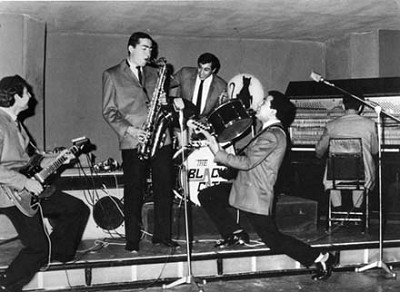
On the wave of interest in the Liverpool four, bands sprang up imitating their music. The most famous of them was Black Cats, who played regularly at the Couchini club in Tehran, in hotel restaurants, and sometimes on television too. After 1979 the group’s musicians left the country and, in the 1990s, revived their activity in Los Angeles. There were other groups as well: Ojoobeh-ha, Rebels, The Flowers, Golden Ring, The Littles. They imitated The Shadows, The Beatles, the Rolling Stones. All of them recorded for local labels such as Royal, Iran Gram and Monogram, and all of them disappeared from the music scene after the 1979 revolution.
McCartney and two days in Tehran
The strangest fragment of this whole story has nothing to do with records at all. On 25 March 1968, at 02:10 local time, Qantas flight QF 763 landed at Tehran airport. On board (on the return journey from India) were Paul McCartney, his fiancee Jane Asher, and Neil Aspinall, The Beatles’ assistant.
The next day, McCartney and Asher saw the sights of Tehran. They bought Persian jackets, along with rings for Ringo Starr. They sampled local dishes at a restaurant, and McCartney appeared on a programme on Iranian state television. He also met privately with Vigen Terteryan, the Armenian Iranian pop idol. A photograph from that meeting shows Paul seated with a hookah in Vigen’s house. In the picture Vigen holds a guitar, and beside him sits his brother, the lyricist of many of his songs.
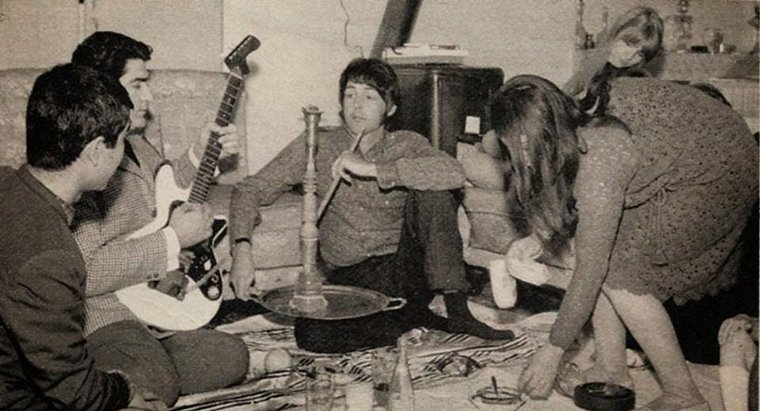
Vigen Terteryan performed his songs mainly in Persian, and also sang in Armenian and English. In 1979, after the Islamic Revolution, he left Iran and settled in California in the United States, where he remained for the rest of his life. He died in 2003 at the age of 74.
The television interview mentioned above passed into history not for its content but for the tone McCartney brought to the encounter. Mehdizadeh, who most likely watched the broadcast as a teenager, describes it like this:
He did not seem interested in answering questions seriously. He played with his camera and practised a few Persian words he had learned. He was visibly annoyed with the security agents who would not let him take pictures. Some viewers, especially the older generation, were unhappy with McCartney’s manners and thought he was making fun of Iranians as a nation.
Royal, TOP4, Monogram and Orfeh
The three main labels pressing EPs of Beatles songs in Iran had different visual and commercial strategies.
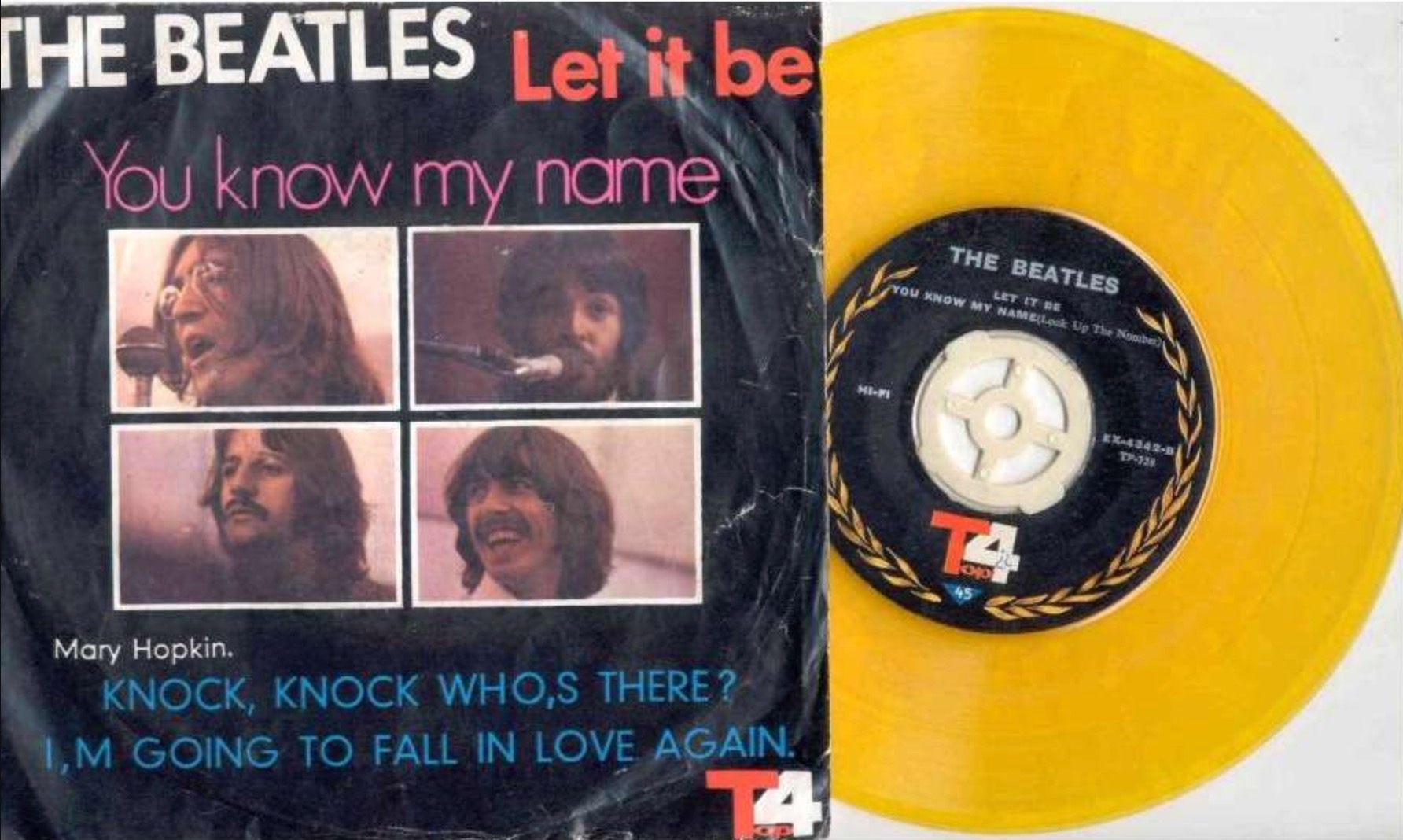
TOP4 issued enormous quantities of records. From the „EX” catalogue numbers (short for „Extended Play”), which ran from EX 4011 (Twist and Shout) to EX 4342 (Let It Be), you can work out a chronology corresponding to the original UK releases, but reaching Iran with a delay of anywhere from a few months to around eighteen months. The records carried black labels with a red and white logo in the form of a stylised letter „T” and silver print. The rarest and most expensive (around 60 EUR (approx. 67 USD) in VG+ condition) among the TOP4 EPs are the mini albums issued on coloured vinyl: Let It Be (EX-4342) was pressed in yellow and red versions, and Come Together (EX-4325) in a multicoloured variant.
Royal was the oldest and most active Persian record label of the 1960s and 1970s. It operated actively until 1975 and pressed more than six thousand tracks with the matrix prefix „AJ.” The Beatles appeared on Royal only sporadically: for example Royal RT 450-9 („Hello Goodbye” alongside the Bee Gees, Neil Diamond and Tommy James) or RT 428 („All You Need Is Love,” the „Sgt. Pepper” reprise, „Baby You’re a Rich Man” and the title track „Sgt. Pepper’s”).
Monogram, in turn, was a smaller label focused mainly on local Iranian recordings. The Beatles appeared on its records twice, on the mini albums Get Back (Monogram 200) and Hey Jude (Monogram 4975/4976).
A curious fact is that in 1969 Monogram also issued the record Give Peace A Chance / Honky Tonk Women (Monogram 221), on which the performance of John Lennon’s solo track „Give Peace a Chance” was credited to The Beatles. This is presumably the only such case anywhere in the world, and the release is now almost impossible to obtain. The same disc also carried two Rolling Stones tracks.
Orfeh was a sister label to Royal, and The Beatles appeared on its releases several times (although the Orfeh logo could sometimes stray onto records issued by Royal, as in the case of All You Need Is Love above). The most interesting release was certainly „Dr Roberts” (Orfeh RT 363) from 1966, with a misprint in the title track and a sleeve familiar from elsewhere.
Sgt. Pepper: the Iranian version as a double EP
The strangest item in the entire Iranian Beatles catalogue is Sgt. Pepper’s Lonely Hearts Club Band, issued by TOP4 as a double EP under the numbers EX-4174 and EX-4175, with the following track listing:
Side A: „Sgt. Pepper’s Lonely Hearts Club Band” and „With A Little Help From My Friends”
Side B: „Lucy In The Sky With Diamonds” and „Getting Better”
Side C: „Lovely Rita” and „Good Morning Good Morning”
Side D: „A Day In The Life”
From the original LP, then, seven tracks out of thirteen were chosen, creating a super mini album aimed at a broad audience. But it should be remembered that this is still a secondary source pressing, a record cut from a master that is a copy of a copy. Either way it is valued at around 250 to 280 EUR (approx. 313 USD) in VG+ condition, though in practice it is completely unobtainable.
Revolution
In February 1979, as the Shah left Iran and Khomeini returned from Neauphle-le-Chateau outside Paris, tens of thousands of Iranian collectors faced the question of what to do with vinyl libraries that held both Western hits and the local pop of Iran’s Golden Era. In the summer of 1979 the answer came officially. Khomeini issued a decree banning the broadcasting of popular music in state media, adding his famous line: „Listening to music makes individuals stupid and dulls and inactivates their brains.” The Ahang-e Rooz, Taraneh and Monogram labels were shut down. Equipment was requisitioned. Warehouse stocks of records were destroyed.
Many private collections survived in hiding, tucked away in attics, stowed in cellars, wrapped in newspaper. Beatles records bearing the TOP4 and Royal labels became, in a sense, not only collectable objects but political ones. Owning them in the early years of the Islamic Republic carried the risk of confiscation. They were kept out of sight. Only in the 1990s, when the regime eased somewhat, did Western music, films and clothing become widely available on the Tehran black market. Some of the collections surfaced then in a handful of shops. In December 2005 the President of Iran once again declared a total ban on broadcasting Western music, and the brief thaw came to an end.
Mehrdad Mehdizadeh closes his essay with these words:
Years went by, The Beatles broke up, and from the mid 1970s Iranian interest in Western popular culture declined. The Iranian Beatles imitation bands broke up too, and those who had founded them, like Shahram Shabpareh, moved towards a new form of music, a blend of Iranian and Western tunes, which today is quite popular and comes mostly out of Los Angeles.
Mehdizadeh wrote those words in January 1996. Thirty years later that same scene, translated into the language of the diaspora, is being documented in compilations such as Tehrangeles Vice from 2025.
Today, on a collector’s shelf in Warsaw or Berlin, those records from Iran are a keepsake of a world that has vanished. A prize catch, a holy grail, the last trace of cosmopolitan Tehran.
| Pressing | Year, cat. no. | Tracklisting | Identifying features | Market value |
|---|---|---|---|---|
| Please Please Me EP holy grail | 1964, Royal Golden Music OG-5001 | „Please Please Me” / „From Me to You” + The Rainbows and The Tometanioses | „Erom” misprint for „From” on the sleeve, the earliest documented Iranian Beatles pressing, distributed in plain company covers | no established value, surfaces at online auction very rarely |
| Twist and Shout mono | 1964, TOP4 EX 4011 | „Sapore di Sale” / „Walking Alone” + „Maria Elena” / „Twist and Shout” | First TOP4 series without a printed sleeve, distributed in a company cover, Italian and Mexican pop alongside The Beatles | £60 – £100 (approx. 79 - 132 USD) in VG+ condition |
| I Saw Her Standing There mono | 1964, TOP4 T4 4012 | „I Saw Her Standing There” / Los Tamara: „Camino de Sahara” + Jerrman: „Dark as a Dungeon” / „Washington Square” | A different number prefix („T4” instead of „EX”) points to the label’s early period | £40 – £80 (approx. 53 - 106 USD) in VG+ condition |
| I’ll Cry Instead mono | 1964, TOP4 EX 4019 | „I’ll Cry Instead” / „Ma Vie” (Alain Barrière) + „Don’t Say Goodbye” / „C’mon Everybody” (Elvis Presley) | The Beatles paired with Elvis on a single EP, impossible to release on the Western market | £50 – £90 (approx. 66 - 119 USD) in VG+ condition |
| I Should Have Known Better mono | 1964, TOP4 EX 4022 | „Ritornerai” (Bravo Luaz) / „Summer Is Over” (Dusty Springfield) + „Isabel” (Charles Aznavour) / „I Should Have Known Better” | „shoulld” misprint for „should” on the label, The Beatles only one of four entries | £40 – £80 (approx. 53 - 106 USD) in VG+ condition |
| Slow Down mono | 1965, TOP4 EX 4038 | The Seekers: „She’s About a Mover” / „Slow Down” + Sam the Sham: „Wooly Bully” / Trumpet Boy: „Let Kiss” | The Beatles on one release with the Australian Seekers and the American Sam the Sham | £40 – £70 (approx. 53 - 93 USD) in VG+ condition |
| Baby’s in Black mono | 1965, TOP4 EX 4040 | Nick Perito: „The Pink Panther” / „El Cid” + The Ventures: „Diamond Head” / „Baby’s in Black” | An unusual pairing with The Pink Panther and Henry Mancini, a typical TOP4 compilation | £40 – £70 (approx. 53 - 93 USD) in VG+ condition |
| Help! mono | 1965, TOP4 EX 4043 | „Help!” / „Ticket to Ride” / „No Reply” / „Dizzy Miss Lizzy” | A set of four tracks exclusively by The Beatles, the first such case on TOP4 | £80 – £130 (approx. 106 - 172 USD) in VG+ condition |
| Girl mono | 1966, TOP4 EX 4065 | „Girl” / „I’m Looking Through You” / „Michelle” / „Drive My Car” | An interesting set of four tracks from Rubber Soul | £80 – £130 (approx. 106 - 172 USD) in VG+ condition |
| Paperback Writer mono | 1966, TOP4 EX 4094 | „Paperback Writer” / „Nowhere Man” / „Norwegian Wood” / „What Goes On” | „No where” misprint for „Nowhere” on the sleeve, a mix of single tracks with tracks from Rubber Soul | £70 – £120 (approx. 93 - 159 USD) in VG+ condition |
| Rain mono | 1966, TOP4 EX 4097 | James Brown: „It’s a Man’s Man’s Man’s World” / Gary Lewis: „Sure Gonna Miss Her” + „Rain” / Cher: „Bang Bang” | The oddest pairing on this list, The Beatles next to James Brown and Cher on one disc | £60 – £100 (approx. 79 - 132 USD) in VG+ condition |
| Yellow Submarine mono | 1966, TOP4 EX 4118 | „Yellow Submarine” / „Taxman” / „Love You To” / „Got to Get You into My Life” | A set of four songs exclusively from Revolver, illustrated sleeve with characters from the animated film | £100 – £170 (approx. 132 - 225 USD) in VG+ condition |
| Eleanor Rigby mono | 1966, TOP4 EX 4133 | „Eleanor Rigby” / „Dr. Robert” + Kinks: „Sunny Afternoon” / Rolling Stones: „Have You Seen Your Mother” | A remarkable pairing of the three biggest British Invasion bands on one record, impossible to release on the Western market because those artists recorded for three competing labels (Parlophone, Decca, Pye) | £100 – £170 (approx. 132 - 225 USD) in VG+ condition |
| Penny Lane mono | 1967, TOP4 EX 4165 | „All You Need Is Love” / „Baby You’re a Rich Man” / „Within You Without You” (possible discrepancy with number EX 4182) | The catalogue number is in doubt, two different EPs were probably pressed under similar numbers | £60 – £100 (approx. 79 - 132 USD) in VG+ condition |
| Sgt. Pepper’s Disc 1 mono | 1967-1968, TOP4 EX 4174 | „Sgt. Pepper’s” / „With a Little Help” / „Lucy in the Sky” / „Getting Better” | Part of a double EP with a gatefold sleeve | 250 € (approx. 280 USD) (cat. 7inchrecords, VG+) |
| Sgt. Pepper’s Disc 2 mono | 1967-1968, TOP4 EX 4175 | „Lovely Rita” / „Good Morning Good Morning” / „A Day in the Life” | The second part of the release, matrices TP 427 / TP 428 | 250 € (approx. 280 USD) (cat. 7inchrecords, VG+) |
| All You Need Is Love mono | 1967, TOP4 EX 4182 | „All You Need Is Love” / „Baby You’re a Rich Man” / „Within You Without You” | A set of four tracks from July and August 1967, sleeve with a Beatles photograph | 200 € (approx. 224 USD) (cat. 7inchrecords, VG+) |
| All You Need Is Love mono compilation | 1967, Royal RT 421 | „All You Need Is Love” / „Sgt. Pepper’s” reprise / „Baby You’re a Rich Man” / „Sgt. Pepper’s” | An unusually assembled release carrying both single tracks and LP title tracks, an item impossible to obtain on the Western market | £100 – £180 (approx. 132 - 238 USD) in VG+ condition |
| Hello Goodbye mono | 1967-1968, Royal RT 450-9 | The Beatles: „Hello Goodbye” / The Bee Gees: „Massachusetts” + Neil Diamond: „You Got to Me” / Tommy James: „Say I Am” | A Beatles photograph on the sleeve, although The Beatles perform only one of the four tracks | 100 € (approx. 112 USD) (cat. 7inchrecords, VG+) |
| Penny Lane / All You Need Is Love mono | 1967, Royal RT 421 variant | „Penny Lane” + other tracks from the Royal catalogue | The tracklisting needs verification, a variant with a different set probably exists | no established value |
| The Inner Light mono | 1968, TOP4 EX 4208 | The Beatles: „The Inner Light” / The Monkees: „Day Dream Believer” + The Move: „I Can Hear the Grass Grow” / Adamo: „L’Amour Te Ressemble” | Photo sleeve without The Beatles, one of the least valued Iranian Beatles EPs | 70 € (approx. 78 USD) (cat. 7inchrecords, VG+) |
| Lady Madonna mono | 1968, TOP4 EX 4210 | The Beatles: „Lady Madonna” / Georgie Fame: „The Ballad of Bonnie and Clyde” + Georgie Fame: „Don’t Tell Me” / Arthur Brown: „Baby What You’re Doing” | Photo sleeve without The Beatles. | 60 € (approx. 67 USD) (cat. 7inchrecords, VG+) |
| The Inner Light / Lady Madonna mono | 1968, Royal RT 457-15 | The Beatles: „The Inner Light” / „Lady Madonna” + Amen Corner: „Bend Me Shape Me” / „Thank You Very Much” | Photo sleeve with The Beatles, a better choice of tracks than TOP4 EX 4208 (both tracks by The Beatles) | 100 € (approx. 112 USD) (cat. 7inchrecords, VG+) |
| Magical Mystery Tour mono | 1968, TOP4 EX 4221 | „Magical Mystery Tour” / „Your Mother Should Know” + „I Am the Walrus” (+ unidentified track) | Sleeve with a Beatles photograph, the identity of the fourth track remains unestablished | 150 € (approx. 168 USD) (cat. 7inchrecords, VG+) |
| Back in the U.S.S.R. mono rare | 1968-1969, TOP4 EX 4235 (not 4225 as in some lists) | „Back in the U.S.S.R.” / „Ob-La-Di Ob-La-Da” + „Glass Onion” / „While My Guitar Gently Weeps” | Gatefold sleeve with a Beatles photograph, one of the most highly valued TOP4 items, a set of four tracks from The White Album | 350 € (approx. 391 USD) (cat. 7inchrecords, VG+) |
| Birthday mono rare | 1968-1969, TOP4 EX 4236 | „Birthday” / „Julia” + „Helter Skelter” / „Everybody’s Got Something to Hide Except Me and My Monkey” | Sleeve with a Beatles photograph, alongside EX 4235 part of a two part selection from The White Album | 350 € (approx. 391 USD) (cat. 7inchrecords, VG+) |
| Hey Jude mono | 1968-1969, TOP4 EX 4275 | „Hey Jude” / „Revolution” + Archie Bell and the Drells: „Tighten Up” | A set of 3 tracks, The Beatles and American funk soul | £80 – £140 (approx. 106 - 185 USD) in VG+ condition |
| Get Back mono | 1969, TOP4 EX 4268 | The Foundations: „Give Me Love” / The Beatles: „Get Back” + MC5: „Kick Out the Jams” / Bobby James: „Shing-a-Ling Dance 69” | Photo sleeve but without The Beatles, the most radical set of tracks released by TOP4, MC5 alongside The Beatles | 90 € (approx. 101 USD) (cat. 7inchrecords, VG+) |
| The Ballad of John and Yoko mono | 1969, TOP4 EX 4284 | The Flirtations: „Need Your Lovin'” / „How Can You Tell Me” + Mary Hopkin: „Goodbye” / The Beatles: „The Ballad of John and Yoko” | „Jogn” misprint for „John”, two variants of the back side (blue bar, pink bar) | 50 € (approx. 56 USD) (cat. 7inchrecords, VG+) |
| Get Back Royal variant mono | 1969, Royal RT 573-65 | The Tremeloes: „Come In Home Baby” / The Beatles: „Get Back” + Bobby James: „Shing-a-Ling Dance” / „C’mon Cupid” | An alternative Get Back set, the same Beatles track in a different lineup | 35 € (approx. 39 USD) (cat. 7inchrecords, VG+) |
| Chains mono | 1969, Royal RT 496-37 | Dave Dee, Dozy, Beaky, Mick and Tich: „Last Night in Soho” / The Marmalade: „Ob-La-Di Ob-La-Da” + The Marmalade: „Mrs. Robinson” / The Beatles: „Chains” | The least Beatles centred Royal item, The Beatles filling spare space on side B | 35 € (approx. 39 USD) (cat. 7inchrecords, VG+) |
| Give Peace a Chance mono | 1969, Monogram No. 221 | „Give Peace a Chance” + Rolling Stones: „Honky Tonk Woman” / „You Can’t Always Get What You Want” | Wrongly credited to The Beatles (should read: Plastic Ono Band), paired with the Rolling Stones, a political lineup | £50 – £90 (approx. 66 - 119 USD) in VG+ condition |
| Something mono | 1969-1970, TOP4 EX 4325 | „Something” / „Come Together” + The Guess Who: „Laughing” / Steam: „Na Na Hey Hey Kiss Him Goodbye” | Sleeve with a Beatles photograph, a set of four songs | 120 € (approx. 134 USD) (cat. 7inchrecords, VG+) |
| Come Together multicoloured vinyl mono rare | 1969-1970, TOP4 EX 4325 | The same tracks as on the black variant | Pressed on coloured vinyl, „corn ear” around the label rim, no other country pressed The Beatles on a coloured 7 inch EP in this period | 350 € (approx. 391 USD) (cat. 7inchrecords, VG+) |
| Let It Be black vinyl mono | 1970, TOP4 EX 4342 | „Let It Be” / „You Know My Name” + Mary Hopkin: „Knock Knock Who’s There” / „I’m Going to Fall in Love Again” | Sleeve with a Beatles photograph, the last of the main TOP4 Beatles items | 150 € (approx. 168 USD) (cat. 7inchrecords, VG+) |
| Let It Be yellow vinyl mono very rare | 1970, TOP4 EX 4342 | The same tracks as on the black variant | Pressed on yellow vinyl, label with the corn ear | 350 € (approx. 391 USD) (cat. 7inchrecords, VG+) |
| Let It Be red vinyl mono very rare | 1970, TOP4 EX 4342 | The same tracks as on the black variant | Pressed on red vinyl, the rarest Let It Be variant | 350 € (approx. 391 USD) (cat. 7inchrecords, VG+) |
| Let It Be / Something / Come Together mono | 1970-1971, Royal RT 620-113 | „Let It Be” / „You Know My Name” + „Something” / „Come Together” | A set of four tracks exclusively by The Beatles, the last item before the Revolution | 100 € (approx. 112 USD) (cat. 7inchrecords, VG+) |
| A Hard Day’s Night mono | 1969-1970, Orfeh RT 273 | The Beatles: „A Hard Day’s Night” / Ferrante and Teicher: „Lawrence of Arabia” + two unidentified tracks | Only one Beatles item on Orfeh, non Beatles picture sleeve, a set with film music | 50 € (approx. 56 USD) (cat. 7inchrecords, VG+) |
Quick check, how to recognise a genuine Iranian Beatles EP:
Source notes: The main collecting documentation comes from 7inchrecords.com (worldwide discography of Beatles Iran), label histories from OIRVM (Online Iranian Vinyl Record Museum). Catalogue values in euros date from 2010 to 2015 and may differ from actual market prices in 2024-2025. Auction data from Popsike, Gripsweat, ValueYourMusic for comparison. Trivia: In July 1979 Ayatollah Khomeini announced a ban on broadcasting popular music in state media. „Listening to music makes individuals stupid and dulls and inactivates their brains.” The labels were shut down, warehouse stocks destroyed. Less than ten percent of the original TOP4 and Royal Beatles EP run probably survives today. The coloured vinyl Let It Be (yellow, red) and Come Together (multicolour) on the TOP4 label are world rarities, with no counterparts in any other jurisdiction in that era. Iran was the only country to press The Beatles on coloured 7 inch vinyl as early as 1969 and 1970, when even Apple Records in the UK and US did not take that risk. |
||||
Share Your Opinion