
 Vinyl Nostalgia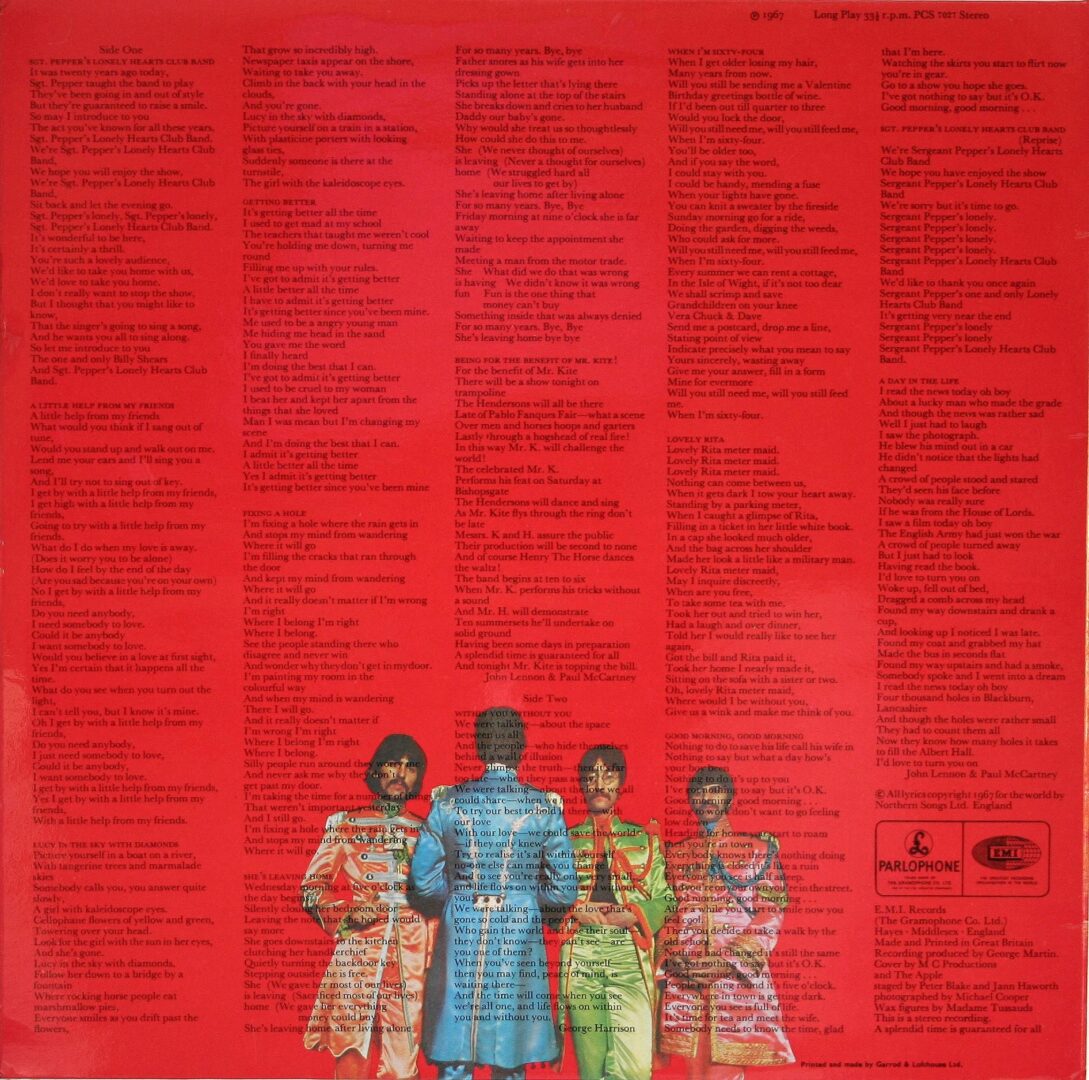
Let us start with a point that surprises some collectors: first pressings of Sgt. Pepper’s Lonely Hearts Club Band (leaving aside the 1984 Nimbus Supercut, which is a separate case) are nowhere near as costly as original Please Please Me or With The Beatles. If, however, you want a copy in anything close to collector-grade condition, expect to part with £200 to £500 (approx. 265 - 662 USD) for a decent near-mint example, and considerably more for a complete first pressing with a pristine Garrod & Lofthouse gatefold, the red & white psychedelic inner and an untouched cut-out insert.
According to the Rare Record Price Guide, the most valuable standard variant (setting aside the prototype „Fourth Proof” sleeve and the Nimbus Supercut) is, rather counter-intuitively, the second mono pressing from 1968 (catalogue number Parlophone PMC 7027), whose side 2 label omits „A Day In The Life” from the track listing. The song is, of course, on the record; the omission was a label-plate error. According to TheBeatles-Collection, when worn-out label printing plates were replaced in 1968, one set was mistakenly altered and the final side-2 track was dropped from the listing. This variant appears only in mono (no stereo copy has ever been documented), which accounts for much of its mystique.
There is a notable source disagreement worth flagging. TheBeatles-Collection and Yoko Ono Beatles Collection both date this variant to 1968, attributing it to the plate replacement. JPGR.co.uk classifies it as a second pressing from 1967. Parlogram Auctions (Andrew Moss) tends to describe it as an early „label error” without committing to a precise year. The technical argument for the 1968 dating (worn plates being reworked rather than first-run error) is the more convincing one, which is why it is preferred here.
Matrix numbers on this variant are the standard XEX 637-1 / XEX 638-1, identical to the first mono pressing. The black-and-yellow Parlophone label retains the „Sold in U.K.” text and the perimeter („rim”) text beginning „The Gramophone Co. Ltd.” RRPG values: Mint £200 (approx. 265 USD), EX £160 (approx. 212 USD), VG £100 (approx. 132 USD). Real-world auction results can push significantly higher with a complete sleeve, cut-outs and original inner, particularly through Parlogram Auctions or major Japanese and UK dealers. A well-worn playing copy, conversely, can still be found for £30 to £50 (approx. 40 - 66 USD) on eBay.
Equally prized is the 1969 mispressing that emerged within the run of the fourth mono pressing (on the one-box „1-EMI” label, with „The Gramophone Co Ltd” rim text). Both labels bear the MONO catalogue number PMC 7027, but both sides carry STEREO matrices (YEX 637-1 / YEX 638-1 or -2). The disc plays in stereo. A 2016 Popsike auction listing described it as „probably the second rarest Sgt Pepper, second only to the ultra rare Nimbus pressing”, a verdict echoed by Parlogram Auctions in a 2022 catalogue entry for the same variant. RRPG lists it at Mint £200 (approx. 265 USD), EX £160 (approx. 212 USD). Realised auction results cluster between £400 (approx. 529 USD) and £800 (approx. 1,059 USD), reflecting how rarely a clean, complete copy changes hands. The diagnostic is straightforward: black one-box label, PMC 7027 catalogue number, but matrices in the dead wax beginning with the letter Y (stereo); the letter X denotes mono.
The first stereo pressing (Parlophone PCS 7027) is RRPG’d at £175 (approx. 232 USD) Mint (EX £140 (approx. 185 USD), VG £87.50 (approx. 116 USD)), and is rarer than its mono counterpart. The reason is market history: in 1967, stereo was still a premium format, most buyers picked up mono, so first stereo runs were smaller. It is also the version that the band and Abbey Road team famously regarded as secondary. Engineer Geoff Emerick summed it up plainly: „We spent three weeks on the mono mixes and maybe three days on the stereo” (Emerick, quoted in M. Lewisohn, The Complete Beatles Recording Sessions, 1988). Tape op Richard Lush went further: „The only real version of Sgt. Pepper’s Lonely Hearts Club Band is the mono version” (ibid.). Notably, the first stereo pressing does not exhibit the hard panning that would creep into later cuts, making it the preferred stereo variant for collectors who want both formats on the shelf. Auction range: typically £300 to £500 (approx. 397 - 662 USD) for a near-mint copy.
The first mono pressing sits only slightly below, at £150 (approx. 199 USD) Mint RRPG (EX £120 (approx. 159 USD), VG £75 (approx. 99 USD), G £45 (approx. 60 USD)). First-run quantities were sufficient that played-to-death copies have minimal collector value today (£3 to £20 (approx. 4 - 26 USD)), and their listening pleasure is modest at best. For a playing copy, the sixth stereo pressing from 1976 (two-box label, „EMI Records Ltd” rim text, matrices YEX 637-1 and YEX 638-2 or higher) is the sensible choice. Typical auction price £20 to £50 (approx. 26 - 66 USD).
A few production-side details that rarely make it into the price discussion but enrich the object. The sleeve was designed by Peter Blake and Jann Haworth (who won the 1968 Grammy for Best Album Cover, Graphic Arts), photographed by Michael Cooper at 4 Chelsea Manor Studios in Chelsea on 30 March 1967. A contract dated 14 April 1967 records the photography fee at £250 (approx. 331 USD), the art direction fee at £350 (approx. 463 USD), and the studio hire with a three-person crew across eight days at £625 (approx. 827 USD) (with additional costs for cut-outs, figures and Easter-weekend overtime). Printing was handled by Garrod & Lofthouse Ltd, the same firm that later produced many Apple album covers. The rarest variant of the sleeve itself is the „Fourth Proof” prototype (AR D 13217), identifiable by an inverted „Fourth Proof” legend in the top right corner of the inner gatefold, above George Harrison’s head. A 1st-press mono „Fourth Proof” copy sold for $1,593.96 on 18 May 2025 (ValueYourMusic). Early sleeves also carry a second printing error: on the rear, „With A Little Help From My Friends” appears as „A Little Help From My Friends” (the label itself has the correct title).
The album was recorded at Abbey Road between 24 November 1966 and 21 April 1967, mostly in Studio Two, with the orchestral overdub for „A Day In The Life” and the „Sgt. Pepper” reprise cut in Studio One. The 10 February 1967 orchestral session has passed into legend: a 40-piece session orchestra, with the session booked in the Abbey Road diary under the codename „The Dakotas”, turned up in formal dress only to don clown noses, fake bald caps and stick-on nipples. Violin leader Erich Gruenberg played with a gorilla paw on his bow hand. George Martin later estimated the album consumed roughly 700 hours of studio time, more than thirty times the budget of Please Please Me. At the very end of side 2, following the last piano chord of „A Day In The Life”, Martin added a 15 kHz tone „for the benefit of dogs”, followed by a looped snippet of „beatle gibberish” in the run-out groove that repeats indefinitely unless the turntable lifts its arm. Both are present only on UK pressings and select official reissues (notably the 2014 mono remaster and 2017 50th Anniversary stereo remix).
A quick word on the Nimbus Supercut (1984, Parlophone/Nimbus, PCS 7027, matrices YEX 637-6 and YEX 638-6 or 6-1-1). A limited run of roughly 1,000 copies, sold exclusively via mail order to Practical Hi-Fi readers, pressed on 120g vinyl. Audiophile reputation is outstanding. Auction prices in NM run £400 to £800 (approx. 529 - 1,059 USD), with the occasional result above £1,000 (approx. 1,324 USD). Worth a dedicated piece.
| Pressing | Year / cat. no. | Matrices | Key identifiers | Market value |
|---|---|---|---|---|
| 1st mono „Fourth Proof” prototype |
June 1967 PMC 7027 |
XEX 637-1 XEX 638-1 |
Prototype sleeve with inverted „Fourth Proof AR D 13217″ legend above Harrison’s head. Test run, very small quantity. | unicorn $1,500 to $2,500 ValueYourMusic: $1,593.96 (May 2025) |
| 1st mono | 1 June 1967 PMC 7027 |
XEX 637-1 XEX 638-1 |
Black & yellow Parlophone label, rim text „The Gramophone Co. Ltd”, „Sold in U.K.”, optional KT tax code. Garrod & Lofthouse fully laminated flipback gatefold. „Wide spine” variant scarcer. | RRPG: Mint £150 (approx. 199 USD), EX £120 (approx. 159 USD), VG £75 (approx. 99 USD) Parlogram auctions: typically £250 to £400 NM |
| 1st stereo | 1 June 1967 PCS 7027 |
YEX 637-1 YEX 638-1 |
Label as per mono, sleeve marked „stereo” in top-right corner of rear. Scarcer than mono (stereo still a premium format in 1967). No hard panning, unlike later stereo pressings. | RRPG: Mint £175 (approx. 232 USD), EX £140 (approx. 185 USD), VG £87.50 (approx. 116 USD) Parlogram auctions: typically £300 to £500 (approx. 397 - 662 USD) NM |
| 2nd mono „No A Day In The Life” rare |
1968 PMC 7027 |
XEX 637-1 XEX 638-1 |
Label as per 1st pressing, but side 2 label omits „A Day In The Life” from track listing (track is on the vinyl). Plain white EMI inner replaces psychedelic inner. Mono only. Variant B: extra dot in „IN.U.K.” on side 1 (H2 1968). |
RRPG: Mint £200 (approx. 265 USD), EX £160 (approx. 212 USD), VG £100 (approx. 132 USD) Auctions: £200 to £500 depending on completeness |
| 2nd stereo | 1968 PCS 7027 |
YEX 637-1 YEX 638-1 |
Label as per 1st stereo. Plain white EMI inner instead of psychedelic. No „no A Day In The Life” variant exists in stereo. | RRPG: Mint c. £100 (approx. 132 USD), EX c. £75 (approx. 99 USD) Auctions: £100 to £200 |
| 3rd mono | summer 1969 to November 1969 PMC 7027 |
XEX 637-1 XEX 638-1 |
Black & yellow label, rim text „The Gramophone Co. Ltd”, no „Sold in U.K.”, no tax code. White or sepia „LP advertising” inner. | RRPG: Mint £60 (approx. 79 USD), EX £50 (approx. 66 USD) Auctions: £50 to £120 |
| 3rd stereo | summer 1969 to November 1969 PCS 7027 |
YEX 637-1 YEX 638-1 |
As 3rd mono, stereo. White or sepia inner. | RRPG: Mint c. £50 (approx. 66 USD) Auctions: £40 to £100 (approx. 53 - 132 USD) |
| 4th mono (one-box) |
November 1969 to 1970 PMC 7027 |
XEX 637-1 XEX 638-1 |
Silver-on-black label with single boxed EMI logo (one-box), rim text „The Gramophone Co Ltd”, „Made in Gt. Britain” below. One of only three Beatles titles issued in mono by Parlophone in 1969 (alongside Please Please Me and Help!). | RRPG: Mint £40 (approx. 53 USD) Auctions: £80 to £200 (rising, as one of the last mono titles) |
| 1969 mispressing mono label, stereo matrices holy grail |
late 1969 PMC 7027 |
YEX 637-1 YEX 638-1 (or -2) |
One-box label bearing the MONO catalogue number (PMC 7027) but with STEREO matrices (YEX) in the dead wax. Disc plays in stereo. Mono sleeve. Auction listings (Popsike 2016, Parlogram 2022): „the second rarest Sgt Pepper, second only to the ultra rare Nimbus pressing”. | RRPG: Mint £200 (approx. 265 USD), EX £160 (approx. 212 USD) Auctions: £400 to £800 (approx. 529 - 1,059 USD) |
| 4th stereo (one-box) |
November 1969 to 1970 PCS 7027 |
YEX 637-1 YEX 638-1 |
Silver-on-black label with single boxed EMI logo (one-box), rim text „The Gramophone Co Ltd”, „Made in Gt. Britain”. | RRPG: Mint £20 (approx. 26 USD) Auctions: £30 to £80 (approx. 40 - 106 USD) |
| 5th stereo (two-box, 2 EMI logos) |
early 1971 to 1973 PCS 7027 |
YEX 637-1 YEX 638-1 (or -2) |
Silver-on-black label with two boxed EMI logos (two-box), rim text still „The Gramophone Co Ltd”, „Made in Gt. Britain”. Sepia „LP advertising” inner. | Auctions: £25 to £60 (approx. 33 - 79 USD) |
| 6th stereo (two-box, „EMI Records Ltd”) |
summer 1976 to October 1980 PCS 7027 |
YEX 637-1 (or 2 to 5) YEX 638-2 (or 3 to 5) |
Silver-on-black label with two boxed EMI logos, rim text now „EMI Records Ltd” (the 1976 corporate rebrand). Laminated gatefold sleeve, white EMI „custom” inner. | Auctions: £20 to £50 (approx. 26 - 66 USD) Best candidate for regular playback |
|
Quick check, 1st UK pressing: 1. Black & yellow Parlophone label with yellow block logo. 2. Rim text beginning „The Gramophone Co. Ltd”. 3. „Sold in U.K.” statement below the logo. 4. Matrices XEX 637-1 / XEX 638-1 (mono) or YEX 637-1 / YEX 638-1 (stereo) in the dead wax. 5. Garrod & Lofthouse fully laminated flipback gatefold sleeve with glue tabs on top. 6. Red & white „psychedelic” inner sleeve reading „Patents Applied For”. 7. Printed cut-out insert signed Peter Blake / Jann Haworth at foot. 8. Optional embossed KT tax code on the side 1 label. Source notes: Not covered in the table: French pressings (1973, „Made in France” rim text), picture disc PHO 7027 (1979), 1981-1982 mono reissue, 1984 Nimbus Supercut (separate article), 2012 stereo remaster, 2014 mono 180g remaster (Optimal Media), 2017 50th Anniversary Giles Martin remix 2LP. Collector trivia: |
||||