Vinyl Nostalgia
There are records in the Beatles catalogue where even buying them is a dilemma. I am not talking about hardcore collectors chasing first pressings with red lines. I am talking about the people who have always wanted to hear the Beatles on vinyl and find themselves asking: do I buy a record for one of its two sides? Because hardly anyone ever plays the other one in this case.
Yellow Submarine, the Beatles’ tenth studio album, released in January 1969, is exactly that kind of record: collectibly fascinating, musically contested, and most importantly split between two entirely incompatible stylistic halves.
A contractual obligation that turned into a cult animation
It all began with the Beatles’ three-film contract with United Artists. After A Hard Day’s Night (1964) and Help! (1965), the band still owed one more film. After the bruising experience of Help!, which Lennon later dismissed with the wry line „Help! was great but I realized we were just big cops in the second Beatles movie”, the prospect of another live-action feature held no appeal. A compromise came from Al Brodax of King Features Syndicate: an animated film with the Beatles appearing only as the voices of their cartoon selves, plus a brief live-action cameo at the end. Four new songs, minimal involvement, contract fulfilled. The Beatles agreed.
Al Brodax later summed it up like this:
There was a commitment for the Beatles to do four songs for the film. Apparently, they would say, this is a lousy song, let’s give it to Brodax.
In other words, whatever the band had rejected during the Sgt. Pepper’s and later sessions was treated as leftovers and bundled off to Yellow Submarine. And that is precisely the paradox of the album: musically it was supposed to be filler, yet it became one of the band’s last carefree psychedelic statements.
The film premiered in London on 17 July 1968, long before the record appeared. The band, initially indifferent, changed their minds after watching the finished animation and were happy to be associated with it. The album, however, had its own history of delays. Originally planned for December 1968, the release was pushed back to make way for the White Album (The Beatles, PMC 7067/8). The final release dates for Yellow Submarine were 13 January 1969 in the US (Apple SW-153) and 17 January 1969 in the UK (Apple PMC 7070 mono, PCS 7070 stereo). Despite a respectable chart performance, the album sold „only” 800,000 copies in its first three months, and did not pass the million mark until the end of the year. Modest, by Beatles standards.
Why Martin took up half the record
This is where the most interesting part of the story begins. The Beatles placed six songs on the album: four new tracks and two previously released ones („Yellow Submarine” from 1966 and „All You Need Is Love” from 1967). To fill the second side, George Martin recorded his orchestral compositions, written specifically for the film, with a 41-piece orchestra. In this way side B became the source of fifty years of argument among critics and collectors.
The obvious question is: why did the Beatles not simply release an EP with the four new songs?
First, the band did consider exactly that. The EP was originally planned for September 1968, but the decision kept being postponed. Side A was to feature „Only A Northern Song”, „Hey Bulldog” and „Across The Universe”; side B was to carry „All Together Now” and „It’s All Too Much”. Mark Lewisohn in The Complete Beatles Recording Sessions confirms that the EP was in fact mastered in March 1969, but never went into production.
The second and less obvious reason was contractual. George Martin held the right to have his orchestral music placed alongside the Beatles on the soundtrack album, and Apple and EMI could not deny him that without financial risk. Put bluntly, if Martin’s compositions had been issued as a separate release, hardly anyone would have bought them.
The third complication, which reveals the full scale of the problem, is that United Artists refused to let Apple and EMI use the original orchestral recordings from the film. The studio kept the film soundtrack rights for itself. So George Martin had to record all seven orchestral pieces from scratch at Abbey Road.
Four new songs, hidden pearls
As I mentioned above, side A of Yellow Submarine carries four new, previously unreleased tracks.
„Only A Northern Song” is a George Harrison composition recorded on 13 and 14 February and completed on 20 April 1967, but rejected from Sgt. Pepper’s. The song expressed Harrison’s frustration with his relationship with Northern Songs Ltd., the Beatles’ publishing company, where he operated on less favourable terms than Lennon and McCartney (as the lyrics state plainly: „It doesn’t really matter what chords I play, what words I say or time of day it is, as it’s only a Northern Song”). And here comes a production curiosity: this song never received a true stereo mix until 1999. The original mix is mono, and for Yellow Submarine EMI produced a duophonic (fake stereo) version from the mono tape, splitting the signal electronically into two channels. For some reason the mono version that appeared on the UK release uses a fold-down of the duophonic mix rather than the original 1967 mono master. True stereo only arrived in 1999, when Peter Cobbin remixed all the tracks from scratch for Yellow Submarine Songtrack. The 2009 remaster then reverted to the original mono. This is worth knowing as a collector, because it is what makes the different editions of the same album genuinely interesting.
„All Together Now” is a simple McCartney song recorded in a single session on 12 May 1967, written specifically for the film. The piece is said to be based on a music-hall phrase McCartney remembered from childhood. Generally regarded as the weakest track on the album, although personally I associate it strongly with the day I taped the film’s soundtrack straight off the television onto a large reel-to-reel Grundig, and I still have a soft spot for it.
„It’s All Too Much” is another Harrison composition, recorded in May 1967, unusually at De Lane Lea Studios in central London rather than Abbey Road (which is notable, since the Beatles almost exclusively worked at Abbey Road). Inspired by his experiences with LSD, the original running time was over 8 minutes; the edited album version still runs a substantial 6:27. Pure psychedelia, if anyone is asking.
„Hey Bulldog” is a Lennon song, though one he himself did not think much of. It has oddly casual origins. On 11 February 1968 the Beatles were in the studio to shoot a promo film for the „Lady Madonna” single, and Lennon arrived with a new song. The tapes were already rolling, so „Hey Bulldog” was cut on the side. Footage from that day survives, showing the band clowning around during the closing jam session. You can watch it below the article. Among collectors it is the most celebrated of the four new tracks, and the only truly rock-driven number on the record, with a punchy riff and a brilliant bass line. A shame the Beatles did not cut more songs like it. Without question one of my favourite Beatles tracks of that period.
| # | Track | Author | Time | Origin | Notes |
|---|---|---|---|---|---|
| A1 | „Yellow Submarine” | Lennon-McCartney | 2:40 | Single (Parlophone R 5493), August 1966, originally on Revolver | Sung by Ringo Starr. Title track, known since 1966. |
| A2 | „Only A Northern Song” Harrison | George Harrison | 3:27 | Sessions 13-14 February, completed 20 April 1967 (during Sgt. Pepper’s, rejected) | 1969 stereo is duophonic (fake stereo) generated from the mono master. True stereo only arrives in 1999 (Songtrack). Title is a pun-critique of Harrison’s terms at Northern Songs Ltd. |
| A3 | „All Together Now” | Lennon-McCartney (mostly McCartney) | 2:11 | 12 May 1967, single session, written specifically for the film | McCartney called it „a throwaway”. A simple children’s music-hall song. |
| A4 | „Hey Bulldog” | Lennon-McCartney (mostly Lennon) | 3:11 | 11 February 1968, recorded during a session originally booked for the „Lady Madonna” promo film | Dark McCartney bass riff, closing jam session. Lennon: „a good-sounding record that means nothing”. Most widely praised of the four new tracks. |
| A5 | „It’s All Too Much” Harrison | George Harrison | 6:27 | 25-31 May 1967, De Lane Lea Studios (not Abbey Road!) | LSD-inspired. Originally over 8 minutes. The longest track on side A. Guitar-feedback psychedelia. |
| A6 | „All You Need Is Love” | Lennon-McCartney (mostly Lennon) | 3:48 | Single (Parlophone R 5620), July 1967, the Our World BBC broadcast | Originally had no official stereo mix. The stereo version was created specifically for this album on 29 October 1968. |
| B1 | „Pepperland” | George Martin | 2:23 | Re-recorded 22-23 October 1968, Abbey Road, 41-piece orchestra | The closest thing to a main theme in the film. Includes a short piano interlude. |
| B2 | „Sea Of Time” | George Martin | 3:00 | Re-recorded 22-23 October 1968 | Contains an „affectionate quotation” (Ian MacDonald) of „Within You Without You” from Sgt. Pepper’s. |
| B3 | „Sea Of Holes” | George Martin | 2:17 | Re-recorded 22-23 October 1968 | Music for the Sea of Holes sequence in the film. Characteristic glissandos. |
| B4 | „Sea Of Monsters” | George Martin | 3:40 | Re-recorded 22-23 October 1968 | Opens with a quotation of Bach’s Air on the G String and continues with Stravinsky parodies. |
| B5 | „March Of The Meanies” | George Martin | 2:18 | Re-recorded 22-23 October 1968 | Music for the Blue Meanies sequence. Allusions to Webern and Mozart. |
| B6 | „Pepperland Laid Waste” | George Martin | 2:10 | Re-recorded 22-23 October 1968 | Dark reprise of the Pepperland theme after the Blue Meanies’ devastation. |
| B7 | „Yellow Submarine In Pepperland” | Lennon-McCartney, arr. George Martin | 2:12 | Re-recorded 22-23 October 1968 | Orchestral arrangement of „Yellow Submarine” for the Beatles’ arrival in Pepperland. Closing track on side B. |
|
Compositional and technical summary: Side A: 6 Beatles tracks, total running time 21:44. Two previously released („Yellow Submarine”, „All You Need Is Love”), four new (1 McCartney, 1 Lennon, 2 Harrison). Side B: 7 George Martin compositions (plus one arrangement of Lennon-McCartney), total 18:00, re-recorded from scratch specifically for the album, because United Artists refused to let Apple/EMI use the original film soundtrack recordings. Technical anomalies: Planned EP (unreleased): in March 1969 Apple/EMI mastered a 5-track mono EP with the four new tracks plus Across The Universe (then unreleased) as a bonus, but never issued it. Peter Doggett’s explanation: both the EP and an expanded soundtrack „would have denied George Martin his contractual right to appear alongside the Beatles and robbed him of potentially the largest royalty payment of his career”. Orchestral personnel (side B): George Martin Orchestra, 41 musicians, conductor George Martin, co-producers John Burgess and Ron Richards, engineer Geoff Emerick. Sessions: Abbey Road Studio 2, 22 and 23 October 1968, three hours each. Editing: 24-25 October. Mixes: November 1968. |
|||||
Side A and B in the UK version, differences from the US
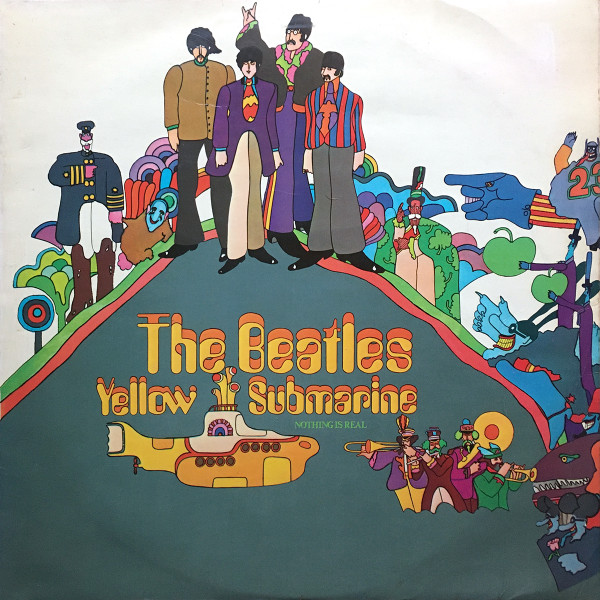
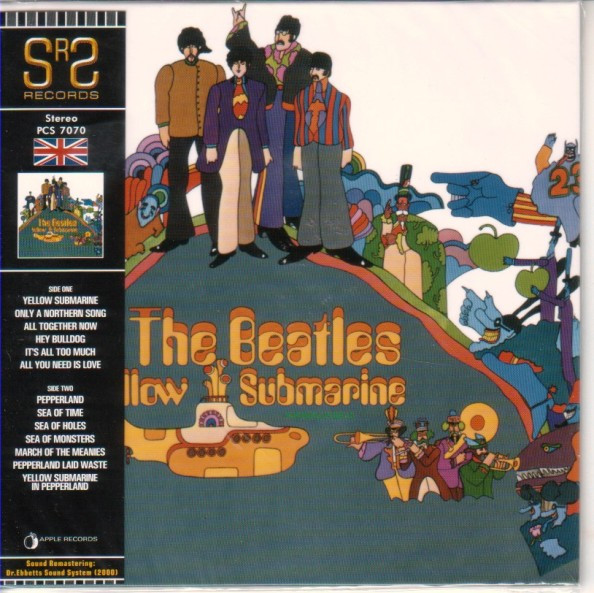
The British sleeve differs from the American one in a few details. Below the Yellow Submarine title on the UK edition (left) there is the phrase „Nothing Is Real” (a line from „Strawberry Fields Forever”), which the US edition (right) omits.
The back of the UK sleeve (left) carries Tony Palmer’s review of the White Album, originally published in The Observer, preceded by a short introductory note from Derek Taylor, head of Apple’s press office. The back of the US sleeve, in place of the review, carries a fictitious biography of the Sgt. Pepper’s Lonely Hearts Club Band by Dan Davis.
The key difference between the UK and US editions is that the US market never got a mono version of Yellow Submarine. From 1968 onwards, Capitol issued all Beatles LPs in stereo only. In the UK, mono (PMC 7070) and stereo (PCS 7070) came out in parallel, although mono pressings were already becoming scarce, which is exactly why they now command higher prices than stereo.
How to identify a first UK pressing
The mono and stereo versions are distinguished by their matrix numbers:
XEX 715-1 / XEX 716-1 (mono)
YEX 715-1 / YEX 716-1 (stereo)
The sleeve carries a few further clues, chief among them the Garrod & Lofthouse credit (the first pressing does not yet have the printer credit on the lower flap; this was only added on the second pressing, late in 1969). There are also the famous red lines above and below the text on the back of the sleeve (this detail disappears on later pressings).
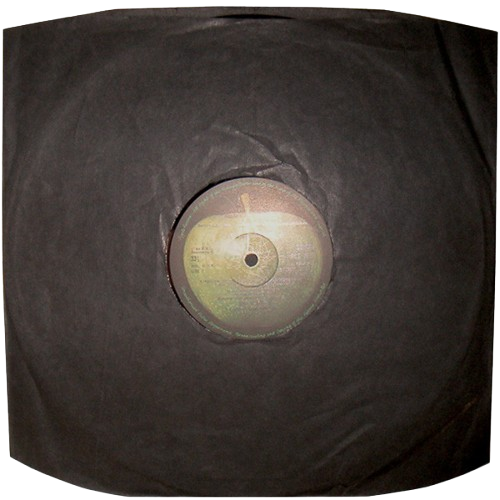
Inside the album there should be a black inner sleeve with a semi-circular cutout exposing the Apple label (likely manufactured by Harrison & Sons). This is one of the most valuable details, because most inner sleeves of this type from 1968 to 1969 did not survive in good condition.
The second pressing (spring 1969 to September 1970) still has the dark green Apple label, but without the „Sold In U.K.” clause, with matrices -1/-2 or -2/-1. The sleeve carries the „Printed and made by Garrod & Lofthouse Ltd. Patent No. 943,895” line on the lower flap, and the red lines are still present. The third pressing (1971 to 1973) has a light green label, again without the „Sold In U.K.” clause, no red lines, and a plain white paper inner sleeve. In the photographs below, the first-pressing label (left) and the third-pressing label (right).
Market values
In NM condition, a complete first UK stereo PCS 7070 with the full red lines and black inner trades at £250 to £400 (approx. 331 - 529 USD). Parlogram Auctions regularly shifted these in 2024 and 2025 at around £300 (then approx. 403 USD). For VG+ without the inner or with a worn sleeve, expect £100 to £18 (approx. 132 - 24 USD), and for VG copies £50 to £90 (approx. 66 - 119 USD).
Mono PMC 7070 NM complete (rarely encountered) runs at £300 to £550 (approx. 397 - 728 USD). Parlogram had an NM mono on offer in 2023 at £450 (approx. 596 USD).
For anyone looking for an interesting copy without the first-pressing obsession, a decent price compromise is a second-pressing stereo, still with the dark green label and -1/-2 matrices (£40 to £80 (approx. 53 - 106 USD)). It is still an Apple 1969 copy, still with red lines (at least on the earlier second-pressing variant), sonically almost identical, only with lower collector value. If you are not a hardcore collector, who really cares?
Reissues: Songtrack 1999, remaster 2009, 180g 2012
In 1999, for the film’s 30th anniversary, Apple and EMI released Yellow Submarine Songtrack, dropping Martin’s side B altogether and replacing it with additional Beatles tracks used in the film. Only „A Day In The Life” was left out, to avoid having too much material from Sgt. Pepper’s. Peter Cobbin at Abbey Road fully remixed every track from the original multitrack tapes, including the first-ever true stereo mix of „Only A Northern Song”. The album came out in two variants: a first pressing on yellow vinyl (gatefold) and a second pressing on black vinyl. Both used the same matrices and the same sleeve; the two pressings differ only in the colour of the record. Current prices are £40 to £70 (approx. 53 - 93 USD) for a yellow NM, and £25 to £45 (approx. 33 - 60 USD) for black.
The 2009 remaster was issued on CD on 9 September 2009 as part of The Beatles in Stereo box, and on 180g vinyl only on 12 November 2012 (Apple 94638246718). Pressed by Optimal Media GmbH in Germany, with the sleeve reproduced from the original Garrod & Lofthouse artwork but without the flipback flaps. The current price for this edition is £30 to £45 (approx. 40 - 60 USD) new, and £20 (approx. 26 USD) (about 97 PLN (approx. 25 USD)) to £30 (approx. 40 USD) used.
Behind the Iron Curtain: AnTrop
Мелодия in the USSR never released Yellow Submarine, but the pirate St. Petersburg label AnTrop did, issuing a double album between 1991 and 1992, Волшебное таинственное путешествие / Жёлтая субмарина (Magical Mystery Tour / Yellow Submarine), catalogue П91 00135-8 or ATR 30001-04. As usual with AnTrop, the audio was copied from a Western CD from 1987 (that is, from the first digital remaster). The sleeve was redrawn by Nikolai Kibalchich in Heinz Edelmann’s original style, but with subtle modifications (the figures of Fred and the Major are swapped, and the submarine faces left in some variants). In 1994 AnTrop released a standalone edition of Yellow Submarine pressed in Riga, with a slightly lighter background on the sleeve. The whole AnTrop series was never legal, not even in Russia. These pressings are now available only second-hand on eBay (Discogs has blocked their sale) or at record fairs, typically at $25 to $60.
Balkanton in Bulgaria, Supraphon in Czechoslovakia, Amiga in East Germany and Muza in Poland never issued a separate licensed edition of Yellow Submarine.
Worth it?
Yellow Submarine from 1969 is a record with two faces. For the collector of original Apple vinyl, a first UK pressing with red lines and matrix numbers XEX/YEX -1 is an absolute must-have. For the modern listener, Yellow Submarine Songtrack from 1999 offers better mixes, more Beatles tracks, and absolutely no orchestral Martin. A dilemma with no clear answer, though with a clear nod towards „Hey Bulldog”.
| Pressing | Date / cat. no. | Matrices | Key identifiers | Market value |
|---|---|---|---|---|
| 1st UK mono | 17 January 1969 Apple PMC 7070 |
XEX 715-1 XEX 716-1 Stamper codes 1/T, 1/M or 1/P |
Dark green Apple label (whole apple / sliced), two-line „An E.M.I. Recording”, „Sold In U.K. subject to resale price conditions, see price lists” clause. Front-laminated tri-flipback Garrod & Lofthouse sleeve without printer credit. Red lines above and below the sleeve notes on the rear. Fluted spine. Black die-cut inner sleeve with semi-circular cutout. | £300 to £550 (approx. 397 - 728 USD) NM complete £150 to £250 (approx. 199 - 331 USD) for VG+ Popsike max: $770 (2015) Scarcer than stereo |
| 1st UK stereo | 17 January 1969 Apple PCS 7070 |
YEX 715-1 YEX 716-1 (alt. -1/-2 in later 1st) |
Identical to mono plus „Stereo” marking in upper right of sleeve. Red line sleeve, laminated tri-flipback, black die-cut inner. „2nd variation” (late 1969, still first pressing): no „Sold in U.K.” clause, -3 matrices on side 1. |
£250 to £400 (approx. 331 - 529 USD) NM complete £100 to £180 (approx. 132 - 238 USD) for VG+ Parlogram regularly: £300 (approx. 397 USD) NM |
| 2nd UK | spring 1969 to September 1970 PMC 7070 / PCS 7070 |
YEX 715-1 (or -2, late -3) YEX 716-1 |
Dark green label, but without „Sold In U.K.” clause. Laminated flipback sleeve with „Printed and made by Garrod & Lofthouse Ltd. Patent No. 943,895″ on the lower flap. Red lines still present on earlier 2nd pressings, disappearing later. White paper Apple inner (instead of black die-cut). | £40 to £80 (approx. 53 - 106 USD) VG+/NM Best value-for-money compromise |
| 3rd UK | 1971-1973 (possible until 1976) PCS 7070 |
YEX 715-3 YEX 716-1 |
Light green label with large © symbol, two-line „An E.M.I. Recording”. Laminated sleeve without flipback flaps, no red lines. | £20 to £40 (approx. 26 - 53 USD) |
| US 1st | 13 January 1969 Apple SW-153 |
SW-1-153 / SW-2-153 (Scranton, Los Angeles, Jacksonville variants) |
Dark green Apple label with „THE BEATLES” above title and „Yellow Submarine” in bold (unique to 1st pressing). Stereo only (no US mono). Back cover: fictitious Sgt. Pepper’s Lonely Hearts Club Band biography by Dan Davis. Los Angeles variant: „✻” in runout. Queens Litho label backdrop variant: extremely rare, 2011 auctions >$200. | $60 to $150 NM Queens Litho variant: $200 to $400 |
| US 1976-77 | Capitol SW-153 | SW1 153 / SW-2-153 „MASTERED BY CAPITOL” „0″/„O” in runout |
Orange Capitol label. Jacksonville pressing (identifier „0″ or „O”). Very good sound (bass-heavy, dynamic range). Some copies: „MASTERED BY CAPITOL BY CAPITOL” doubled stamp. | $30 to $60 NM A good sonic alternative |
| US 1978 | Capitol SW-153 | standard | Purple label with purple plastic dust jacket. One of the most visually distinctive variants. | $40 to $80 |
| AnTrop (USSR) behind the Iron Curtain | 1991-1992 П91 00135-8 / ATR 30001-04 |
N/A (bootleg) | Double LP set Волшебное таинственное путешествие / Жёлтая субмарина (MMT+YS). Audio copied from the 1987 Western CD. Cover redrawn by Nikolai Kibalchich in Heinz Edelmann’s style with modifications. Five known colour variants. Never legal, not even in Russia. | $40 to $80 on eBay Discogs has blocked sales |
| AnTrop single LP behind the Iron Curtain | 1994 П91 00137 |
N/A (Riga pressing) | Standalone Yellow Submarine pressed in Riga. Slightly lighter background than the double set. Some collectors manually split the 1991-1992 double albums to sell as „standalone” — these can be identified by a darker background and double-set catalogue markings. | $25 to $60 |
| Yellow Submarine Songtrack | 13 September 1999 Apple 7243 5 21481 1 7 |
CBA 521481-1 / -2 Abbey Road cutting |
Not the original, but a full Peter Cobbin remix from the multitrack tapes. 15 Beatles tracks from the film (6 from the original + 9 additional, minus „A Day In The Life”). No Martin side B. First true stereo „Only A Northern Song”. First pressing: yellow vinyl gatefold. Second: black vinyl. Gatefold features Heinz Edelmann artwork. | Yellow NM: £40 to £70 (approx. 53 - 93 USD) Black NM: £25 to £45 (approx. 33 - 60 USD) CD: £3 to £6 (approx. 4 - 8 USD) |
| 2009 remaster CD | 9 September 2009 094638260721 |
N/A (CD) | Part of The Beatles in Stereo box. Digipak with 32-page booklet. Allan Rouse team at Abbey Road. „Only A Northern Song” restored to true mono (duophonic dropped). Rest in stereo. | CD: £6 to £10 (approx. 8 - 13 USD) new, £3 to £5 (approx. 4 - 7 USD) used |
| 2012 180g vinyl | 12 November 2012 Apple 94638246718 |
Optimal Media digital matrices | Vinyl reissue of the 2009 remaster. 180g, pressed by Optimal Media GmbH in Germany. Sleeve reproduced from the original Garrod & Lofthouse without flipback flaps (a loss). Colour inner with original US 1968 liner notes. Part of the vinyl stereo box or available separately. | New: £30 to £45 (approx. 40 - 60 USD) Used NM: £20 to £30 (approx. 26 - 40 USD) |
|
Quick check, 1st UK pressing: 1. Dark green, matte Apple label (not light green). 2. Two-line „An E.M.I. Recording” (later pressings one-line). 3. „Sold In U.K. subject to resale price conditions, see price lists” clause on the label. 4. Dead-wax matrices: mono XEX 715-1 / XEX 716-1, stereo YEX 715-1 / YEX 716-1. 5. Laminated tri-flipback Garrod & Lofthouse sleeve, without printer credit on the lower flap. 6. Red lines above and below the sleeve notes on the rear. 7. Black die-cut inner sleeve with semi-circular cutout exposing the Apple label. 8. UK only: „Nothing Is Real” phrase below the title (a line from „Strawberry Fields Forever”); US sleeve omits it. UK vs. US sleeve differences: Source notes: Not included in this table: Canadian (Capitol-EMI of Canada), Indian (Gramophone Co of India, Dum Dum), Japanese (Toshiba/Apple AP-8610, then EAS-80559 1976), German Odeon, Dutch, French, Italian, Australian pressings. Yellow Submarine was never licensed in Poland (no Muza, Supraphon, Amiga or Balkanton edition); only Western imports circulated. No Melodiya edition exists. |
||||