Vinyl Nostalgia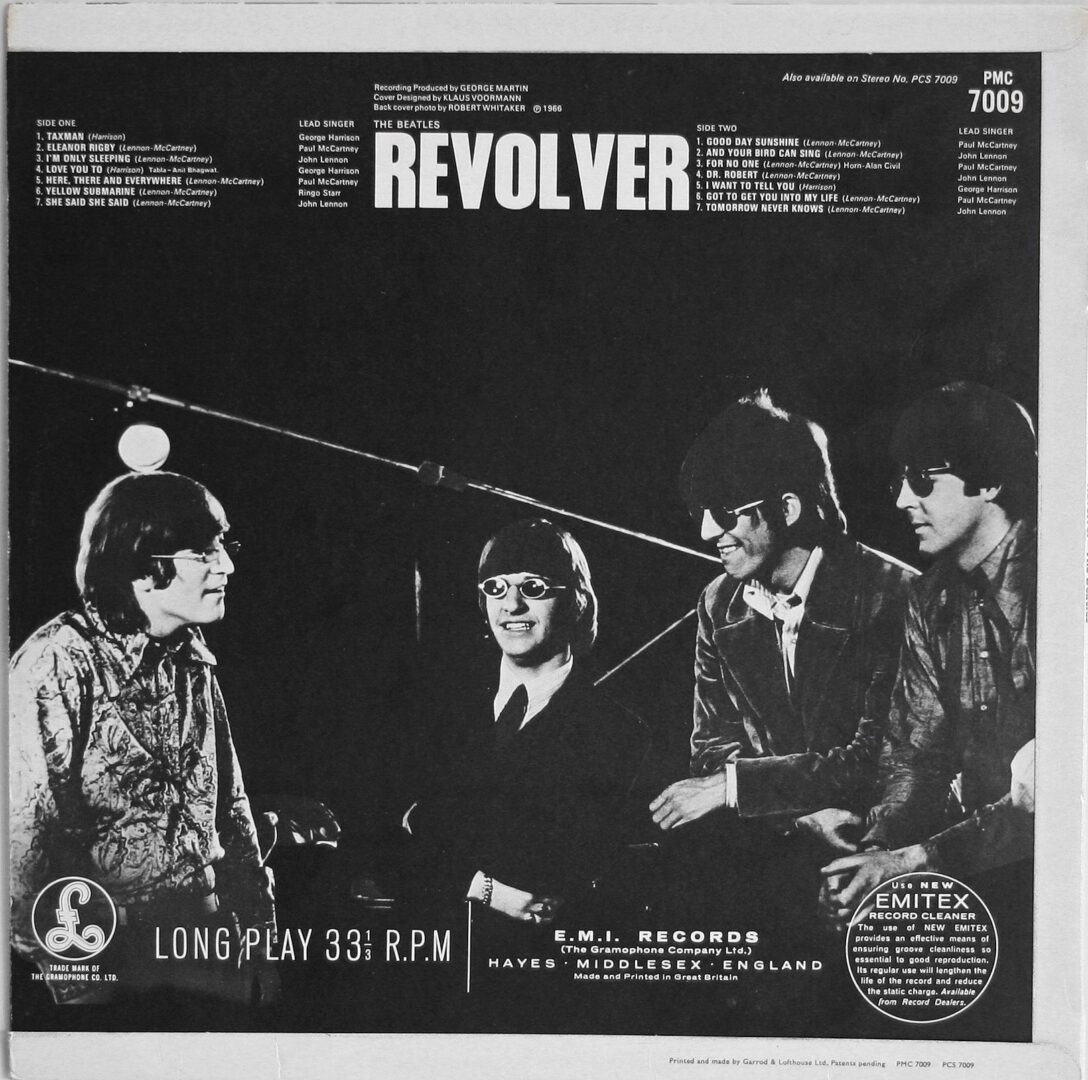
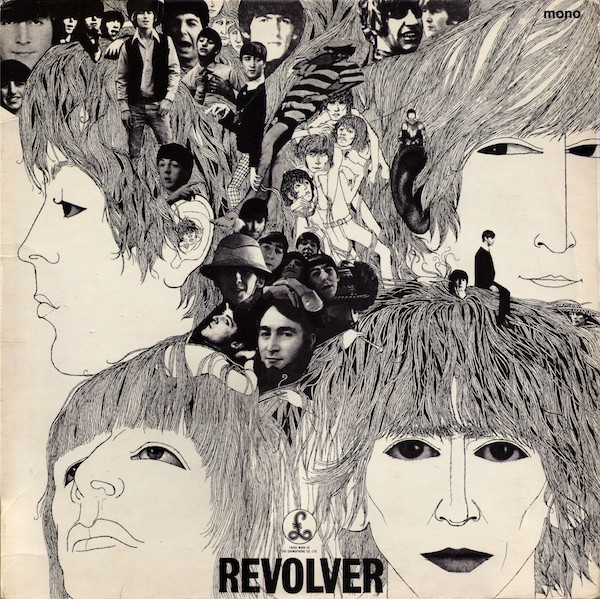
Regular first pressings of Revolver sit, in the Rare Record Price Guide, at a valuation broadly comparable to the Beatles’ chronologically next studio album, Sgt. Pepper’s Lonely Hearts Club Band. But an entirely different conversation begins the moment you stray into copies that went out with a mistake — wrong labels, scrambled matrices, or misprinted sleeves. With Revolver, we have one of the most celebrated such mistakes in the entire Beatles catalogue.
The legendary XEX 606-1
For a Beatles collector, those three- and four-digit dead-wax codes are almost poetry. The prefix XEX denotes a mono cutting (stereo is YEX); 606 is the EMI catalogue number for side two of Revolver; and the -1 suffix signals the first lacquer cut from the master tape (later cuts are numbered -2, -3, etc., and don’t necessarily make it to production — first-pressing mono Help! famously shows -2 on both sides, suggesting something went wrong with the initial lacquers). And it was precisely this first lacquer for Revolver — stamped XEX 606-1 — that went into production carrying the wrong mix of “Tomorrow Never Knows”, known in the Abbey Road paperwork as Remix 11 (RM11).
The chronology runs like this. On 6 June 1966 George Martin and Geoff Emerick prepared a batch of mono mixes in Studio Three, among them three versions of “Tomorrow Never Knows” — numbered RM10, RM11 and RM12. RM11 was judged the best and earmarked for production. On 14 July 1966 — the day cutting for the album began — George Martin nevertheless telephoned Emerick with a fresh instruction: replace RM11 with mix eight, made back on 27 April 1966. That earlier Remix 8 (RM8) is the canonical “Tomorrow Never Knows” we all know.
Part of the collector folklore, repeated by more than one auction house, credits the decision to pull RM11 to John Lennon himself, who is said to have phoned Martin after auditioning one of the first copies off the line. The better-documented sources (Beatles Bible, About The Beatles, and Mark Lewisohn’s research) tell a plainer story: it was Martin who made the call. The “Lennon” version makes for punchier sales copy, but it isn’t supported by EMI session documentation.
What does the lost mix actually sound like?
Despite the common claim that RM11 differs from RM8 “only marginally”, the two are in fact distinctly different — you just need to listen A/B to hear it. Lennon’s vocal sits louder on RM11 and cuts through the effects with greater clarity; the fade-out is longer and carries more piano; and the tape-loop effects — most famously the “seagull” sounds sped up from Paul McCartney singing “ah, ah, ah, ah” — are faded in with a different dynamic. To many collectors, RM11 sounds closer to the 1966 stereo mix than to the final mono RM8.
It’s worth stressing that Remix 11 has never been officially reissued on any other format — not on CD, not on Anthology, not on the 2022 Super Deluxe edition. The only legitimate way to hear it remains an original vinyl copy stamped XEX 606-1.
What is it really worth — and is it a safe investment?
Here caution is required. The Rare Record Price Guide has historically valued mint XEX 606-1 mono copies in the region of £500 (approx. 662 USD), but on the actual auction floor high-grade copies regularly cross and exceed £1,000 (approx. 1,324 USD) (Parlogram Auctions, Omega, Gripsweat). One Reading auction closed at US$1,100 for an EX copy in June 2020. The market is uneven, however: the same pressing in VG condition lands at €200 (approx. 224 USD)–250 on popsike.com.
And here is the part auction descriptions tend to omit. The popular line — “they only pressed these for the first day, only a handful of copies exist” — may be significantly overstated. Beatles researcher Paul Moss, in his excellent 2016 piece XEX 606-1 is 50, points out that according to Bruce Spizer’s factory research at Hayes, a single stamper typically produced up to 5,000 records before wearing out. Given that UK mono pre-orders alone ran to around 300,000 copies, the number of XEX 606-1 pressings in circulation is likely to run into the low tens of thousands — potentially fifteen per cent or more of the first production run, not the “tiny handful” of auction copy. Moss puts it bluntly: be cautious about committing very large sums, because the supply may be larger than the collector mythology suggests.
The “copies went only to Liverpool shops” narrative — repeated in various Gripsweat and eBay listings — has no primary-source confirmation whatsoever. It’s a fragment of regional collector folklore, and it should be read with quotation marks around it.
Stereo: PCS 7009 is a different story

As with other mid-’60s Beatles albums, the first stereo pressing (Parlophone PCS 7009) tends to command a premium over later stereo copies — principally because, in 1966, stereo was still a technological novelty and most UK buyers were reaching for the cheaper, “proper” mono format (think of it as the early Blu-ray-vs-DVD era). The RRPG values the first stereo at around £150 (approx. 199 USD) in mint and £120 (approx. 159 USD) in near-mint.
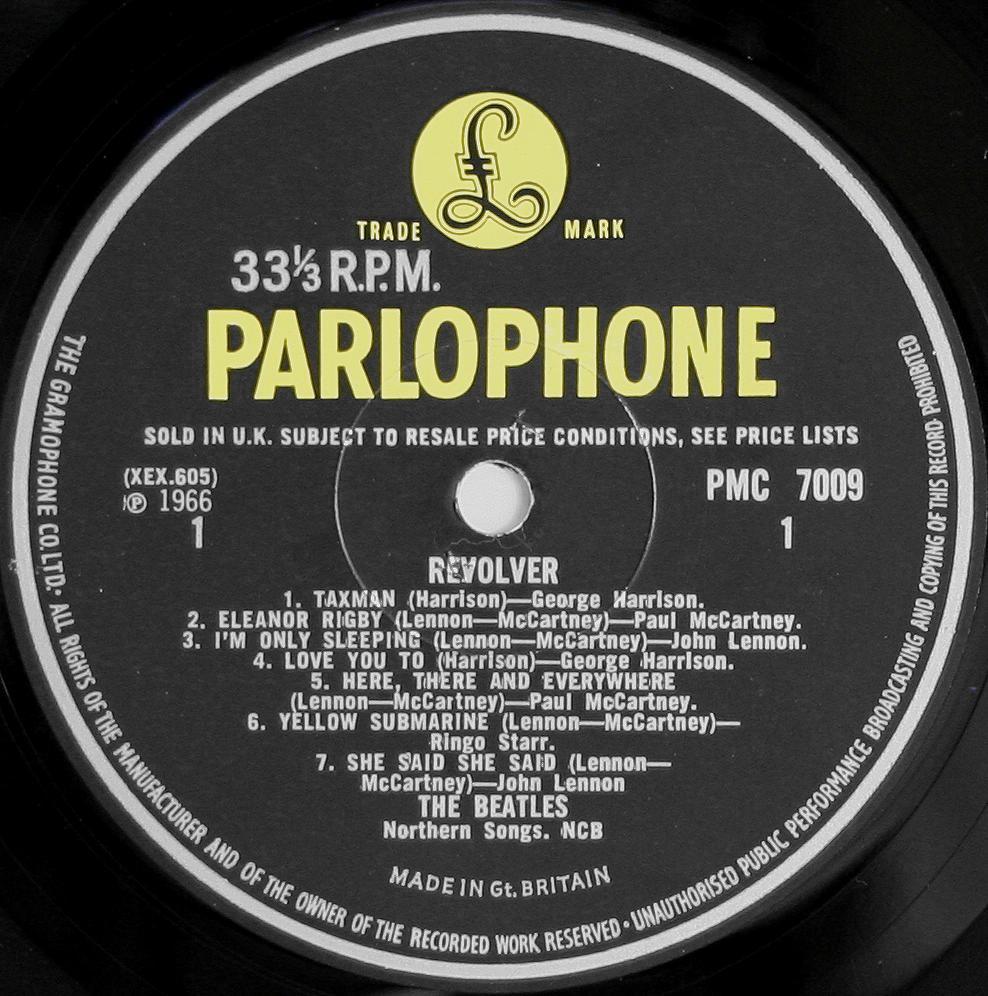
A very important caveat: the YEX 606-1 stereo matrix does NOT contain Remix 11. The stereo “Tomorrow Never Knows” was a separate mix and had no part in the RM11/RM8 drama. The same matrix codes (YEX 605-1, YEX 606-1) also appear on the second, third and fourth stereo pressings from 1969–1970, which means that matrix alone can’t identify a first stereo. The label does the work: look for the “Sold in U.K. subject…” line beneath the large PARLOPHONE wordmark at the top of the label, and for the “KT” purchase-tax code by the spindle hole.
The standard first mono: XEX 606-2
The so-called “standard first mono pressing” — chronologically the second, because it already carries the corrected Remix 8 — is identified by matrix XEX 606-2 or XEX 606-3. The RRPG rates it at roughly £100 (approx. 132 USD) mint and £80 (approx. 106 USD) near-mint. A separate article on this particular pressing is available elsewhere on the blog.
An extra identifier: the “Dr. Robert” misprint
Early Revolver labels also carry a nice additional tell: the song title is printed as “Dr. Robert” (with the abbreviated honorific), where later pressings corrected it to “Doctor Robert”. The same misprint also appears on the rear sleeves of early copies, making it a useful secondary indicator of original production.
How to identify a first mono sleeve

Beyond matrix and label, a lot can be read off the rear sleeve alone — and it’s worth knowing what to look for, since most buyers eye the sleeve first and only afterwards reach for the disc. The original 1966 sleeve is a laminated tri-flipback — laminated only on the front, with the back cover wrapped around and glued at the edges (hence “flipback”). In the top right corner of the rear sleeve you’ll find two catalogue numbers side by side: PMC 7009 PCS 7009 — a consequence of EMI unifying mono and stereo numbering from early 1966 (previously each format had its own series). The centre of the back carries the Robert Whitaker band photograph (from the Abbey Road session of 19 May 1966), surrounded by song lyrics and credits. And on the same back panel you should see a distinctive circular black stamp reading “USE NEW EMITEX RECORD SLEEVE” — an advert for the EMI paper inner sleeve, standard for UK Parlophone releases from roughly 1964 through 1967.
The critical identifier is the name of the sleeve printer, set in small type on the back cover (typically near the bottom-left corner). Two legitimate variants exist for first-pressing mono: “Printed and made by Garrod & Lofthouse Ltd. Patents pending PMC 7009 PCS 7009” or “Printed and made by Ernest J. Day & Co. Ltd., London PMC 7009 PCS 7009” — both printers worked for EMI in parallel, both sleeves are authentic, and the Ernest J. Day variant is statistically the scarcer of the two. Important caveat: the EMITEX stamp alone does not confirm a first pressing. The same stamp appears on the second, third and fourth mono pressings (through early 1967), as well as on the first stereo pressing. What nails down an XEX 606-1 “Remix 11” copy is the side-2 dead-wax matrix plus the label details (“KT” tax code, “Dr. Robert” misprint). On the later reissues (1981, 1995, 2014) the rear layout is quite different — no EMITEX stamp, a different printer credit (often with a barcode), and the period-correct partial lamination (front only, often split or missing by now) is replaced by a cleanly reproduced modern sleeve. If the paper shows obvious yellowing and genuine age wear, you are almost certainly looking at a 1966 original.
Collector’s summary
XEX 606-1 mono Revolver is without question one of the more fascinating factory mistakes in EMI history, and one of the most frequently mislabelled — or deliberately misrepresented — items in Beatles collecting. If an opportunity to buy comes your way:
- Verify the matrix in person — XEX 606-1 must be stamped (not just etched) in the dead wax of side two; do not confuse it with the label catalogue number.
- Check the sleeve — tri-fold flipback by either Garrod & Lofthouse Ltd. or Ernest J. Day & Co. Ltd. — both variants are legitimate.
- Compare the audio — the louder vocal and longer piano fade should make RM11 distinguishable from RM8 within seconds.
- Mind the price — before parting with a four-figure sum, remember the Moss/Spizer point: supply may be higher than auction copy admits.
Even with that caution in mind, this remains one of the more compelling records a Beatles collector can shelve — not so much as a pure investment, but as a tangible artefact of the moment George Martin picked up a telephone on 14 July 1966 and told Geoff Emerick: “Geoff, swap that mix.”
| Pressing / matrix | Year / status | Identifying features | Collector notes |
|---|---|---|---|
|
PMC 7009 — XEX 606-1 (withdrawn)
Side 1: XEX 605-2 · Side 2: XEX 606-1
mono |
1966 · “1st pressing” | Yellow/black Parlophone label, “Sold in U.K. subject…” rim text, “The Gramophone Co. Ltd.”, KT tax code, “Dr. Robert” misprint on label and sleeve. Tri-flipback cover by Garrod & Lofthouse Ltd. or Ernest J. Day & Co. Ltd. | Carries Remix 11 of “Tomorrow Never Knows” — pulled on 14 July 1966 at George Martin’s instruction. Louder vocal, longer piano fade, more prominent “seagull” effects. RRPG ~£500 (approx. 662 USD) mint; real auctions £1,000 (approx. 1,324 USD)+ for EX/NM. Supply is likely higher than auction descriptions imply — Paul Moss / Bruce Spizer estimate well over 10% of the first production run. |
|
PMC 7009 — XEX 606-2/-3
Side 1: XEX 605-2 · Side 2: XEX 606-2 or -3
mono |
1966–1969 · “2nd pressing” | Same yellow/black label; early copies retain “Sold in U.K. subject…”, later copies drop it. “Dr. Robert” on early variants; corrected to “Doctor Robert” on later ones. | The standard first-press mono — with the correct Remix 8. RRPG ~£100 (approx. 132 USD) mint / £80 (approx. 106 USD) near-mint. The most common route into mono Revolver on first-press vinyl; sleeve variants matter. |
|
PCS 7009 — YEX 606-1
Side 1: YEX 605-1 · Side 2: YEX 606-1
stereo |
1966 · 1st stereo pressing | Yellow/black Parlophone label, “Sold in U.K. subject…”, “The Gramophone Co. Ltd.”, KT tax code, “Dr. Robert”. Laminated tri-flipback Garrod & Lofthouse sleeve. | Important: YEX 606-1 stereo does NOT contain Remix 11 — the RM11/RM8 issue was mono-only. Priced above mono purely because fewer stereo copies were pressed at the time. RRPG ~£150 (approx. 199 USD) mint / £120 (approx. 159 USD) near-mint. |
|
PCS 7009 — later stereo
Side 1: YEX 605-1/-2 · Side 2: YEX 606-1/-2
stereo |
1969–1976 · 2nd–5th stereo pressings | Same yellow/black label (2nd, 3rd pressing), then black/silver with white EMI logo (4th, 5th pressing). No “Sold in U.K.” rim text. Laminated Garrod & Lofthouse sleeve. | The same YEX 606-1 matrix often appears on several consecutive pressings, so matrix alone will not identify a first stereo — you must read the labels and rim text. Prices well below the 1966 first pressing. |
|
Parlophone 5099963380415
The Beatles in Mono — 180 g
reissue |
2014 · Mono remaster | Pressed at Optimal Media GmbH (Germany) from the original mono master tape. Replica tri-flipback Garrod & Lofthouse sleeve, insert with mastering notes. Part of the Beatles in Mono vinyl box. | The best current mono listening option. Contains the standard Remix 8 — not Remix 11. A sensible entry point for collectors wanting to compare mono against stereo without committing to a four-figure original. |
|
Rear sleeve quick reference — all 1966 UK pressings (mono & stereo)
Laminated tri-flipback · “PMC 7009 PCS 7009” in top right corner · Robert Whitaker band photo · circular “USE NEW EMITEX RECORD SLEEVE” stamp · printer credit: Garrod & Lofthouse Ltd. or Ernest J. Day & Co. Ltd. (both legitimate; E.J. Day is the scarcer variant). The EMITEX stamp alone does NOT confirm a first pressing — it appears on all four 1966 mono pressings and on the first stereo. Final confirmation always requires the dead-wax matrix plus label details. |
|||