Vinyl Nostalgia
 Discography
The Beatles Official Discography (UK)
No one has come even close for 60 years – they are the best!
The Beatles are the best-selling artists of all time with over 520 million album sales. Michael Jackson is the runner-up, more than 175 million sales behind.
Let’s look at the others. The Rolling Stones have accumulated approximately 237 million total equivalent album sales — impressive for a band still recording six decades on, but less than half the Beatles’ total. ABBA, across a mere eight studio albums, accumulated 156.6 million equivalent album sales — remarkable efficiency, but still less than a third of the Beatles’ figure. Crucially, their management team was notorious for communicating grossly exaggerated sales claims, which led the general public to view their success as bigger than it actually is, placing them alongside The Beatles and Michael Jackson — a league they do not, by verified data, belong to.To put the Beatles’ total in perspective: it surpasses the combined sales of the Rolling Stones and Pink Floyd, or the sum of the Beach Boys, ABBA, and U2 — groups that together issued smash records for 50 years. Michael Jackson comes closest on individual albums: Thriller is the world’s best-selling album, estimated at over 67 million copies worldwide. But Jackson’s catalog success is heavily concentrated in that single record. The Beatles’ strength lies in the extraordinary consistency of their entire catalog — every album selling, not just the peak.

The Beatles have the most number-one hits in the history of the Billboard Hot 100, with 20 songs having reached the top position — a record they have held since 1965, when they surpassed Elvis Presley. The contrast with their competitors is sharp here. The Rolling Stones scored 8 No. 1 hits on the Billboard Hot 100 — a respectable achievement, but less than half the Beatles’ count, despite a career now spanning more than 60 years. ABBA scored nine number-one singles in the UK, but their American chart performance was far more limited; they had only one US number-one single (Dancing Queen, 1977). Michael Jackson is the only artist who can mount a credible case: with 13 number-ones on the Hot 100, he is closer — but still three behind.
In 1964 alone, the Beatles earned 10 top-five Hot 100 hits — a single-year record that still stands today. That same year, they also became the only act in history to simultaneously hold the top two positions on both the singles and albums charts in America. The Beatles have 19 number-one albums on the Billboard 200 — the most of any artist in the chart’s history. Jay-Z, the closest rival, has 14.

According to Guinness World Records, „Yesterday” holds the record for the most cover versions of any song ever written — over 1,600 recorded versions. BMI asserts it was performed publicly more than seven million times in the 20th century alone. „Eleanor Rigby” has over 752 known cover versions, „Norwegian Wood” over 510, „And I Love Her” over 574.
The Rolling Stones wrote visceral, often brilliant rock and roll, but their best-known songs — „(I Can’t Get No) Satisfaction”, „Paint It Black”, „Sympathy for the Devil”, „Gimme Shelter” — rarely attract the cross-genre, cross-generation covering culture that Beatles songs do. ABBA’s songwriting was impeccable within its own tight pop idiom, but their catalog shows little of the stylistic scope the Beatles demonstrated from album to album.

The Beatles were active as a recording unit for eight years (1962–1970). In that span, they did not merely produce a handful of classic records — they produced an unbroken sequence of albums that critics and musicians consistently rank among the greatest in the history of recorded music. When Rolling Stone ranked the 500 Greatest Albums of All Time, four Beatles records appeared in the top ten: Revolver, Rubber Soul, the White Album, and Sgt. Pepper’s Lonely Hearts Club Band at number one.
No other band in this comparison can match that density. The Rolling Stones produced three or four undisputed masterpieces (Exile on Main St., Let It Bleed, Sticky Fingers) — but over a 60-year career, not eight years. ABBA’s peak was compressed into roughly 1974–1981 and produced consistently enjoyable pop; their best albums simply don’t occupy the same critical altitude. Michael Jackson’s run from Off the Wall (1979) through Dangerous (1991) is extraordinary — but it represents a peak of roughly 12 years and three truly dominant albums, not the unbroken sequence of creative reinvention the Beatles achieved.
During their active years, the Beatles had the top-selling US single one out of every six weeks, and the top-selling US album one out of every three weeks. That is a commercial consistency that no other artist has matched in any era.
No artist in music history appears at the top of as many authoritative lists as consistently as the Beatles. Rolling Stone ranked the Beatles number one on its list of the Greatest Artists in History in both 2004 and 2011. Billboard ranked the Rolling Stones as the second greatest artist of all time — directly behind the Beatles. Michael Jackson ranked at or near the top of commercial metrics but is less uniformly dominant in critical rankings that measure long-term artistic significance. ABBA, beloved and critically rehabilitated over the past two decades, tends to place high in genre-specific and popularity-based lists, but rarely in the broadest critical surveys.
Sgt. Pepper’s Lonely Hearts Club Band was the first rock album to win Album of the Year at the Grammy Awards, in 1968 — a watershed moment that legitimized rock music as a serious art form in the eyes of the industry’s most prestigious institution. Neither the Rolling Stones, ABBA, nor Michael Jackson triggered a comparable institutional shift.
The Beatles also hold a unique distinction at the individual album level: they are one of only four artists to have three albums on the list of best-selling records with over 20 million copies each — alongside Michael Jackson (who has five, the most of any single artist), Celine Dion, and Madonna.
1965

1969

1970
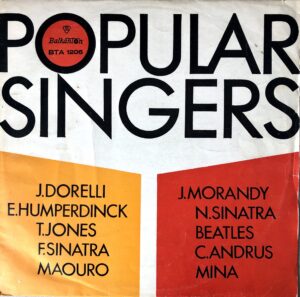
Popular Singers
The historic first LP with a Beatles song in the Eastern Bloc (under the communism regieme).
1972
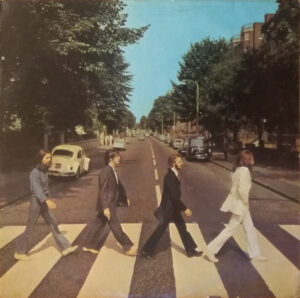
Abbey Road
The cover is imported from UK release with Apple Records logo and the old boxed Supraphon logo (used until 1972) and Gramofonový klub logo added in upper right corner with catalogue numbers. Track "Her Majesty" not listed on cover.
1974

A Collection of Beatles Oldies
W notatkach na okładce błędnie podano, że ostatni koncert zespołu The Beatles odbył się 29 sierpnia 1968 r., podczas gdy prawidłowo powinno być 1966 r.