Vinyl Nostalgia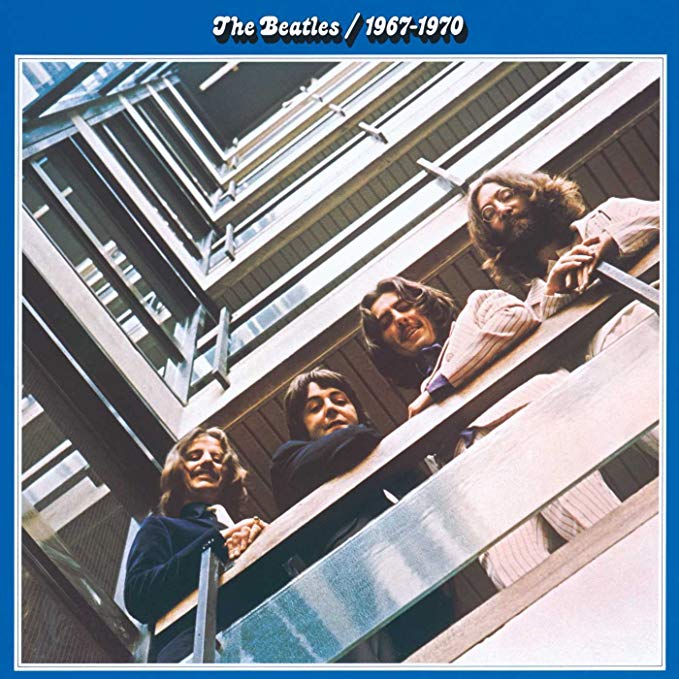
If I were to go to a desert island, I would definitely take the so called Blue Album with me. This double-LP set contains 28 hits spanning the Sgt. Pepper’s Lonely Hearts Club Band recording sessions, up to the band’s dissolution and the album Let It Be. This edition includes one song previously released only as a single – „Hey Jude,” and with it the most famous coda in the history of popular music (Na, na, na, na-na-na na…).
The Pirate Who Gives the Beatles an Idea
The story of the Blue Album begins, paradoxically, not in Abbey Road or in Apple’s offices, but on American television in 1972. A New Jersey company called Audio Tape Inc. released a four-LP boxed set titled The Beatles Alpha Omega — 120 Beatles tracks (plus a handful of solo compositions from the former Fab Four) sold by mail order, advertised on ABC stations and their local affiliates, mostly across the American Midwest. The price: $13.95 for four LPs. Cheap — shockingly cheap — because Audio Tape Inc. simply wasn’t paying any copyright royalties, despite the claim on the sleeve that „copyright royalties paid”.
The sets were a sonic curiosity. All tracks came from US Capitol pressings and the recordings had probably been dubbed from vinyl rather than pulled from master tapes. „Sgt. Pepper’s Lonely Hearts Club Band” faded out just before the introduction to „With a Little Help From My Friends”, which ended up on a completely different side. The running order was more or less alphabetical — until perhaps someone ran out of patience and started placing tracks in wherever they fit.
The case, of course, went to court, and a quiet settlement was supposedly reached, but Allen Klein—an Apple manager at that time—understood there was a market demand for a high-quality compilation of Beatles hits. And that’s why Apple came out with an idea of two double LPs: the Red Album and the Blue Album, with Klein taking decision on the track listing (apparently former band members had veto power).
Tracklist
| # | Track | Source album / single | Year | UK | US |
|---|---|---|---|---|---|
| A1 | „Strawberry Fields Forever” | Single (Parlophone R 5570) | 1967 | stereo | stereo (1966 mix) |
| A2 | „Penny Lane” | Single (Parlophone R 5570) | 1967 | stereo | mono |
| A3 | „Sgt. Pepper’s Lonely Hearts Club Band” | Sgt. Pepper’s Lonely Hearts Club Band | 1967 | stereo | stereo |
| A4 | „With A Little Help From My Friends” | Sgt. Pepper’s Lonely Hearts Club Band | 1967 | stereo | stereo |
| A5 | „Lucy In The Sky With Diamonds” | Sgt. Pepper’s Lonely Hearts Club Band | 1967 | stereo | stereo |
| A6 | „A Day In The Life” | Sgt. Pepper’s Lonely Hearts Club Band | 1967 | stereo (crowd-noise fade-in) | stereo (different fade-in) |
| A7 | „All You Need Is Love” | Single (Parlophone R 5620) / Magical Mystery Tour (US) | 1967 | stereo | stereo |
| B1 | „I Am The Walrus” | B-side of „Hello, Goodbye” / Magical Mystery Tour EP & LP | 1967 | stereo (6-beat intro) | stereo (4-beat intro) |
| B2 | „Hello, Goodbye” | Single (Parlophone R 5655) | 1967 | stereo | mono |
| B3 | „The Fool On The Hill” | Magical Mystery Tour EP & LP | 1967 | stereo | stereo |
| B4 | „Magical Mystery Tour” | Magical Mystery Tour EP & LP | 1967 | stereo | stereo |
| B5 | „Lady Madonna” | Single (Parlophone R 5675) | 1968 | stereo | stereo |
| B6 | „Hey Jude” | Single (Apple R 5722) | 1968 | stereo (shortened ~9 sec.) | stereo (shortened ~9 sec.) |
| B7 | „Revolution” | B-side of „Hey Jude” (Apple R 5722) | 1968 | stereo | stereo |
| C1 | „Back In The U.S.S.R.” | The Beatles (White Album) | 1968 | stereo | stereo |
| C2 | „While My Guitar Gently Weeps” Harrison | The Beatles (White Album) | 1968 | stereo | stereo |
| C3 | „Ob-La-Di, Ob-La-Da” | The Beatles (White Album) | 1968 | stereo | stereo |
| C4 | „Get Back” | Single (Apple R 5777), single version | 1969 | stereo (single version) | stereo (single version, insert sheet erroneously lists as album version) |
| C5 | „Don’t Let Me Down” | B-side of „Get Back” (Apple R 5777) | 1969 | stereo | stereo |
| C6 | „The Ballad Of John And Yoko” | Single (Apple R 5786) | 1969 | stereo | stereo |
| C7 | „Old Brown Shoe” Harrison | B-side of „The Ballad Of John And Yoko” (Apple R 5786) | 1969 | stereo | stereo |
| D1 | „Here Comes The Sun” Harrison | Abbey Road | 1969 | stereo | stereo |
| D2 | „Come Together” | Abbey Road | 1969 | stereo | stereo |
| D3 | „Something” Harrison | Abbey Road / single (Apple R 5814) | 1969 | stereo | stereo |
| D4 | „Octopus’s Garden” Starr | Abbey Road | 1969 | stereo | stereo |
| D5 | „Let It Be” | Single (Apple R 5833), single version | 1970 | stereo (single version) | stereo (single version) |
| D6 | „Across The Universe” | Let It Be (Phil Spector production) | 1970 | stereo | stereo |
| D7 | „The Long And Winding Road” | Let It Be (Phil Spector production) | 1970 | stereo | stereo |
|
Mono vs. stereo and UK / US differences summary: UK edition (PCSP 718, 1973): all 28 tracks in stereo. „I Am The Walrus” in the standard version with a 6-beat electric piano intro. US edition (Capitol SKBO-3404, 1973): 2 tracks in mono („Penny Lane”, „Hello, Goodbye”), rest in stereo. „I Am The Walrus” in a unique version with a 4-beat intro. „Strawberry Fields Forever” in its original 1966 stereo mix. The US insert sheet erroneously lists „Get Back” as the album version when it is in fact the single version, identical to the UK pressing. Edits and fades: „Hey Jude” was shortened by about 9 seconds from the original single on both vinyl editions (full length restored on the 1993 CD). „A Day In The Life” fades in over the preceding crowd noise, with different fade points on UK and US vinyl (the 1993 CD used the clean version from the Imagine: John Lennon soundtrack, 1988). Authorship trivia: the Blue Album includes compositions beyond the Lennon-McCartney duo: three Harrison songs („While My Guitar Gently Weeps”, „Here Comes The Sun”, „Something”) and one Starr song („Octopus’s Garden”). „Across The Universe” and „The Long And Winding Road” carry Phil Spector’s production credit (McCartney and George Martin never approved Spector’s production, which led to the Let It Be… Naked release in 2003). Spanish variant: on the Spanish pressing, „The Ballad Of John And Yoko” was replaced with „One After 909″, because the 1969 single had been banned from Spanish airwaves for referencing „Christ” and „Gibraltar” in the lyrics. 2023 expansion: the 50th Anniversary edition added 9 tracks: „Within You Without You”, „Dear Prudence”, „Glass Onion”, „Blackbird”, „Hey Bulldog”, „Oh! Darling”, „I Want You (She’s So Heavy)”, „I Me Mine” and „Now And Then” (the last Beatles song, completed in 2023 from a 1970s Lennon demo). |
|||||
Release date: April 2, 1973 (US), April 19 (UK)
The Blue Album was released in the US on April 2, 1973, and two weeks later in the UK. The album came out together with the Red Album, which contains hits from the earlier source of The Beatles’ career, but it was the Blue Album that climbed to number one on the US Billboard Top 200 albums chart on May 26th pushing Led Zeppelin’s Houses Of The Holy to second place. By the end of 1973 US sales had hit 1.3 million copies; by the end of the decade — 5.85 million. Today, according to ChartMasters estimates, the Blue Album has sold around 24.3 million copies worldwide — making it one of the three best-selling Beatles compilations (alongside 1 and the Red Album).
 >
>
The First UK Pressing — What to Look For
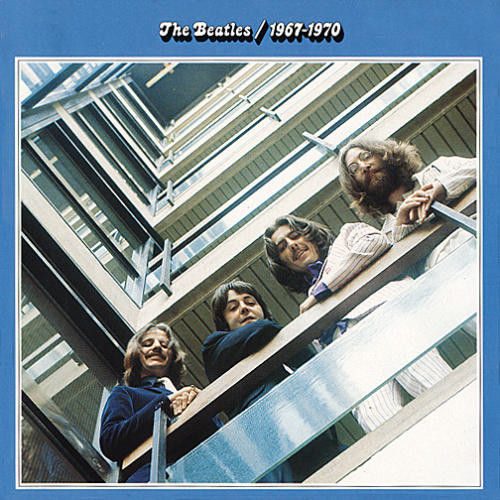
As befits true collectors, we are of course interested in the first British edition and it is relatively easy to obtain it in Poland and across Europe. I bought my copy quite by accident, ordering a few other records from Allegro (Polish auction site like eBay), and to add on something else I just asked for The Beatles 1967-1970. As it turned out, I got the first pressing. The cover of this album is similar to The Beatles 1962-1966 (Red Album, differing only in color.

The gatefold sleeve — with its distinctive blue border, carrying the 1969 EMI House photograph on the front and the additional frame from the same session on the back. The inner paper sleeves were colour-matched to the blue border of the cover and carried the printed lyrics — something of a novelty for first-pressing buyers, since none of the original Beatles albums had come with a full set of lyrics on the inner sleeves. Covers were manufactured by Garrod & Lofthouse Ltd., as on most UK pressings of the era.
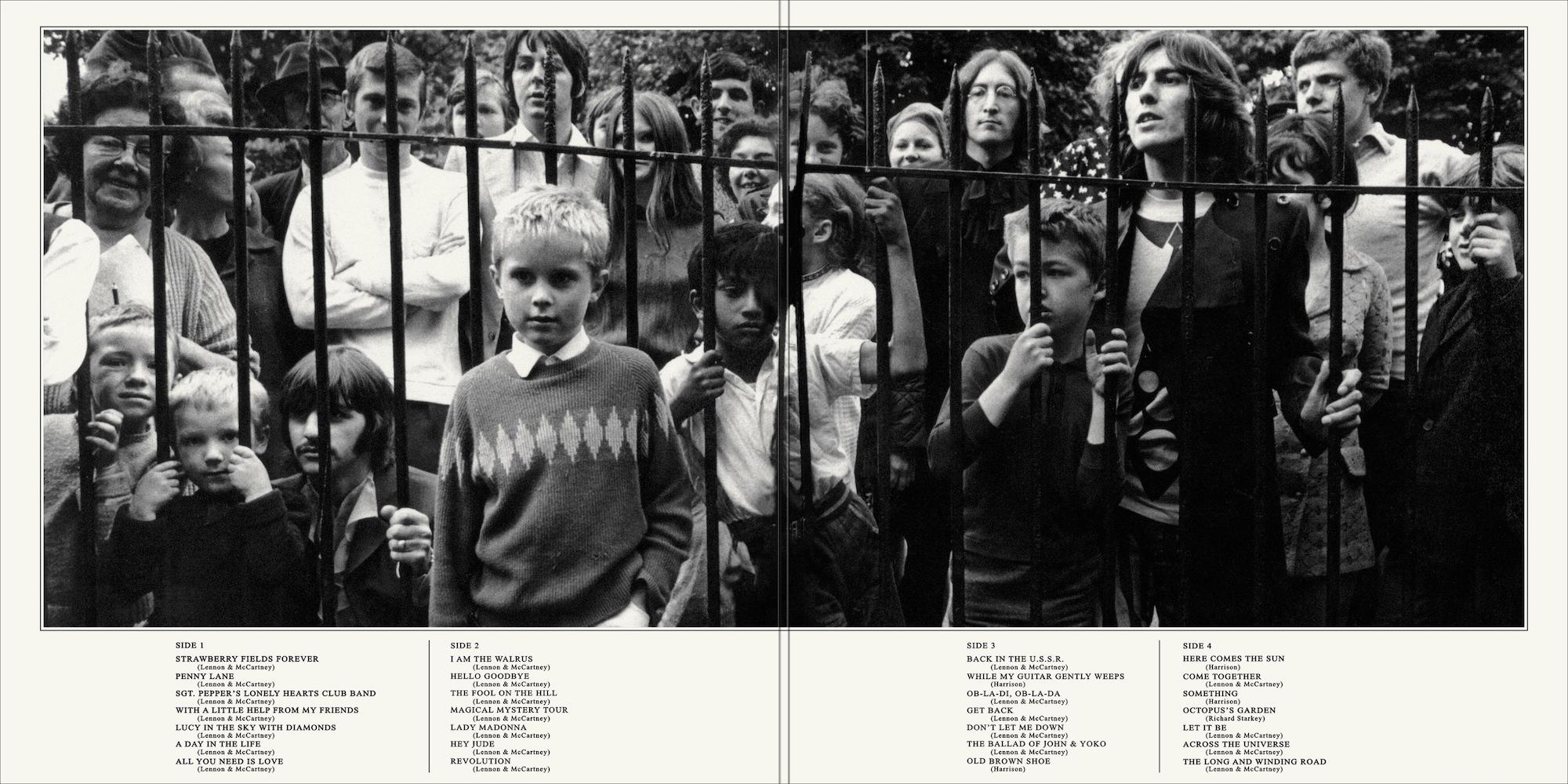
A collector’s note: 1967-1970 officially carries the catalogue number PCSP 718 for the complete set, but the two individual LPs also have their own sub-numbers — PCS 7181 for the first disc and PCS 7182 for the second. This kind of catalogue numbering was typical of Parlophone in the 1970s.
Also, on the inside pages of the first UK edition of this album, George Martin and Phil Spector were not listed as producers. This error was later corrected and on the covers of subsequent pressings, on the right side, next to the titles „Across The Universe” and „The Long And Winding Road”, there is a note: „All titles produced by George Martin with the exception of 'Across The Universe’ and 'The Long And Winding Road’ which were produced by Phil Spector.” If this text is missing, it means that we are dealing with the first original edition.
The first British pressing (20 April 1973) is identifiable by a handful of distinct features. Matte labels — not glossy, and that’s crucial — in a dark blue colour, with the characteristic Apple graphic: whole Apple on sides one and three, sliced Apple on sides two and four. The rim text reads: „Mfd. in U.K.”, „An Apple Record”, „An EMI Recording”, and „The Gramophone Company Limited”.
First-pressing matrix numbers:
YEX 909-1 (side 1)
YEX 910-1 (side 2)
YEX 911-1 (side 3)
YEX 912-1 (side 4)
Crossover combinations also exist within the first pressing — -1/-3/-3/-1 and -2/-2/-2/-1 — which TheBeatles-Collection still classifies as first-pressing copies.
Later Pressings and Collector Nuances
On 20 December 1978 the second pressing appeared — with glossy labels instead of matte, in a laminated Garrod & Lofthouse sleeve carrying George Martin’s production credit printed inside the gatefold. On the same day, EMI issued a limited edition on blue vinyl (Apple PCSPB 718) — one of the first Beatles releases on coloured vinyl altogether, alongside the Red Album on red. Copies with the round front-cover sticker reading „Limited Edition Blue Vinyl” fetch £25 (approx. 33 USD)-40 at auction today.
In 1993 — alongside the CD debut — another remastered blue vinyl edition appeared under a new catalogue number, PCSPP 718 (digital master, limited to 20,000 copies, sold with a blue Beatles poster). And in November 2014 came the 180-gram reissue from Germany’s Optimal Media GmbH, prepared from the original UK 1973 compilation master.
Polish and East Germany
For the readers highly interested in the „Behind the Iron Curtain” section, it’s worth noting: 1967-1970 was never officially released in the Poland — it reached Polish listeners either as UK copies smuggled in from the West or as East German pressings. In 1980, East Germany’s Amiga released a single-LP version of 1967-1970 (catalogue 8 55 742) — fourteen tracks selected mostly from the first LP of the original double set. The sleeve was simplified, with no gatefold. For the Eastern Bloc collector it’s today one of the more interesting items in the Amiga catalogue. You can read more about it in this article.
Deluxe 2023 and the Circle Closed
For the record: on 10 November 2023, fifty years after the original release, Apple issued an expanded version of both compilations (remastered mixes, with six tracks from 1967-1970 receiving completely new stereo mixes — „I Am the Walrus”, „The Fool on the Hill”, „Magical Mystery Tour”, „Revolution”, „Hey Bulldog”, and „Old Brown Shoe”), along with the first appearance of „Now and Then” — the track completed using AI separation technology, and the final official Beatles single. The vinyl edition preserves the original two-LP layout from 1973, with the additional tracks placed on a third LP. The deluxe edition carries a different catalogue number from PCSP 718, but the spirit of the release is the same — because one way or another, fifty-one years ago, first the pirates wanted to cash in, then the Beatles responded with something better, and then the combined effect landed on millions of record shelves around the world.
| Pressing | Year / Cat. No. | Matrices | Identifying Features | Market Value |
|---|---|---|---|---|
|
1st pressing
matte Apple labels
stereo |
20 April 1973 Apple PCSP 718 (PCS 7181 / PCS 7182) |
YEX 909-1 (side 1)
YEX 910-1 (side 2)
YEX 911-1 (side 3)
YEX 912-1 (side 4)
First-pressing crossovers: |
Matte Apple labels on a dark blue background Rim text: „Mfd. in U.K.”, „An Apple Record”, „An EMI Recording”, „The Gramophone Company Limited” Laminated Garrod & Lofthouse gatefold sleeve No George Martin production credits inside the gatefold Dark blue die-cut inner sleeves with three cut corners, printed with lyrics |
£80 (approx. 106 USD)–120 NM £50 (approx. 66 USD)–70 EX £25 (approx. 33 USD)–35 VG |
|
2nd pressing
glossy labels
stereo |
20 December 1978 Apple / EMI PCSP 718 |
Most common combinations:
-4/-3/-2/-1
-4/-3/-3/-1
-3/-3/-2/-1
-5/-5/-2/-3
-6/-5/-2/-3
|
Glossy Apple labels Laminated Garrod & Lofthouse sleeve George Martin production credit inside the gatefold Blue die-cut inner sleeves with four rounded corners |
£25 (approx. 33 USD)–40 NM £15 (approx. 20 USD)–25 EX |
|
2nd pressing — blue vinyl
limited edition |
1978 Apple PCSPB 718 |
Matrices as in the 2nd black pressing |
Blue vinyl (limited coloured edition) Round sticker on front cover: „Limited Edition Blue Vinyl” Without the sticker, value drops significantly German pressing (EMI Electrola) also exists as 1C 172-05 309/310 |
£30 (approx. 40 USD)–50 NM with sticker £15 (approx. 20 USD)–20 without sticker |
|
3rd pressing
stereo |
1980–1983 Apple / EMI PCSP 718 |
Matrix combinations:
-6/-5/-5/-3
-6/-6/-2/-3
-7/-6/-3/-3
-9/-7/-7/-6
|
Unlaminated Garrod & Lofthouse sleeve George Martin credits inside Labels as in the 2nd pressing Blue inner sleeves with no cut corners |
£15 (approx. 20 USD)–25 NM £8 (approx. 11 USD)–15 EX |
|
4th pressing
green apple
stereo |
1983–1987 Apple / EMI PCSP 718 |
YEX 909-9-1-2
YEX 910-7-1-2
YEX 911-7
YEX 912-6-1-3
|
Apple label on a dark green background Rim text at the 5 o’clock position: „UNAUTHORISED COPYING, HIRING, RENTING, PUBLIC PERFORMANCE AND BROADCASTING” Unlaminated sleeve with barcode „Sleeve printed in England Manufactured in England” text |
£10 (approx. 13 USD)–18 NM £5 (approx. 7 USD)–10 EX |
|
5th pressing — 1993 blue vinyl
remaster |
14 February 1994 Apple PCSPP 718 (0777 7 97039 0) |
PCSPP 7181 A-01-01-1
PCSPP 7181 B-2-01-1
PCSPP 7182 A-01-01-1
7182 B-01-01-1
|
Blue vinyl, digitally remastered edition Limited run: 20,000 copies Unlaminated sleeve with round black-and-white sticker Blue inner sleeves + Beatles poster included |
£40 (approx. 53 USD)–60 NM £20 (approx. 26 USD)–30 EX rising |
|
6th pressing — 2014 reissue
180g |
21 November 2014 Apple 0602547048448 |
11140 1A…
11140 1B…
11140 2C…
11140 1D…
|
180g vinyl, pressed by Optimal Media GmbH (Germany) Cut from the original UK 1973 compilation master Facsimile Garrod & Lofthouse sleeve Liner notes insert |
£30 (approx. 40 USD)–45 (secondary market) |
|
7th pressing — 50th Anniversary Deluxe
2023 / 3LP |
10 November 2023 Apple 0602455920805 |
Half-speed master, Abbey Road, Room 30 Engineer: Miles Showell Sides A–F: BN96948–BN96950 |
3 LP, 38 tracks (original 28 + 12 added) Six new 2023 stereo mixes: „I Am the Walrus”, „The Fool on the Hill”, „Magical Mystery Tour”, „Revolution”, „Hey Bulldog”, „Old Brown Shoe” First appearance of „Now and Then” — the final Beatles single Available on black and blue vinyl Sleeve notes by John Harris |
£50 (approx. 66 USD)–80 (blue edition) £40 (approx. 53 USD)–60 (black edition) |
|
Quick first-pressing check (20 April 1973): matte, not glossy Apple labels · dark blue label background · rim text „Mfd. in U.K. / An Apple Record / An EMI Recording / The Gramophone Company Limited” · matrices YEX 909-1/910-1/911-1/912-1 (or early crossovers -1/-3/-3/-1 and -2/-2/-2/-1) · no George Martin credits inside the gatefold · laminated Garrod & Lofthouse sleeve · dark blue die-cut inner sleeves with three cut corners, printed with lyrics · PCSP 718 as the set catalogue number, with PCS 7181 and PCS 7182 as individual disc numbers A note on the colour: legend has it that the Red and Blue Album covers echo the colours of Liverpool’s two football clubs — Liverpool FC (red) and Everton FC (blue). TheBeatles-Collection treats this as fact; Radio X calls it „legend has it” — but the story is too well-woven into Beatles lore to be missing from any serious collector’s piece. |
||||