
 Vinyl Nostalgia
Magical Mystery Tour is a unique case in the Beatles’ catalogue. The only title that first appeared in the UK in 1967 as a double EP, came out in the US simultaneously as a full LP with five additional tracks, and was then issued on LP by EMI in the UK nine years later. And to make things more interesting, when that finally happened, EMI compiled their long-playing version from Capitol tapes rather than their own. As a result, today’s British collector faces three different editions of the same music, each with its own faults and virtues. Bez vodki ne razberyosh.
Origins, or McCartney and the coach from Liverpool
The idea for Magical Mystery Tour came to McCartney in April 1967, before the Beatles had finished work on Sgt. Pepper’s. Paul wanted to make a film combining the atmosphere of Liverpool-to-Blackpool coach trips (the so-called „mystery tours” popular in the 1950s and 1960s, where passengers did not know where they were going until they arrived) with a heavy dose of American psychedelia. The film was to be shot live without any script at all. A group of ordinary people travel by coach, and „magicians” (played by the Beatles and Mal Evans) cause „magical things” to happen along the way. Lennon, sceptical at first, eventually came round to the idea:
If stage shows were to be out, we wanted something to replace them. Television was the obvious answer.
The Beatles recorded the title track between 25 April and 3 May 1967 at Abbey Road, but the project stalled following the death of Brian Epstein. McCartney took over the initiative and had filming under way by 11 September 1967 in Newquay, continuing until 24 September at West Malling RAF Station in Kent. Editing, which was supposed to take a week, ended up taking eleven. During that time, four new songs emerged: „The Fool On The Hill” (McCartney), „I Am The Walrus” (Lennon), „Your Mother Should Know” (McCartney) and „Blue Jay Way” (Harrison), plus the instrumental „Flying” (the first Beatles song ever credited to the whole group).
A magical mini album
The Beatles had only six songs ready, and at the time British long-playing records typically held fourteen. The single „Hello, Goodbye / I Am The Walrus” had already come out on 24 November 1967, which left five tracks plus the title song „Magical Mystery Tour”. The solution to this problem was unconventional: to issue a double EP with a booklet and colour photographs.
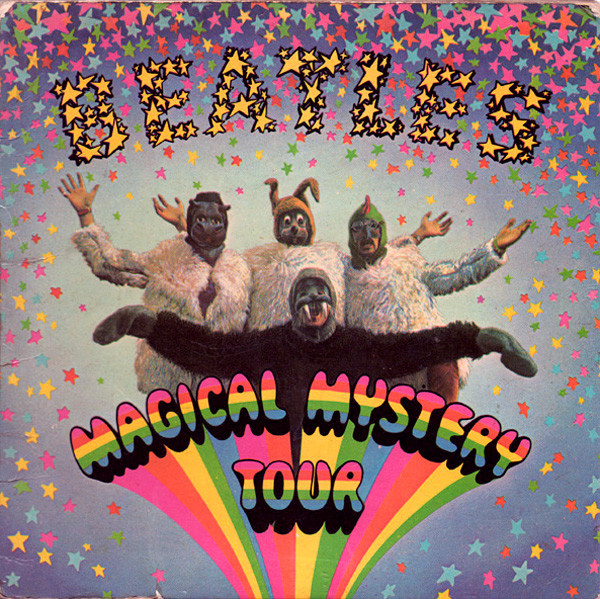
The mini album came with a reasonable price tag: 19 shillings and sixpence, close to a full pound, essentially the cost of two ordinary singles. It was also the first British Beatles EP issued in both mono and stereo (MMT-1 mono, SMMT-1 stereo). Earlier EPs had appeared in mono only. And crucially for the collector, the UK EP carries true mono and stereo mixes from 1967, cut at Abbey Road from the original multitrack tapes.
The American solution
Capitol Records, EMI’s American arm, decided a double EP would not sell on the US market. The band’s two previous American EPs (Four By The Beatles 1964 and 4 By The Beatles 1965) had been total commercial failures. For that reason Capitol decided to issue a full album, adding five 1967 singles that had not yet appeared on any album. This is how the American version of Magical Mystery Tour came about, featuring all the film tracks plus „Hello, Goodbye”, „Strawberry Fields Forever”, „Penny Lane”, „Baby, You’re A Rich Man” and „All You Need Is Love”. The record received catalogue numbers MAL-2835 (mono) and SMAL-2835 (stereo) and was released on… 27 November 1967, a week before the British EP.
The commercial result was staggering. The album hit number one on the Billboard chart, stayed there for eight weeks, and spent a total of 82 weeks on the listings (over a year and a half). Within three weeks of release Capitol had netted $8 million from the record (source: TheBeatles-Collection), a record figure at the time. The Beatles were admittedly unhappy watching Capitol assemble an album of their own from singles, but the market decided it was a great idea. In May 1968, at an Apple Corps press conference in New York, Lennon summed it up:
It’s not an album, you see. It turned into an album over here, but it was just [meant to be] the music from the film.
| # | Track | Author | Time | UK EP 1967 | US LP 1967 |
|---|---|---|---|---|---|
| A1 | „Magical Mystery Tour” | Lennon-McCartney (mostly McCartney) | 2:51 | mono / stereo | mono / stereo |
| A2 | „The Fool On The Hill” | Lennon-McCartney (mostly McCartney) | 3:00 | mono / stereo | mono / stereo |
| A3 | „Flying” instrumental | Lennon-McCartney-Harrison-Starkey | 2:16 | mono / stereo | mono / stereo |
| B1 | „Blue Jay Way” Harrison | George Harrison | 3:51 | mono / stereo | mono / stereo |
| B2 | „Your Mother Should Know” | Lennon-McCartney (mostly McCartney) | 2:33 | mono / stereo | mono / stereo |
| B3 | „I Am The Walrus” | Lennon-McCartney (mostly Lennon) | 4:35 | mono / stereo | mono / stereo |
| B4 (US) | „Hello, Goodbye” | Lennon-McCartney (mostly McCartney) | 3:27 | not included | mono / stereo |
| B5 (US) | „Strawberry Fields Forever” | Lennon-McCartney (mostly Lennon) | 4:07 | not included | stereo (new 1967 mix with greater separation) |
| B6 (US) | „Penny Lane” | Lennon-McCartney (mostly McCartney) | 3:00 | not included | mono / duophonic (fake stereo) |
| B7 (US) | „Baby, You’re A Rich Man” | Lennon-McCartney | 3:03 | not included | mono / duophonic (fake stereo) |
| B8 (US) | „All You Need Is Love” | Lennon-McCartney (mostly Lennon) | 3:48 | not included | mono / duophonic (fake stereo) |
|
Format differences summary: UK EP 1967 (Parlophone MMT-1 / SMMT-1): 6 film soundtrack tracks, 2x 7″, true mono and stereo mixes from Abbey Road 1967 cut from original multitrack tapes. Six tracks, no duophonic anywhere. US LP 1967 (Capitol MAL-2835 / SMAL-2835): 11 tracks (6 from the EP plus 5 1967 singles). Key flaw: three LP stereo tracks („Penny Lane”, „Baby, You’re A Rich Man”, „All You Need Is Love”) in duophonic (fake stereo). „Strawberry Fields Forever” in a new stereo mix with greater channel separation. Only „Hello, Goodbye” among the five additional tracks had a natural stereo mix. UK LP 1976 (Parlophone PCTC 255): same tracklist as the US LP, but using fourth-generation Capitol masters rather than the EMI originals. Technically sounds worse than the UK EP and the 1971 German Hör Zu. West Germany 1971 (Hör Zu SHZE 327): the first ever full-stereo LP in the world, all 11 tracks with true stereo mixes (thanks to the 1968 and 1971 Abbey Road mixes for the three singles). Compositional trivia: Quotations: |
|||||
Fake stereo
In the shadow of this great success there was, however, a snag. Capitol used the original EP tapes (for the six film tracks) and, separately, the singles tapes. And here American engineers hit a serious problem. The singles „Penny Lane” (February 1967), „Baby, You’re A Rich Man” (July 1967) and „All You Need Is Love” (July 1967) had no original stereo mixes, only mono. Capitol reached for their favourite fix: they produced duophonic (fake stereo), electronically generated from the mono mix. The same process they had applied to Revolver, Yellow Submarine (side A), the Red Album and many other releases. The upshot was that on the American stereo edition those three crucial tracks sound artificial, with the signal split electronically, far from what real stereo ought to be. Only for „Strawberry Fields Forever” was a new, true stereo mix prepared, with greater channel separation.
Hör Zu 1971
In 1968 and 1971, George Martin and EMI’s engineers went back to the multitrack tapes of those three songs and produced true stereo mixes. Which meant that in 1971 the West German label Hör Zu issued the first ever full-stereo Magical Mystery Tour (catalogue SHZE 327). Today this is quite a collector’s find. The original 1971 German Hör Zu pressing sounds fundamentally different (and better) than the 1967 American edition, because it carries true stereo on those three tracks.
PCTC 255, or how EMI fumbled it
For nine years, British Beatles fans who wanted Magical Mystery Tour on LP had to import the American Capitol SMAL-2835. In 1976 EMI finally decided to issue the British album officially, and it appeared on 19 November 1976 under the catalogue number Parlophone PCTC 255. It was intended to be a triumphant return to British shops. It was not.
Rather than compiling the record from their own masters (which held the original multitrack tapes and the true 1968 and 1971 stereo mixes), EMI for some reason decided to take a shortcut. They contacted Capitol and asked for their master tapes, which were fourth-generation copies of the same material. First, the original stereo mix prepared for the British EP had been copied for Capitol. Then those mixes had been redubbed to Capitol’s audio standards along with fake-stereo mixes for side B, and those same tapes had been duplicated and shipped back to EMI, who filed them in their tape vaults as „stereo masters”. In short: the album issued in the UK in 1976 sounds worse than the original 1967 UK EP, and worse than the 1971 West German Hör Zu. It is one of the strangest cases of audio archive mismanagement in the entire Beatles story, fully confirmed by reliable sources (About The Beatles and Graham Calkin’s Beatles Pages, among others).
On top of all that, the TC-PCS 3077 cassette from the same year of 1976 (an odd catalogue number, completely different from the LP’s PCTC 255) carried a true stereo mix of „Baby, You’re A Rich Man”, even though that stereo version was not present on the British LP, plus a different version of „All You Need Is Love”. Why did EMI put the better mixes on cassette rather than on vinyl???
How to identify a first UK EP pressing from 1967
A first pressing of Parlophone MMT-1 mono (or SMMT-1 stereo) can be identified by the following features:
Matrix numbers in the dead wax: MMT A-1, MMT B-1 for mono; SMMT A-1, SMMT B-1 for stereo.
Push-out centre (a square cut-out / pushable centre).
Label rim text beginning with „The Gramophone Co. Ltd.” (the first words of the perimeter printing).
The clause „Sold In U.K. subject to resale price conditions, see price lists” inside the centre cut-out. On later pressings (1970-72) this clause disappears.
Tax code „KT” on the label of side 1 or side 3 (on one of the discs).
Laminated gatefold sleeve with flipback flaps inside, printed by Garrod & Lofthouse Ltd (with the printer credit on the lower flap inside the gatefold).
28-page booklet with lyrics, John Kelly’s filming stills, colour comic-strip illustrations by Bob Gibson, and a blue lyric sheet in the middle (the second pressing has a yellow one).
The second pressing (early 1970s) differs mainly in the absence of the „Sold In U.K.” clause on the labels.
Identifying the PCTC 255 from 1976
First pressing
A first pressing of Parlophone PCTC 255 can be identified by the following features:
Matrix numbers in the dead wax: YEX 959-1 / YEX 960-1 with HTM initials (Harry Moss mastering) hand-stamped on both sides. Stamper codes: 3/OA and 2/AP (confirmed by Parlogram).
Black label with two white-black EMI logos and silver print, „The EMI Records Ltd” as the first words of the rim text, „Made In GT. Britain” at the end.
Matt gatefold without barcode (the barcode appears on the fourth pressing from 1987-1991).
24-page colour booklet with lyrics and photographs (not like the US edition, which also had 24 pages, but the British one is redone with larger photographs and illustrations).
White paper EMI inner sleeve.
No flipback flaps (in contrast to the original EP gatefold, which had them).
Second pressing (October 1980 to April 1984)
The second pressing can be identified by the text „ALL RIGHTS OF THE PRODUCER” in the rim (running around the outer edge of the label), matrices YEX 959-1 / YEX 960-1, plus the text „MANUFACTURED IN THE UK BY EMI RECORDS LIMITED” added at the end of the rim.
Behind the Iron Curtain: AnTrop MMT
The St. Petersburg pirate label AnTrop issued, in 1991-1992, a double LP set Волшебное таинственное путешествие / Жёлтая субмарина (Magical Mystery Tour / Yellow Submarine), catalogue П91 00135-8 or ATR 30001-04. Just as with Yellow Submarine, the audio was copied from a Western CD from 1987. The difference: on this release, Bob Gibson’s comic strip was fully translated into Russian by Nikolai Kibalchich (smaller than the original, around 7 inches, but in keeping with the original style).
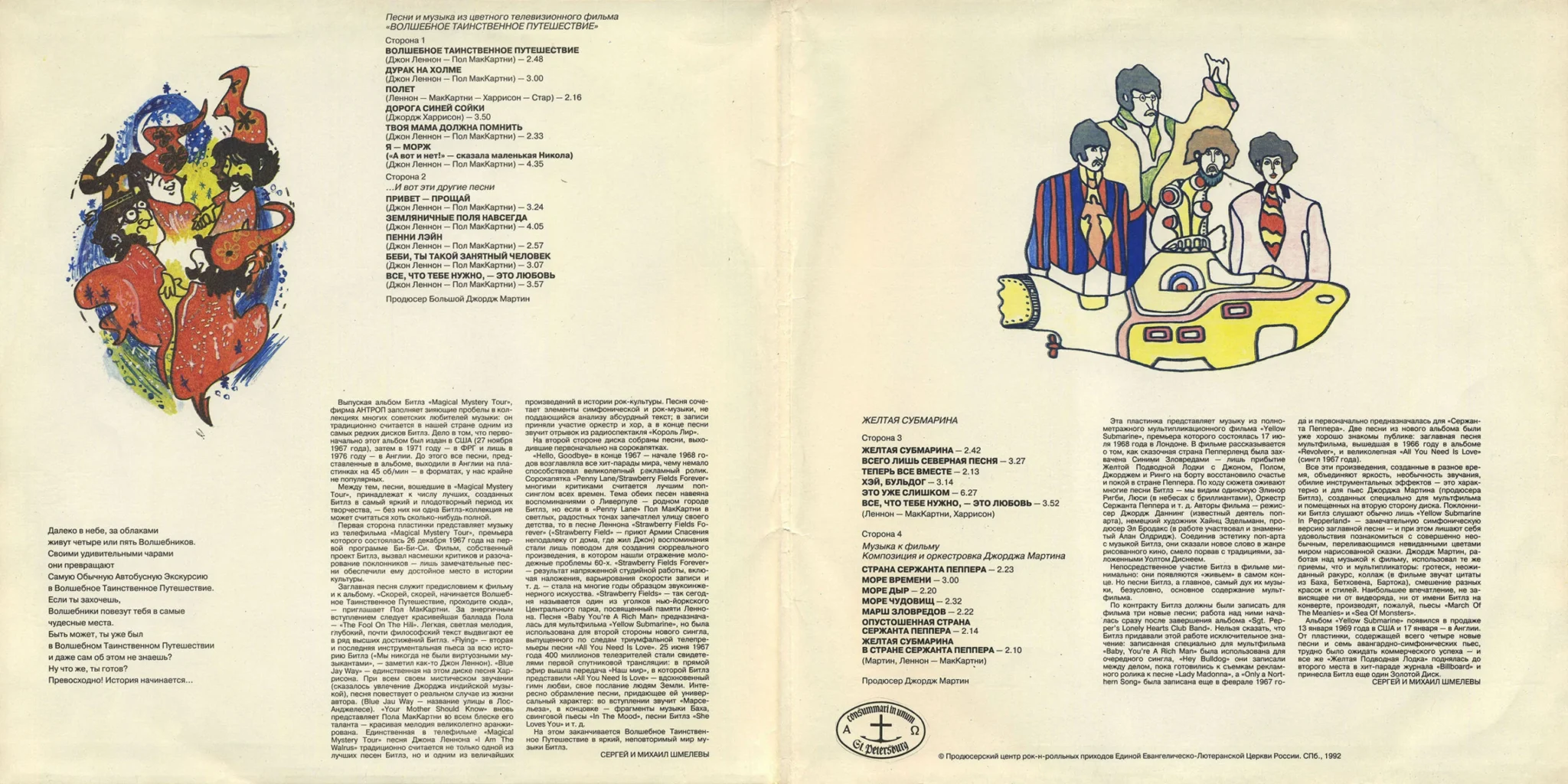
Track-name translations were sometimes loose: „Baby You’re A Rich Man” became „Baby, You’re Such an Interesting Person” (corrected to „Baby, You’re Such a Busy Person” on the 1994 standalone edition). The name „Wendy Winters” in the comic was rendered as „Wendy Wuaners”, although the text used the correct name almost everywhere. On page 4, panels 25 to 30 are printed out of order, and the comic contains quite a few minor typographic errors.
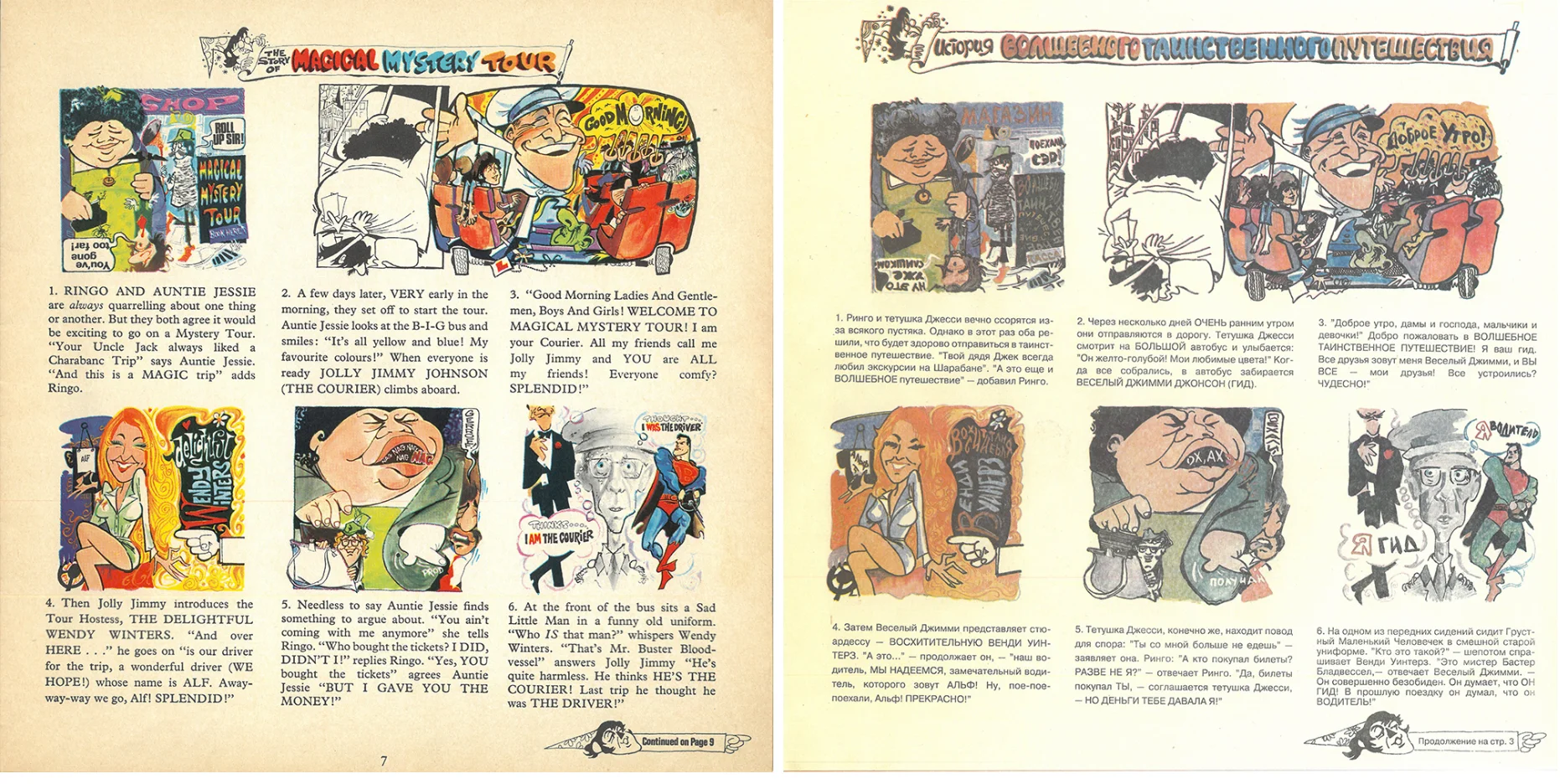
In 1994 AnTrop issued a standalone Magical Mystery Tour. The sleeve is simply a double-set gatefold cut in half, with a „STEREO” sticker and the correct catalogue number added in the upper-right corner. The vinyl was pressed at the former Melodiya plant in Riga, which after 1990 operated under the name RITONIS (Riga Tonis). Collectors identify hand-cut copies by the visible tape inside the gatefold (amateurs would cut their own double copies to sell them as standalones). Colour differences on the sleeve: genuine copies have rich, saturated tones and a bright lemon-yellow background.
Market values (2025-2026)
A British mini album EP (MMT-1 mono) first pressing complete with the 28-page booklet today runs at £120 to £200 (approx. 159 - 265 USD) for NM condition, or £60 to £100 (approx. 79 - 132 USD) for VG+. It is worth noting that the mono is more sought after today than the stereo. Parlogram, along with many collectors, largely agrees that the mono mixes have a fundamentally different character from the stereo.
Noticeable differences between the Mono & Stereo mixes of this EP have led to the Mono copies actually becoming more sought after these days than the Stereo – RareVinyl.com
A first pressing stereo EP (SMMT-1) complete runs at £100 to £180 (approx. 132 - 238 USD) for NM and £50 to £90 (approx. 66 - 119 USD) for VG+.
The American first-pressing mono with the rainbow label and 24-page booklet (MAL-2835) is very rare and highly sought after. No surprise then that in NM condition it costs $200 to $400. It was, after all, the last American Beatles release in mono, and the print runs were already relatively small. The stereo version of the album (SMAL-2835) can be found for $80 to $150 in NM condition. Two first-pressing variants dominate: Scranton (with „IAM” in a triangle) and LA (with „✲”), and both fetch similar prices.
For the obvious reasons discussed above, collectors are not rushing to snap up the 1976 British edition, and nobody is grabbing copies from anybody’s hands. A first pressing (matt gatefold, matrix numbers YEX 959-1 / YEX 960-1, engraved HTM, 24-page booklet, EMI inner sleeve) runs at £30 to £60 (approx. 40 - 79 USD) for NM. It is not an expensive record, and little wonder. One version of it does enjoy moderate interest: the yellow-vinyl export edition (PCTC 255) from 1978. Let us call it, informally, a rarity, though there is no need to spend a fortune on it. It costs £80 to £150 (approx. 106 - 199 USD) for NM condition if you can find one. It was aimed at foreign buyers and reportedly was not available in British shops. You have to look for it in other countries or on eBay.
The West German Hör Zu edition (SHZE 327, first pressing 1971) is probably the most valuable collector’s item in this set. Prices start at £100 (approx. 132 USD), but you should expect to pay closer to £200 (approx. 265 USD) for NM condition depending on the variant. It is worth knowing that three variants exist (1971, 1973, 1976-77); the first one from 1971 is the rarest and, consequently, the most expensive.
The AnTrop double LP (packaged with Yellow Submarine) from 1991-1992 costs $40 to $80, while the standalone (with just Magical Mystery Tour) from 1994 costs only slightly less, at $30 to $60. Prices are pushed up by the fact that selling this pirate release is hampered by bans on the major platforms (e.g. Discogs). On the whole it is just a curiosity from behind the Iron Curtain, but because it is hard to get, sellers can push the price up.
In my collection
Personally, I own the British mini album EP in the mono version (first pressing), though with a slightly worn booklet, and the Hör Zu SHZE 327 edition in the 1973 variant with matrices SHZE 327 A-1 and SHZE 327 B-3.
| Pressing | Date / cat. no. | Matrices | Key identifiers | Market value |
|---|---|---|---|---|
| 1st UK EP mono | 8 December 1967 Parlophone MMT-1 |
MMT A-1 MMT B-1 |
2x 7″ 45 rpm. Push-out centres (square removable) on the vast majority of copies; a rarer Solid Centre variant exists, classified by the Yoko Ono Collection as a fifth first-pressing variant. Rim text beginning with „The Gramophone Co. Ltd.”. „Sold In U.K. subject to resale price conditions, see price lists” clause. Tax code „KT” on side 1 or 3. Laminated gatefold with flipback flaps inside, printed by Garrod & Lofthouse Ltd. 28-page colour booklet with lyrics, John Kelly’s filming stills, Bob Gibson comic-strip illustrations. Blue lyric sheet. White paper inner sleeves without cutouts. | £120 to £200 (approx. 159 - 265 USD) NM complete £60 to £100 (approx. 79 - 132 USD) VG+ Mono more sought than stereo (mix differences) |
| 1st UK EP stereo | 8 December 1967 Parlophone SMMT-1 |
SMMT A-1 SMMT B-1 |
Identical to mono but with preceding „S” in cat. no. („SMMT” instead of „MMT”). C-2 labelled as „Flying (Instrumental)”. Blue lyric sheet. | £100 to £180 (approx. 132 - 238 USD) NM complete £50 to £90 (approx. 66 - 119 USD) VG+ |
| 2nd UK EP mono | early 1970s Parlophone MMT-1 |
MMT A-1 MMT B-1 |
Like the 1st pressing but without the „Sold In U.K.” clause on the label. Blue lyric sheet. Otherwise identical to the first pressing. | £40 to £80 (approx. 53 - 106 USD) NM £20 to £40 (approx. 26 - 53 USD) VG+ |
| 3rd UK EP | 1973 MMT-1 / SMMT-1 |
Standard | Per JPGR (Graham Calkin), adds boxed EMI logo on the label, no „Sold In U.K.” clause, yellow lyric sheet (instead of blue). Sleeve may have minor print variations. | £30 to £60 (approx. 40 - 79 USD) NM |
| US LP mono | 27 November 1967 Capitol MAL-2835 |
MAL-1-2835 / MAL-2-2835 (variants: „IAM” in triangle = Scranton, „✲” = Los Angeles) |
Very rare. The last American Beatles release in mono. Black label with rainbow colorband, no „A Subsidiary Of…” text, BMI credit after each track. Gatefold with stapled 24-page booklet. Gatefold „No you’re not” next to „I Am The Walrus” in plain font (not cursive). | $200 to $400 NM $80 to $150 VG+ RRPG 1999: $200 NM |
| US LP stereo | 27 November 1967 Capitol SMAL-2835 |
SMAL-1-2835 / SMAL-2-2835 press plant variants |
Black label with rainbow colorband, no „A Subsidiary Of…” text. Three side B tracks in duophonic (fake stereo): „Penny Lane”, „Baby, You’re A Rich Man”, „All You Need Is Love”. „Strawberry Fields Forever” in a new 1967 stereo mix. | $80 to $150 NM $40 to $80 VG+ RRPG 1999: $85 NM |
| US LP Apple | 1968 Apple SMAL-2835 |
SMAL-1-2835 / SMAL-2-2835 | Apple label with Capitol logo on top. Stereo only (mono discontinued). Content identical to the Capitol first-pressing stereo. | $40 to $80 NM RRPG 1999: $40 NM |
| West Germany Hör Zu unicorn | 1971 Hör Zu SHZE 327 |
SHZE 327 – A-1 / B-1 or B-3 | The first full-stereo LP ever. Three tracks („Penny Lane”, „Baby, You’re A Rich Man”, „All You Need Is Love”) in true stereo from the 1968 and 1971 Abbey Road mixes. Front cover carries a Hör Zu photo (replaced by the Apple logo on the later 1976 pressings). Three variants exist (1971 first, 1973 second, 1976-77 third with Apple logo). | £100 to £200 (approx. 132 - 265 USD) NM (first 1971) £60 to £120 (approx. 79 - 159 USD) NM (1976 with Apple) |
| 1st UK LP | 19 November 1976 Parlophone PCTC 255 |
YEX 959-1 YEX 960-1 HTM initials stamper codes 3/OA 2/AP |
Black label with two white-black EMI logos, silver print, „The EMI Records Ltd” at the start of the rim text, „Made In GT. Britain” at the end. Matt gatefold without barcode. 24-page colour booklet. White paper EMI inner. Note: uses fourth-generation Capitol masters, so technically sounds worse than the UK EP. | £30 to £60 (approx. 40 - 79 USD) NM Parlogram 2024-25: £35 (approx. 46 USD) regularly |
| UK yellow vinyl export scarce | 1978 Parlophone PCTC 255 |
YEX 959-PCTC 255 SIDE 1 YEX 960-PCTC 255 SIDE 2 HTM initials |
Limited edition yellow vinyl, stereo only. Not available in UK shops, pressed for export only. Black label with silver print, 2 EMI logos, „EMI RECORDS” and „GT. BRITAIN” rim print. Unlaminated Garrod & Lofthouse gatefold with 24-page booklet (printed in the USA, „Printed in the USA” on page 24). | £80 to £150 (approx. 106 - 199 USD) NM |
| 2nd UK LP | October 1980 to April 1984 PCTC 255 |
YEX 959-1 YEX 960-1 |
„ALL RIGHTS OF THE PRODUCER” at the start of the rim text. „MANUFACTURED IN THE UK BY EMI RECORDS LIMITED” added at the end of the rim text. | £15 to £25 (approx. 20 - 33 USD) NM |
| AnTrop USSR double behind the Iron Curtain | 1991-1992 П91 00135-8 / ATR 30001-04 |
N/A (bootleg) | Double LP set MMT + YS. Audio copied from the 1987 Western CD. Cover redrawn in Cyrillic by Nikolai Kibalchich (in keeping with the Peter Max style of the US LP). Bob Gibson’s comic strip translated into Russian (smaller, 7″), with typographic errors (panels 25-30 out of order, „Wendy Wuaners” instead of „Wendy Winters”). „Baby You’re A Rich Man” translated as „Baby, You’re Such an Interesting Person” (corrected on the 1994 single LP). Never legal, not even in Russia. | $40 to $80 on eBay Discogs has blocked sales |
| AnTrop standalone behind the Iron Curtain | 1994 П91 (standalone) |
N/A (Riga/RITONIS) | Standalone MMT pressed at the former Melodiya plant in Riga (after 1990 operating as RITONIS = Riga Tonis). The sleeve is a double-set gatefold cut in half, with a „STEREO” sticker and the correct catalogue number added. Hand-cut copies are identifiable by visible tape inside the gatefold. Genuine standalones have rich, saturated tones and a bright lemon-yellow background. More limited run than the double set. | $30 to $60 |
| 1987 CD | 22 September 1987 Parlophone CDP 7 48062 2 |
N/A (CD) | First official full-stereo 11-track version. The first case of the American configuration being adopted as the world standard (instead of the British EP format). From this point on, the 1987 standardisation of the Beatles catalogue locked in the US layout. | Secondary market: £3 to £6 (approx. 4 - 8 USD) |
| 1992 EP Collection CD box | June 1992 C2-15852 (US) / EMI/Odeon/Apple TOCP-7101-15 (Japan) |
N/A (CD) | Double CD of MMT: one disc mono, one disc stereo, all 6 tracks. Reproduction of the 28-page booklet. Part of the 15-disc box with all British Beatles EPs. | Complete box: £80 to £150 (approx. 106 - 199 USD) |
| 2009 remaster CD stereo | 9 September 2009 Apple 0946 3 82465 2 7 |
N/A (CD) | Part of The Beatles in Stereo box. Allan Rouse team at Abbey Road. Digipak with booklet. Label uses the original Capitol LP design (a nod to the American edition). | £5 to £10 (approx. 7 - 13 USD) new, £3 to £5 (approx. 4 - 7 USD) used |
| 2009 mono CD | 9 September 2009 Capitol MAL 2835 |
N/A (CD) | In The Beatles In Mono box. First official European reissue of the US mono version MAL-2835. Reproduction of the 24-page booklet (scaled for CD size). | Complete box: £200 to £350 (approx. 265 - 463 USD) |
| 2012 180g vinyl | 12 November 2012 Capitol-Apple 94638246510 |
Optimal Media matrices | Vinyl reissue of the 2009 stereo remaster. 180g, pressed by Optimal Media GmbH in Germany. Gatefold reproduced from the original US Capitol edition, 24-page booklet. US version, 11 tracks. | New: £30 to £45 (approx. 40 - 60 USD) Used NM: £20 to £30 (approx. 26 - 40 USD) |
| 2012 Deluxe MMT box | October 2012 Apple |
N/A (mixed media) | Multi-format box set: remastered double EP mono (facsimile gatefold and 24-page booklet with Parlophone labels), restored film on DVD and Blu-Ray, 52-page booklet with facsimiles of invoices, filming dates, actor mini-biographies and production photographs, replica MMT ticket. | Box: £40 to £80 (approx. 53 - 106 USD) new |
| 2014 mono 180g | 8 September 2014 Capitol-Apple 5099963380613 |
From US mono analogue tapes | US MAL-2835 mono version, officially issued in Europe on vinyl for the first time. Gatefold reproduced from the US original, 24-page booklet. Part of The Beatles In Mono LP box. | New: £45 to £60 (approx. 60 - 79 USD) Complete box: £350 to £500 (approx. 463 - 662 USD) |
|
Quick check, 1st UK EP 1967: 1. Matrices MMT A-1 / MMT B-1 (mono) or SMMT A-1 / SMMT B-1 (stereo). 2. Push-out centres (square removable) on the vast majority of copies. 3. „Sold In U.K. subject to resale price conditions, see price lists” clause on the label. 4. Rim text beginning with „The Gramophone Co. Ltd.”. 5. Tax code „KT” on side 1 or 3. 6. Laminated gatefold by Garrod & Lofthouse with flipback flaps inside. 7. Blue lyric sheet in the booklet centre (yellow on the 1973 third pressing). 8. White paper inner sleeves without cutouts. Quick check, 1st UK LP PCTC 255 1976: Source notes: Not included in this table: Canadian pressings (Capitol-EMI of Canada), Japanese (Apple AP-8610, then Odeon EAS-80569), Italian, French, Dutch, Israeli, New Zealand (an interesting „Magical Mystery Tour And Other Splendid Hits” variant with the last 4 tracks in mono), Mobile Fidelity MFSL 1-047 (1981 US audiophile), Mobile Fidelity UDCD-519 (1988 CD audiophile), Hör Zu SHZE 327 second pressing 1973 and third 1976-77. Additional trivia: |
||||

