Vinyl Nostalgia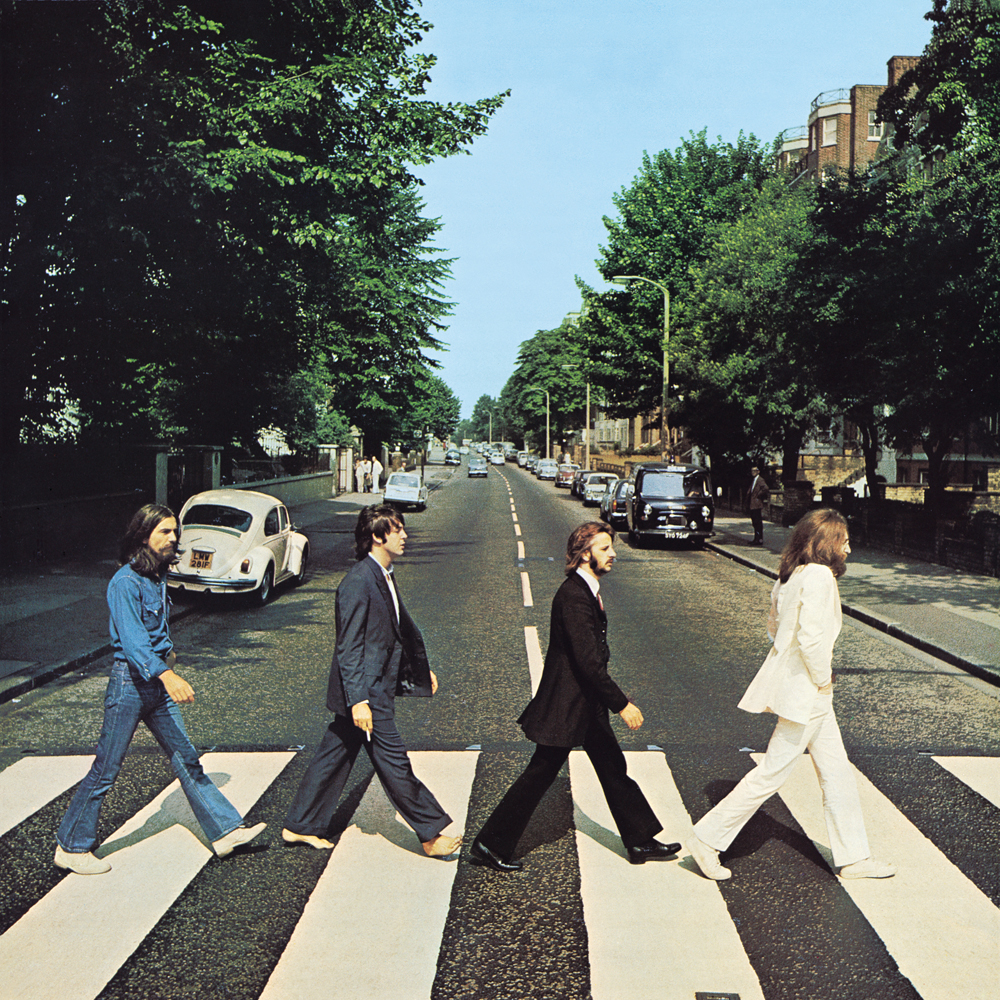
Abbey Road is the eleventh studio album by the Beatles, released on 26 September 1969 in the UK (catalogue number Apple PCS 7088) and on 1 October 1969 in the United States (SO-383, on Capitol). One point of clarification that every serious collector should have settled in their mind before buying: Abbey Road was the last album the Beatles recorded, but Let It Be (1970) was the last album they completed and released. McCartney put it simply: „Let It Be was actually the last release, but Abbey Road was the last recording.” The final day all four Beatles were in a studio together was 20 August 1969. After that, it was only a matter of months before Lennon privately told the others he was leaving.
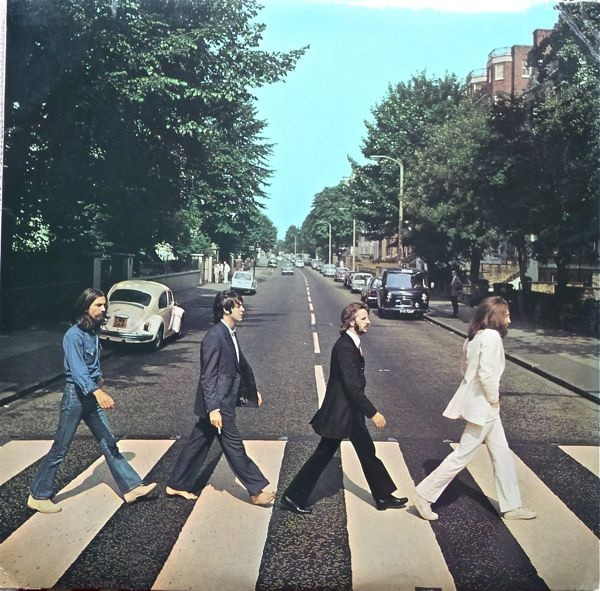
The cover photograph was taken by Iain Macmillan on the morning of 8 August 1969. A police officer held the traffic on Abbey Road for ten minutes while six frames were shot. The finished sleeve carries neither the band’s name nor the album title — an unprecedented decision at the time, and one that has dated not at all.
What to Check: Matrices and Label Together
Identifying a genuine first pressing of Abbey Road requires examining both the runout matrix and the label. Neither alone is sufficient — and this is where many buyers go wrong.
The majority of first and second pressings share the same matrix codes: Side 1: YEX 749-2; Side 2: YEX 750-1. There is also a rare variant with YEX 749-3U on Side 1 paired with YEX 750-1 on Side 2 — some sources treat this as a second pressing variant, others as a small run from the original 1969 release. The critical caveat: the third pressing (late 1970) carries the same YEX 749-2 / YEX 750-1 codes as the first and second. Matrices alone will not distinguish them. Later pressings eventually move to YEX 749-3, 749-4 and YEX 750-2, 750-2U, 750-3 — but not until the fourth pressing and beyond.
The Label: „Her Majesty” and the 33⅓ Position
The most important identifier on the first pressing is what is absent from the Side 2 label: no credit for „(Her Majesty)”. The 23-second track appears on the vinyl — separated from „The End” by approximately twenty seconds of silence — but is not listed anywhere. The second pressing and all subsequent editions add it to the label.
The story of how it got there is one of the great accidents in recording history. McCartney had originally placed the fragment in the Abbey Road medley between „Mean Mr. Mustard” and „Polythene Pam”, but decided it didn’t fit and told engineer John Kurlander to discard it. Kurlander, under standing orders never to destroy Beatles material, picked the tape up off the floor, attached roughly twenty seconds of leader tape, and spliced it onto the end of the master reel. When McCartney heard the result on playback — a sudden apparition of a song after the grand finale of „The End” — he approved it immediately. „Typical Beatles,” he said, „an accident.” By the time the decision was made to keep it, the sleeve artwork had already been printed, leaving „Her Majesty” unlisted. It is now regarded as one of the first hidden tracks in popular music history.
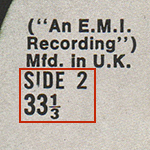
The second label identifier concerns the „33⅓” marking on the Side 2 (sliced apple) label. On the first and second pressings, it is aligned to the left side of the label. From the third pressing onwards, it is centred relative to the „An E.M.I. Recording” text above it. This single detail, easily missed, is the only way to distinguish a first or second pressing from a third pressing when the matrix codes are identical.
One additional first-pressing label variant exists on Side 2, where the standard two-line layout is rearranged: the second line becomes the last, pushing „33⅓” below SIDE 2 and the catalogue number PCS 7088 below the year. These copies are genuinely uncommon but are not assigned particular premium by the market.
The Misaligned Cover
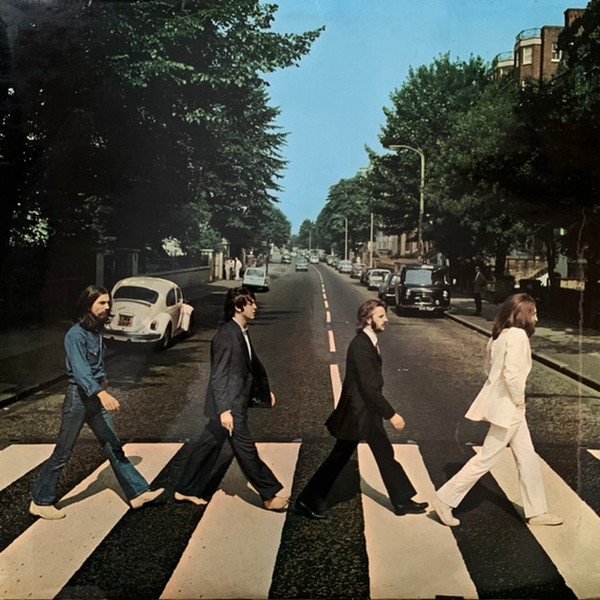
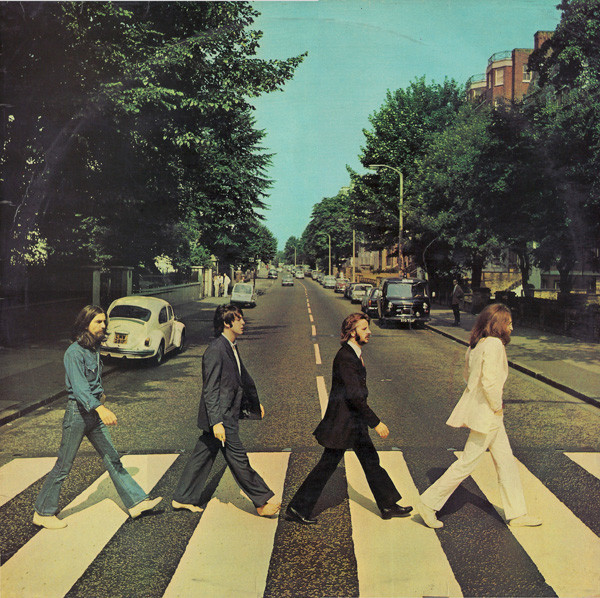
Two variants of the rear sleeve circulated from the day of release. The standard version has the Apple logo correctly positioned beneath the Side 1 tracklist. The variant has a slightly different crop — the background photograph is shifted, the front cover image is marginally more zoomed in, and the Apple logo appears displaced toward the left. The fact that both versions appeared simultaneously on launch day indicates they were printed in parallel runs rather than one correcting the other. Both are legitimate first-pressing covers; the misaligned version is not significantly more valuable, but it is the more interesting conversation piece.
| Abbey Road (Apple PCS 7088) — UK pressing identification guide | ||
| 26 September 1969 |
1st pressing YEX 749-2 / 750-1 |
Matrices: YEX 749-2 (Side 1) / YEX 750-1 (Side 2). Dark green Apple label. Side 2 label does not list „(Her Majesty)”. The „33⅓” marking on Side 2 is aligned to the left — the key differentiator from the third pressing, which shares identical matrices. Rare label variant: „33⅓” displaced below SIDE 2, PCS 7088 below the year. Cover variant: standard Apple logo placement, or misaligned crop with logo shifted left. |
| 1969–1970 |
2nd pressing YEX 749-2 / 750-1 (or 749-3U) |
Matrices as first pressing: YEX 749-2 / 750-1, or rare variant YEX 749-3U / 750-1. Dark green Apple label. Side 2 label now lists „(Her Majesty)”. The „33⅓” on Side 2 remains left-aligned — same as first pressing. Large phonogram symbol (P) before year. |
| Late 1970–early 1971 |
3rd pressing 33⅓ centred |
Matrices: YEX 749-2 / 750-1 — identical to first and second pressings. Label is the only differentiator. Dark green Apple label. „(Her Majesty)” listed. Critical identifier: „33⅓” on Side 2 is now centred relative to „An E.M.I. Recording” — no longer left-aligned. Large (P). |
| 1971–c.1976 |
4th pressing light green label |
Matrices: YEX 749-2 / 750-1 or 750-2 / 750-2U. Light green Apple label — the change in label colour is the primary visual differentiator from earlier pressings. „(Her Majesty)” listed. „33⅓” centred. Large (P). |