
 Vinyl Nostalgia
The album *Sgt. Pepper’s Lonely Hearts Club Band* was released on June 1, 1967, in the United Kingdom, and just one day later across the Atlantic. Two versions were released simultaneously: mono and stereo, but all the material was originally recorded and mixed in mono. According to many sources, the musicians spent most of their time mixing Sgt. Pepper in mono and left the creation of the stereo version to the studio engineers. Critics are almost unanimous: the mono version is the foundation for understanding what The Beatles wanted to convey with this groundbreaking album, and it is perhaps no coincidence that the famous phrase—attributed interchangeably to John Lennon or George Martin—is often repeated: “You’ve never really heard Sgt. Pepper until you’ve heard it in mono” (You haven’t really heard Sgt. Pepper until you’ve heard it in mono).
As it happens, the mono version of the first—original—pressing of the album “Sgt. Pepper’s Lonely Hearts Club Band” is relatively easy to find, which cannot be said of the stereo release, which for some reason is rare—as evidenced by the prices whenever it appears in record stores or on auction sites. In November 2016, a very well-preserved copy of the stereo version was purchased at auction for $563.99 (nearly 2,200 PLN (then approx. 585 USD)), but I myself saw this record in January 2020 at one of Warsaw’s vinyl stores for a round 1,000 PLN (approx. 255 USD).
Just as with the mono version, we need to carefully examine the label on the record (on both sides!) to identify the original first pressing from 1967.
The label of the original first pressing features the Parlophone label’s yellow logo and silver lettering (pressings from the UK were yellow, while those from other countries often omitted the yellow color, resulting in a white label logo). The copyright notice begins with the words “The Gramophone Co. Ltd.,” and beneath the yellow label name is the line “Sold in U.K. subject…,” which is absent from this location starting with the third (or second, according to Yoko Ono’s chronology) edition from 1969.
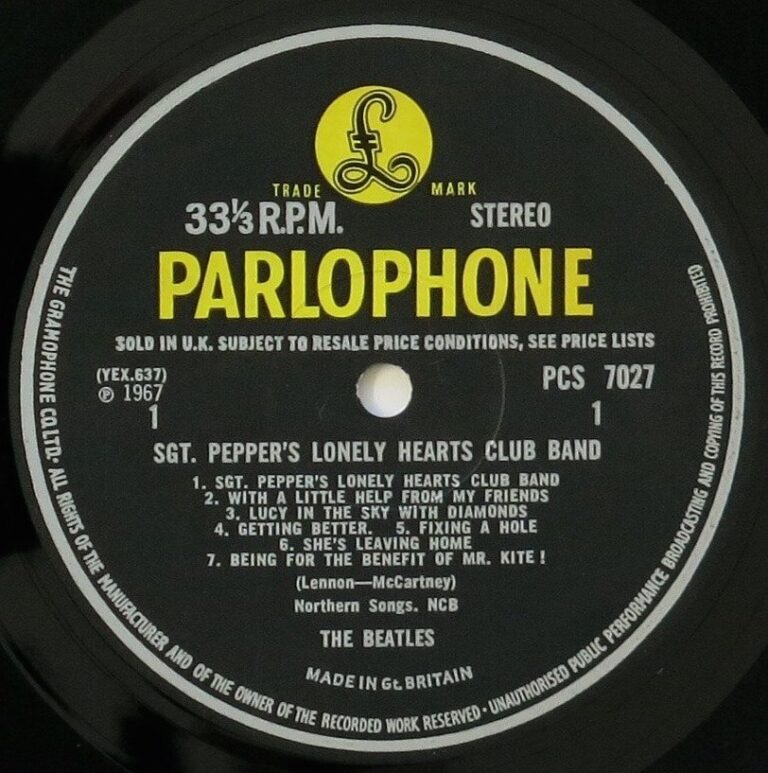
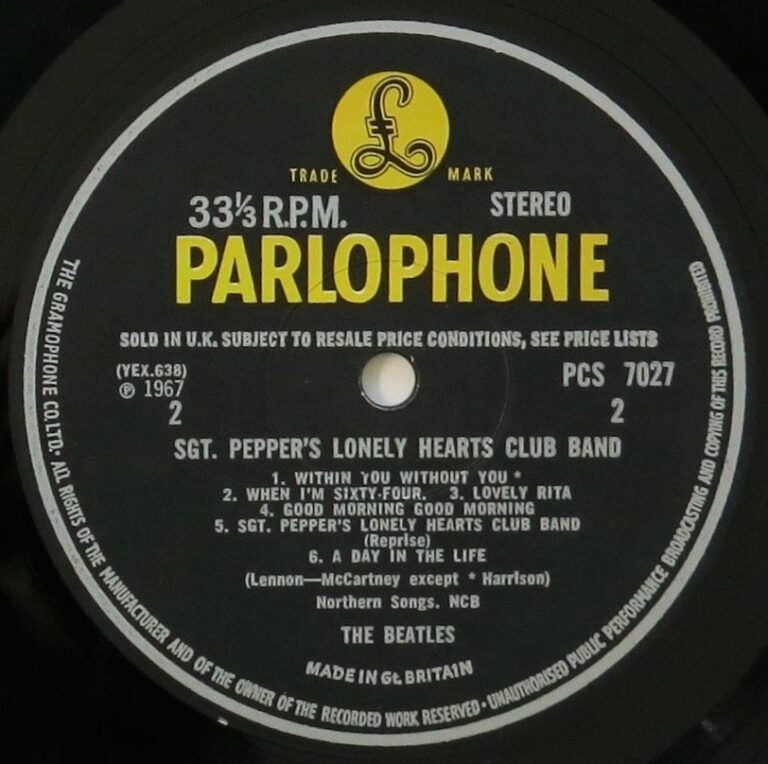
Additionally, at the top of the label on the right side (above the name PARLOPHONE), there is the notation STEREO.
The code from the run-out area of the record on side 1: YEX 637-1; and on side 2: YEX 638-1. Here, the digit following the hyphen—in this case, “1”—is extremely important, as it indicates the matrix number from which the record was pressed.
Very important! In the stereo version, the song “A Day In The Life” was not omitted from the label on the B-side in the second pressing (from 1968).
Share Your Opinion