
 Vinyl Nostalgia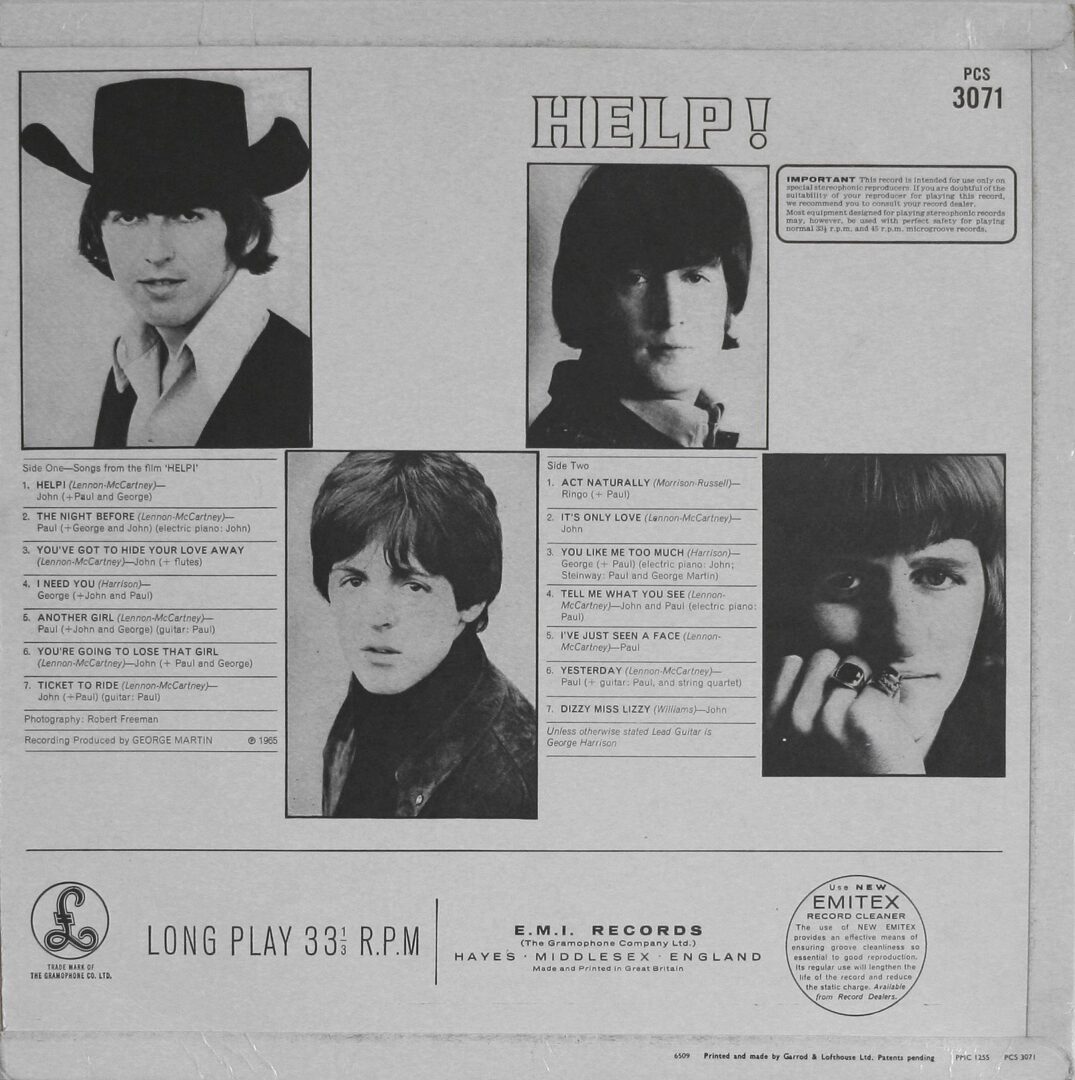
Discussing prices for individual pressings of Help! makes a fine pretext for taking a closer look at the one-box label. In autumn 1969 (TheBeatles-Collection dates the change precisely to November 1969) EMI changed its label design, moving away from the traditional black-and-yellow Parlophone in favour of a black-and-silver label with a single EMI box frame at the bottom edge. Collectors call them „one-box” or „one-mark” labels today. The label in this form survived less than a year, because by mid-1970 the „two-box” labels appeared — with two EMI box frames, one at the top and one at the bottom. For the blogger’s sake, it’s worth noting that TheBeatles-Collection, one of the most meticulous sources for this period, dates the transition to „two-box” labels to early 1971.
Only 3 Beatles mono albums were released with the one-box label: Please Please Me, Help!, and Sgt. Pepper’s Lonely Hearts Club Band — each in a small print run, certainly no more than a few thousand copies. There was even a discussion among collectors on Steve Hoffman Music Forums about the rarity of these editions, and the claim frequently appearing in online auction listings about tiny print runs (200-500 copies max) was dismissed as unlikely. Either way — due precisely to their limited availability and the much higher quality of the vinyl pressed at the turn of the 1960s and 1970s, these three mono releases are highly valued, sought-after, and accordingly expensive.
Parlogram Auctions — one of the most respected UK auction portals specialising in the Beatles and rare 1960s records — puts it plainly:
Sgt. Pepper’s… and Please, Please Me were also pressed in mono on this label, but Help! was the poorest seller and is certainly the rarest.
As for the actual print run — experienced collectors on Steve Hoffman Forums dismissed the auction-listing claim of „200-500 copies max” as understated. Most likely EMI pressed a few thousand copies of each of the three titles.
Which brings us to the one-box edition of Help!. Of the three, the one-box Help! is today the hardest to track down. It’s the fourth pressing of this title, and the first on the black-and-silver label, released in November 1969 with matrix numbers XEX 549-2 (side 1) and XEX 550-2 (side 2) — identical to those of the 1965 first pressing. It was also the last mono edition to hit the shelves before 1981. The fifth pressing appeared in 1981, already in the yellow-and-black EMI format, with matrix XEX 549-3 on side 1.
The Rare Record Price Guide values the fourth mono „one-box” edition at £400 (approx. 529 USD) NM, £320 (approx. 424 USD) EX, and £200 (approx. 265 USD) VG+. This is the most expensive and most sought-after edition of Help!.

A copy of the first stereo pressing of Help! is valued at £400 (approx. 529 USD) NM, £320 (approx. 424 USD) EX, and £200 (approx. 265 USD) VG+. The matrix numbers of this edition are YEX 168-1 (side 1) and YEX 169-1 (side 2), and a distinguishing feature — typical only of the first stereo pressing label — is the asterisk placed to the left of the song title „I Need You” (referring to its author credit). On subsequent stereo pressings, this asterisk was moved to the right of the title and stayed there all the way through to the eighth pressing from 1984, released with a black-and-silver two-box label. So it’s an easy-to-spot and ultimately decisive detail. The KT tax code was stamped on the side 2 label (rarely MT — a typographic error, because the MT code had expired back in 1963). The sleeve: a laminated tri-flipback by Garrod & Lofthouse Ltd. or Ernest J. Day & Co. with „stereo” marked on the front.
For anyone interested in the details, TheBeatles-Collection resolves this question more precisely for PCS 3071 (stereo):
The first pressing (August 1965) uses Times New Roman typeface, with a bold STEREO banner next to the Parlophone logo. The „I Need You” asterisk sits to the left of the title, not to the right.
The second pressing (1965-1969), variant A: typeface switched to sans-serif, and the „I Need You” asterisk was moved to the right of the title. This is the tracklist layout we see across most of the 1960s.
Variant C (closer to 1968): the typeface remains sans-serif, but the asterisk RETURNS TO THE LEFT.
Parlogram Auctions in some listings writes „As with all true 1st stereo pressings, the side 1 label has an asterisk after the 'I Need You’ title” — but they use their own simplified pressing numbering (calling the earliest sans-serif pressing „1st” and skipping over the rarest Times New Roman pressing). These discrepancies between sources are the reason most collectors don’t actually know which version they own.
First mono pressing — the most „accessible” rarity
The first mono pressing of Help! (PMC 1255, August 1965, matrices XEX 549-2 / XEX 550-2) is valued considerably lower than the one-box — according to RRPG, just £100 (approx. 132 USD) NM, £80 (approx. 106 USD) EX, and £50 (approx. 66 USD) VG+. Why lower? The answer lies in the print run: UK pre-orders for Help! hit 250,000 copies, and in its first week of sales the album shifted 270,000 units — so the first pressing was spread across a large number of copies that aren’t particularly hard to find today.
TheBeatles-Collection distinguishes three variants of the first mono pressing (A, B, C) that differ in tracklist details and the layout of the band name on the label — variant A, with „Northern Songs, NCB” placed incorrectly under the band name, is the rarest of the three and tends to fetch a higher price. We cover it in a separate article here.
Help! and the Puzzle of the One-Box Labels — Late 1969/1970 at the EMI Hayes Factory
Discussing prices for individual pressings of Help! makes a fair pretext for taking a closer look at the one-box label — one of the most curious episodes in the history of British Beatles vinyl. In autumn 1969 (TheBeatles-Collection dates the change precisely to November 1969) EMI changed its label design, moving away from the traditional black-and-yellow Parlophone in favour of a black-and-silver label with a single EMI box at the bottom edge. Collectors call this the „one-box” or „one-mark” label.
A correction is needed here relative to what Polish collector writing often repeats: the one-box label did not last „less than a year”. It lasted considerably longer. TheBeatles-Collection, one of the most meticulous sources for this period, dates the transition to the two-box label (two EMI boxes, one at the top and one at the bottom) to early 1971 — so the one-box label lived for well over a year. Other sources (JPGR, friktech.com) push the date to 1973, which likely stems from confusion with a later rim-text change (when „The Gramophone Co. Ltd.” was replaced by „EMI Records Ltd.” in 1976). Either way — the one-box didn’t last „less than a year”, but at least well over twelve months.
Only Three Mono Albums Got the One-Box Label
All credible sources confirm this — TheBeatles-Collection, Parlogram Auctions, friktech.com, atlasrecords.co.uk. Only three mono Beatles albums from the original era received a one-box reissue: Please Please Me (PMC 1202), Help! (PMC 1255), and Sgt. Pepper’s Lonely Hearts Club Band (PMC 7027). Parlogram Auctions — one of the most respected UK auctioneers specialising in Beatles vinyl — states outright: „Sgt. Pepper’s… and Please, Please Me were also pressed in mono on this label too, but Help! was the poorest seller and is certainly the rarest.” Of the three, Help! is today the hardest to find.
There’s been a discussion on Steve Hoffman Forums about the actual pressing quantity — the auction-listing claim of „200-500 copies max” has been dismissed by experienced collectors as too low. Most likely EMI pressed a few thousand copies of each of the three titles. Parlogram uses the phrase „single small batch”. Still, against the millions of copies pressed for the original 1965-1967 issues, a few thousand is a drop in the ocean. That’s why these three mono pressings are so highly valued today — and not only for rarity, but because they were pressed on thick, quality late-1960s vinyl (Parlogram cites weights of 138-142 g, which was the standard for higher-tier pressings at the time).
Help! One-Box — The Fourth Mono Pressing
Which brings us to the one-box edition of Help!. It is the fourth mono pressing (PMC 1255), the first on the black-and-silver label, released in November 1969. Matrix numbers: XEX 549-2 (side 1) and XEX 550-2 (side 2) — identical to the first 1965 pressing (late-1960s EMI productions repeatedly reused the same lacquers until they showed defects).
Parlogram Auctions provides detailed identifiers for auctioned copies: stamper codes 9/MDT and 1,8/ATM (or 1,8/ATA in another copy) — very high stamper numbers, which confirms the pressing reused existing production matrices rather than new lacquers. Vinyl weight: 138-142 g. Sleeve: tri-flipback laminated Garrod & Lofthouse Ltd. with outline „mono” on the front; inside, a red-and-white EMI advertising inner-sleeve.
One more important detail: the 1969 Help! one-box was the last mono pressing of the album until summer 1981 (fifth pressing, yellow-and-black EMI reissue with matrix XEX 549-3 on side 1). That means nearly twelve years without a new mono issue — which explains the intense collector interest in this one small late-1969/1970 batch.
The Rare Record Price Guide values this variant at £400 (approx. 529 USD) NM, £320 (approx. 424 USD) EX, and £200 (approx. 265 USD) VG+. It’s the most expensive and most sought-after edition of Help!. For context: recent auction prices on Parlogram frequently exceed those figures — EX+ copies have gone for £500 (approx. 662 USD)-900, and a near-untouched copy can fetch over £1,000 (approx. 1,324 USD) today. The market is moving upwards.
First Stereo Pressing — the „I Need You” Asterisk Controversy
Here I need to dig into a typographic detail, because there’s a simplification circulating in Polish collector writing that gets the facts slightly wrong. It’s traditionally said that „the asterisk after the 'I Need You’ title placed to the right” is a feature of the first stereo pressing, and that later pressings moved it to the left. Reality is more subtle — and, at the critical moment, exactly the opposite.
TheBeatles-Collection resolves this very precisely for PCS 3071 (stereo):
- First pressing (August 1965) uses Times New Roman typeface, with a bold STEREO banner next to the Parlophone logo. The asterisk („*”) next to the „I Need You” credit sits TO THE LEFT of the title, not to the right.
- Second pressing (1965-1969), Variation A: typeface switched to sans-serif, and the „I Need You” asterisk MOVED TO THE RIGHT of the title. This tracklist layout stayed for most of the 1960s.
- Variation C (closer to 1968): still sans-serif, but the asterisk RETURNS TO THE LEFT.
So the asterisk on the right is not a feature of the first pressing — it’s a feature of the second sans-serif pressing from 1965-1968. Parlogram Auctions in some listings writes „As with all true 1st stereo pressings, the side 1 label has an asterisk after the 'I Need You’ title” — but they use their own simplified pressing numbering (calling the earliest sans-serif pressing „1st”, skipping over the rarer Times New Roman). For a collector working with TheBeatles-Collection or Discogs taxonomy, the true first stereo Help! pressing is a Times New Roman copy with the asterisk on the LEFT — the right-side asterisk copies are „earliest of the common variants”, but not absolutely first.
First stereo pressing matrices: YEX 168-1 (side 1) and YEX 169-1 (side 2). The KT tax code is stamped on the side 2 label (rarely MT — a typographic error, because the MT code had ended in 1963). Sleeve: laminated tri-flipback Garrod & Lofthouse Ltd. or Ernest J. Day & Co. with outline „stereo” on the front.
RRPG values the first stereo pressing at £150 (approx. 199 USD) NM, £120 (approx. 159 USD) EX, and £75 (approx. 99 USD) VG+. Times New Roman copies with the left-side asterisk (the absolute first pressing) run 30-50% above the standard value — this is for the collector paying attention to every detail.
First Mono Pressing — The „Accessible” Rarity
The first mono pressing of Help! (PMC 1255, August 1965, matrices XEX 549-2 / XEX 550-2) is valued significantly lower than the one-box — £100 (approx. 132 USD) NM, £80 (approx. 106 USD) EX, and £50 (approx. 66 USD) VG+ per RRPG. Why lower? The answer lies in the print run: UK pre-orders for Help! reached 250,000 copies, and in its first week of sales the album shifted 270,000 units — the first pressing was therefore spread across a large number of copies that aren’t particularly hard to find today. TheBeatles-Collection distinguishes three variations of the first mono pressing (A, B, C) differing in tracklist details and band name layout on the label — Variation A with „Northern Songs, NCB” placed under the band name is the rarest of the three and commands a premium.
A Short Timeline of EMI Labels for Context
To make clear how the whole Parlophone/EMI label family evolved for Beatles releases:
- Black & Gold (Please Please Me, 1963): only the first two pressings of Please Please Me
- Yellow & Black („Y&B”): from summer 1963 to November 1969 (with rim-text variations: Parlophone Co. Ltd. → Gramophone Co. Ltd., „Sold in UK” → without „Sold in UK”)
- One-box EMI (black & silver, one EMI box at the bottom): November 1969 → early 1971 — only three mono titles: Please Please Me, Help!, Sgt. Pepper
- Two-box EMI (two EMI boxes, „Gramophone Co. Ltd.” rim text): early 1971 → summer 1976 — stereo only
- Two-box EMI (two boxes, „EMI Records Ltd.” rim text): summer 1976 → October 1980
- Yellow & Black reissue (summer 1981): limited mono reissues (Mono Box 1982)
- Two-box EMI with „ALL RIGHTS OF THE PRODUCER”: October 1980 → 1987
- The Beatles in Mono box (Optimal Media GmbH, 180g, remaster): 8 September 2014
| Pressing | Year / Cat. No. | Matrices | Identifying Features | Market Value |
|---|---|---|---|---|
|
1st pressing mono
mono |
6 August 1965 Parlophone PMC 1255 |
XEX 549-2
XEX 550-2
|
Black-and-yellow Parlophone label Rim text: „The Gramophone Co. Ltd.”, „Sold in U.K.” Tracing-paper „Use Emitex” die-cut inner sleeve KT tax code (often) — sometimes absent Laminated tri-flipback Garrod & Lofthouse or Ernest J. Day sleeve with outline „mono” Variants A, B, C (different tracklist and band name layouts) |
£100 (approx. 132 USD) NM £80 (approx. 106 USD) EX £50 (approx. 66 USD) VG+ |
|
1st pressing stereo — Times New Roman
stereo |
6 August 1965 Parlophone PCS 3071 |
YEX 168-1
YEX 169-1
|
Black-and-yellow label, bold STEREO next to logo Times New Roman typeface „I Need You” asterisk ON THE LEFT of the title Rim text: „The Gramophone Co. Ltd.”, „Sold in U.K.” KT tax code (rarely MT — typographic error) Laminated sleeve with outline „stereo” |
£200 (approx. 265 USD)–250 NM £150 (approx. 199 USD)–180 EX rarity among first pressings |
|
2nd pressing stereo — sans-serif, right asterisk
stereo |
1965–1969 Parlophone PCS 3071 |
YEX 168-1
YEX 169-1
|
Sans-serif typeface „I Need You” asterisk ON THE RIGHT of the title Rim text: „The Gramophone Co. Ltd.”, „Sold in U.K.” Variations A, B, C differing in layout details In Variation C (around 1968) the asterisk returns to the LEFT |
£150 (approx. 199 USD) NM £120 (approx. 159 USD) EX £75 (approx. 99 USD) VG+ |
|
3rd pressing (summer 1969 – November 1969)
mono + stereo |
Summer 1969 – Nov 1969 Parlophone PMC 1255 / PCS 3071 |
XEX 549-2 / XEX 550-2
YEX 168-1 / YEX 169-1
|
Last Y&B pressing Rim text: „The Gramophone Co. Ltd.”, NO „Sold in U.K.” text Small „mono”/”stereo” on front cover Plain white or sepia „LP advertising” inner sleeve No tax code |
£50 (approx. 66 USD)–70 NM (mono) £40 (approx. 53 USD)–60 NM (stereo) |
|
4th pressing mono — ONE-BOX
mono |
Nov 1969 – 1970 Parlophone PMC 1255 |
XEX 549-2
XEX 550-2
Stamper codes: 9/MDT, 1,8/ATM or 1,8/ATA |
Black-and-silver label with a single EMI box at the bottom Rim text: „The Gramophone Co Ltd” Laminated tri-flipback Garrod & Lofthouse sleeve, outline „mono” Red-and-white EMI advertising inner-sleeve Vinyl weight: 138–142 g „Single small batch” — a few thousand copies Last mono pressing before 1981 |
£400 (approx. 529 USD) NM £320 (approx. 424 USD) EX £200 (approx. 265 USD) VG+ (2023–2024 auctions: £500 (then approx. 628 USD)–1000+) |
|
4th pressing stereo — ONE-BOX
stereo |
Nov 1969 – 1970 Parlophone PCS 3071 |
YEX 168-1
YEX 169-1
|
Black-and-silver label with single EMI box Rim text: „The Gramophone Co Ltd” Laminated Garrod & Lofthouse sleeve No tax code |
£40 (approx. 53 USD)–60 NM £25 (approx. 33 USD)–40 EX |
|
5th pressing stereo — TWO-BOX „Gramophone”
stereo |
Early 1971 – 1973 Parlophone PCS 3071 |
YEX 168-1
YEX 169-1
|
Black-and-silver label with two EMI boxes (top + bottom) Rim text still: „The Gramophone Co Ltd” Stereo ONLY (no mono reissue existed) Laminated Garrod & Lofthouse sleeve |
£25 (approx. 33 USD)–35 NM £15 (approx. 20 USD)–20 EX |
|
5th pressing mono — Y&B reissue
mono |
Summer 1981 – Aug 1982 Parlophone PMC 1255 |
XEX 549-3
XEX 550-2
|
Return of the yellow Parlophone logo Rim text: „ALL RIGHTS OF THE PRODUCER” (7 o’clock: „UNAUTHORISED…”) „MANUFACTURED IN THE UK BY EMI RECORDS LIMITED” Unlaminated sleeve with outline „mono” White EMI inner sleeve Included in Mono Box BMC 10 (August 1982) |
£40 (approx. 53 USD)–60 NM £25 (approx. 33 USD)–35 EX |
|
8th pressing stereo — TWO-BOX 1984
stereo |
Late spring 1984 – 1987 Parlophone PCS 3071 |
YEX 168-4
YEX 169-4
|
Two EMI boxes, black-and-silver label Rim text: „ALL RIGHTS OF THE PRODUCER” 11 o’clock position: „UNAUTHORISED COPYIN, HIRING, RENTING, PUBLIC PERFORMANCE AND BROADCASTING” „MANUFACTURED IN THE UK BY EMI RECORDS LIMITED” Unlaminated sleeve with outline „stereo” |
£15 (approx. 20 USD)–20 NM £8 (approx. 11 USD)–12 EX |
|
6th pressing mono — The Beatles in Mono
mono |
8 September 2014 Parlophone 5099963380217 |
New matrices from 1965 analogue mono master Pressing: Optimal Media GmbH, Germany |
180g vinyl, remastered from original analogue mono master tapes Facsimile tri-flipback Garrod & Lofthouse sleeve Advertising flyer + insert with mastering notes Part of The Beatles In Mono box (2014) |
£40 (approx. 53 USD)–60 (secondary market) |
|
Quick one-box mono Help! check (November 1969 – 1970): black-and-silver label with a SINGLE EMI box at the bottom · rim text „The Gramophone Co Ltd” (not „EMI Records Ltd.”) · matrices XEX 549-2 / XEX 550-2 · laminated tri-flipback Garrod & Lofthouse sleeve with outline „mono” · red-and-white EMI advertising inner-sleeve · vinyl weight 138-142 g · stamper codes in the dead wax: 9/MDT and 1,8/ATM or 1,8/ATA Source resolution — the „I Need You” asterisk: TheBeatles-Collection and Discogs state that the first stereo pressing (Times New Roman) has the asterisk ON THE LEFT of the title; the second sans-serif pressing has it ON THE RIGHT; Variation C from 1968 returns to the left. Parlogram Auctions in listings calls the earliest sans-serif pressing „1st pressing”, skipping over the rare Times New Roman — hence in their descriptions „asterisk on the right = 1st pressing”. Source resolution — one-box to two-box transition: TheBeatles-Collection dates the transition to early 1971 (the one-box label ran from November 1969 to January 1971 — over a year). JPGR, friktech.com, and atlasrecords.co.uk give the year 1973 — likely confusing this transition with the later one (rim text „Gramophone Co. Ltd.” → „EMI Records Ltd.” in 1976). Polish writing frequently repeats the incorrect „mid-1970” date. Trivia: the Help! one-box was the last mono pressing of this album for nearly 12 years — the next mono pressing appeared only in summer 1981 as part of the Y&B reissue programme (fifth pressing, matrix XEX 549-3). After November 1969 EMI closed its mono catalogue, with the only exceptions being short one-box runs of these three selected titles. |
||||


