
 Vinyl Nostalgia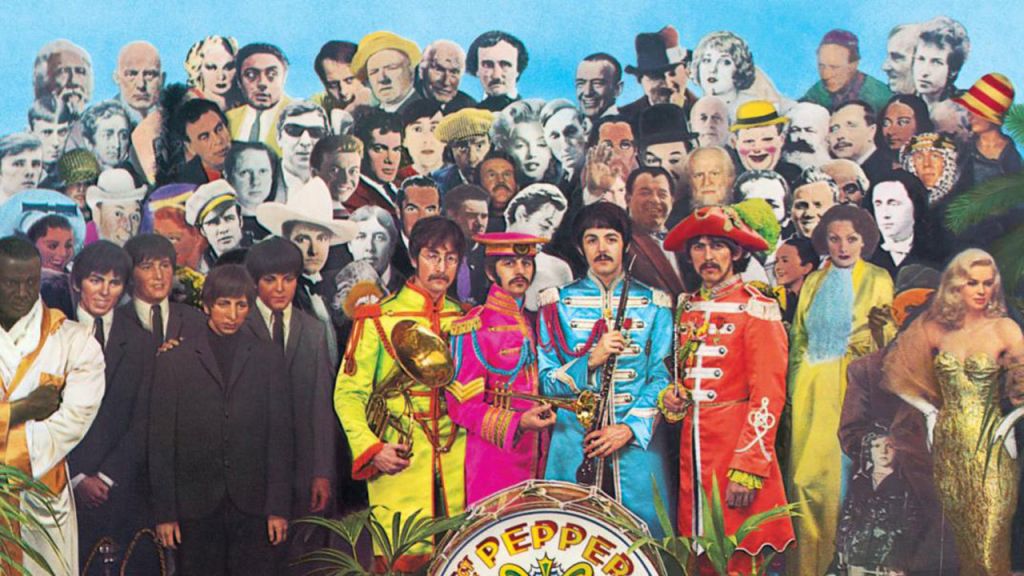
Sgt. Pepper is the true “Mona Lisa” of album covers, an iconic illustration that is now recognized around the world. Designed by the married couple Peter Blake and Jann Haworth, it earned them a Grammy Award. Incidentally, it also became the most expensive album cover in history. Its final cost was nearly £3,000 (approx. 3,971 USD) (over £51,000 (approx. 67,507 USD) in today’s money), which was a totally extravagant sum at a time when album covers typically cost around £75 (approx. 99 USD).
Few people know that the concept for the cover originated from a sketch by Paul McCartney, who was inspired by a photo (from the 1920s) of his father’s orchestra, “Jim Mac’s Jazz Band,” surrounded by well-dressed fans. Building on this idea, Peter Blake surrounded the Beatles with a “magical crowd” of 58 stars from film (e.g., Marlon Brando, Marilyn Monroe, Stan Laurel and Oliver Hardy, Tony Curtis, Shirley Temple, Marlene Dietrich), music (e.g., Bob Dylan), literature (Oscar Wilde, H.G. Wells, Edgar Allan Poe, Lewis Carroll, and Dylan Thomas), the brush (Richard Lindner), religion (Sri Mahavatar Babaji), sports (Johnny Weissmuller, Sonny Liston), and science (Albert Einstein). Additionally, the album features, among others, the philosopher and founder of scientific socialism Karl Marx, as well as Carl Gustav Jung, the founder of analytical psychology. This eclectic mix was intended to reflect the diverse styles of the songs on the album, ranging from rock ’n’ roll to Indian raga.
The cover’s creators revealed in their memoirs that the musicians had their own picks for who they’d like to see in the “magic crowd,” but not every choice was accepted. “John Lennon wanted Hitler and Jesus in the crowd, Paul chose Brando and Astaire, and George asked for Maharishi,” said Jann Haworth. She added:
Hitler was John’s wrong choice. We made a figure, but we removed him just before the photo shoot. In the end, The Beatles chose only a third of the heads for the cover, so Peter and I picked the rest.
The absence of Elvis Presley from the illustration is surprising, but Paul McCartney stated in an interview that “Elvis was too important and stood out too much from the rest to even mention him.”
According to Yoko Ono’s official website, EMI primarily used two different companies to produce album covers: Ernest J. Day and Garrod & Lofthouse. In addition to the text indicating the manufacturer, the covers can also be distinguished by the thickness of the cardboard. For example, Ernest J. Day’s early covers were made of thicker material. In the case of The Beatles’ albums, Garrod & Lofthouse covers are the most common.
There are at least three different editions of the Sgt. Pepper’s Lonely Hearts Club Band album cover, and they differ essentially only by a single line of text on the back of the album.
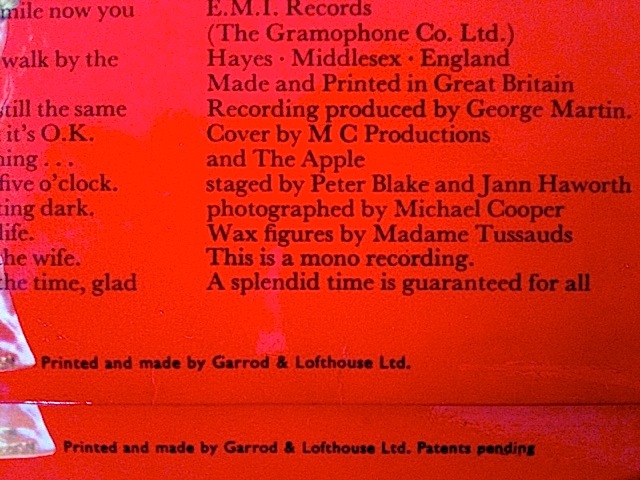
The First Edition Sleeve has the following text in the lower right corner of the back cover: “Printed and made by Garrod & Lofthouse Ltd. Patents applied for”.
In the second edition (Second Edition Sleeve), the same spot features the note: “Printed and made by Garrod & Lofthouse Ltd. Patents pending.”, while the third (Third Edition Sleeve) has the shortest version: “Printed and made by Garrod & Lofthouse Ltd.”
Collectors agree on one thing: each of these editions has exactly the same value, because attention is now focused on the condition of the cover, and above all on the condition and pressing of the record (which subsequent pressing) and its place of origin.
There is one more, very unique version, but it is virtually inaccessible to the average collector. The original cover of “Sgt. Pepper” was modified in 1967 to feature the faces of the executives of the American label Capitol Records on a limited-edition LP. It is believed that only 100 copies of this record were produced, and they were distributed as gifts to employees. The locations of only three copies are currently known. The value of each is estimated at 70,000 British pounds (source).
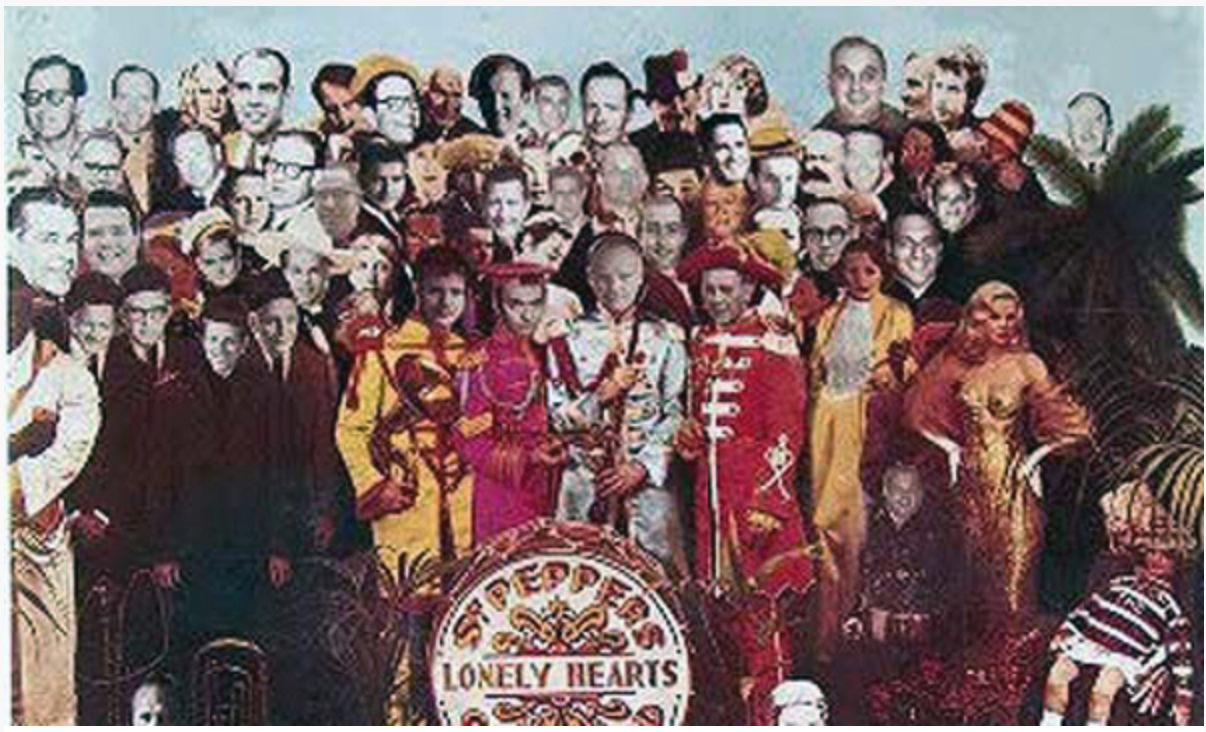
In this version, the faces of 40 people from the original design were replaced, and the Beatles do not appear on it.
| Sleeve Edition | Year | Printer | Key Sleeve Features | Market Value (RRPG / NM Auction) |
|---|---|---|---|---|
|
„Fourth Proof” Sleeve MONO Production proof sleeve |
1967 | Garrod & Lofthouse Ltd. | The text „Fourth Proof” appears inverted in the top right corner of the inner gatefold, directly above George Harrison’s head. Additional print „AR D 1321” on the left side of the flipback. „Patents Pending” credit on rear cover lower right. Fully laminated flipback gatefold. These proof sleeves were intended for destruction after press-run approval; a small number survived because they were used to house the very first production copies. Known only with mono PMC 7027 copies. Unknown quantity; a handful of confirmed examples exist in circulation. Sources: TheBeatles-Collection, Popsike, RareVinyl.com. |
RRPG: no data Auction: multiples of standard 1st press value; no reliable open-market price established |
|
UK 1st Sleeve Edition STEREO MONO „Patents applied for” |
1967 (from 26 May) |
Garrod & Lofthouse Ltd. | Fully laminated one-piece flipback gatefold. Rear cover lower right reads: „Printed and made by Garrod & Lofthouse Ltd. Patents applied for.” Two spine variants: wide spine (rarer) and thin spine (more common). Catalogue number on spine and rear: PMC 7027 (mono) or PCS 7027 (stereo). Dark green cut-outs card insert with printed signatures of Peter Blake and Jann Haworth. Psychedelic red and white inner sleeve. Cover and spine title reads „Sgt. Peppers” (missing apostrophe — a typographic error on all 1967 copies); labels correctly read „Sgt. Pepper’s”. |
RRPG: £800 – £900 (approx. 1,059 - 1,191 USD) Auction (NM, complete): £1,500 – £6,000 (approx. 1,985 - 7,942 USD)+ |
|
UK 2nd Sleeve Edition STEREO MONO „Patents pending” |
1967 (later copies) |
Garrod & Lofthouse Ltd. | Visually identical to the 1st edition; the sole difference is the rear cover lower right text, changed to „Printed and made by Garrod & Lofthouse Ltd. Patents pending.” Lamination, flipbacks, cut-outs insert and inner sleeve as per 1st edition. Per Record Collector (issue 335), sleeve edition differences do not affect market value. Most commonly encountered variant with 1st and 2nd pressings. |
RRPG: £800 – £900 (approx. 1,059 - 1,191 USD) Auction (NM, complete): £1,000 – £4,000 (approx. 1,324 - 5,295 USD) |
|
UK 3rd Sleeve Edition STEREO MONO No „Patents” wording |
1967 – 1969 | Garrod & Lofthouse Ltd. | Rear cover lower right reads only „Printed and made by Garrod & Lofthouse Ltd.” — no patents reference. Lamination and flipbacks retained. Found with 2nd and 3rd pressings (1968 – 1969). Inner sleeve may be standard white EMI rather than the original psychedelic design. |
RRPG: £50 – £60 (approx. 66 - 79 USD) Auction (NM): £200 – £600 (approx. 265 - 794 USD) |
|
UK Sleeve — No Printer Credit BOTH Wide spine / E.J. Day |
1967 | E.J. Day (Ernest J. Day & Co.) |
No printer credit of any kind in rear cover lower right corner. Wide spine is the key physical identifier for E.J. Day printing on this title, per JPGR. Lamination and flipback construction retained. Per Record Collector (issue 335), absence of the printer credit does not affect market value relative to Garrod & Lofthouse editions. |
RRPG: £800 – £900 (approx. 1,059 - 1,191 USD) Auction (NM): £1,500 – £4,000 (approx. 1,985 - 5,295 USD) |
|
US Capitol „Executives Cover” STEREO #1 per Record Collector 2011 |
Late 1967 | Capitol Records art department | Standard US Capitol SMAS 2653 sleeve fitted with an additional thick gloss front cover slick featuring approximately 40 Capitol Records sales executives’ faces superimposed over Peter Blake’s original collage. Produced for a Capitol sales conference in Miami, Florida, late 1967. Estimated run: 40 – 100 copies (Perry Cox and Bruce Spizer: 40 – 50, Beatles Bible and Record Collector: approximately 100). Caution: Discogs (2023) records 198 users claiming ownership — strongly suggesting bootleg covers circulate alongside originals. Provenance documentation is essential before purchase. Ranked #1 most valuable record sleeve in the world by Record Collector (December 2011). |
RRPG: no data Heritage Auctions 2013: $32,500 (with buyer’s premium) Record Collector 2011: approx. £70,000 (approx. 92,656 USD) |
|
UK Picture Disc REISSUE |
16 Jan 1979 PHO 7027 |
Metronome Records, West Germany | Peter Blake’s artwork on side A, Sgt. Pepper drum artwork on side B. Single-pocket cover (not gatefold). Manufactured and printed by Metronome Records in West Germany. Unlike the US picture disc edition (which had the drum on the reverse), both sides of the UK cover carry the same front image. Retail price at issue: £6.99 (approx. 9 USD). |
RRPG: approx. £30 (approx. 40 USD) Auction: £50 – £150 (VG+) |
|
1981 – 1982 Reissue REISSUE |
1981 – 1982 | Garrod & Lofthouse Ltd. | Gatefold cover without lamination. Cut-outs insert retained. Standard white EMI inner sleeve instead of the psychedelic original. No internal flipback flaps. Identical front artwork to the 1967 original. |
RRPG: no data Auction: £20 – £50 (then approx. 31 - 78 USD) |
|
2014 Remaster Sleeve REISSUE The Beatles In Mono box and standalone |
8 Sep 2014 | Optimal Media GmbH, Germany | Gatefold modelled on the original Garrod & Lofthouse construction with two internal flipback flaps restored. Full reproduction of Peter Blake’s artwork. Psychedelic inner sleeve reproduced. Dark green cut-outs insert. Additional insert combining Mark Lewisohn’s 1987 liner notes and Paul McCartney’s introduction. |
RRPG: no data Discogs: £50 – £120 (approx. 66 - 159 USD) |
|
50th Anniversary 2017 REISSUE 2LP and Super Deluxe 6LP |
26 May 2017 | Not confirmed | Gatefold with full reproduction of Peter Blake’s collage. Cut-outs insert and anniversary booklet. Super Deluxe 6LP edition adds a 144-page hardback book, posters and five mono 7″ singles in a rigid box. „50th Anniversary Edition” sticker on front cover. Label styled on the original black and yellow 1967 design. |
2LP: Discogs £35 – £90 (approx. 46 - 119 USD) 6LP Super Deluxe: Discogs £200 – £350 (approx. 265 - 463 USD) |
|
Quick check: how to identify UK 1967 sleeve editions Check the lower right corner of the rear cover: (1) „Patents applied for” = earliest 1st edition, (2) „Patents pending” = 2nd edition, (3) „Garrod & Lofthouse” only, no patents reference = 3rd edition, (4) no printer credit at all + wide spine = E.J. Day printing. „Fourth Proof” text printed upside-down on the inner gatefold above Harrison’s head = production proof, absolute rarity. Source notes: Collector notes: |
||||
Share Your Opinion