
 Vinyl Nostalgia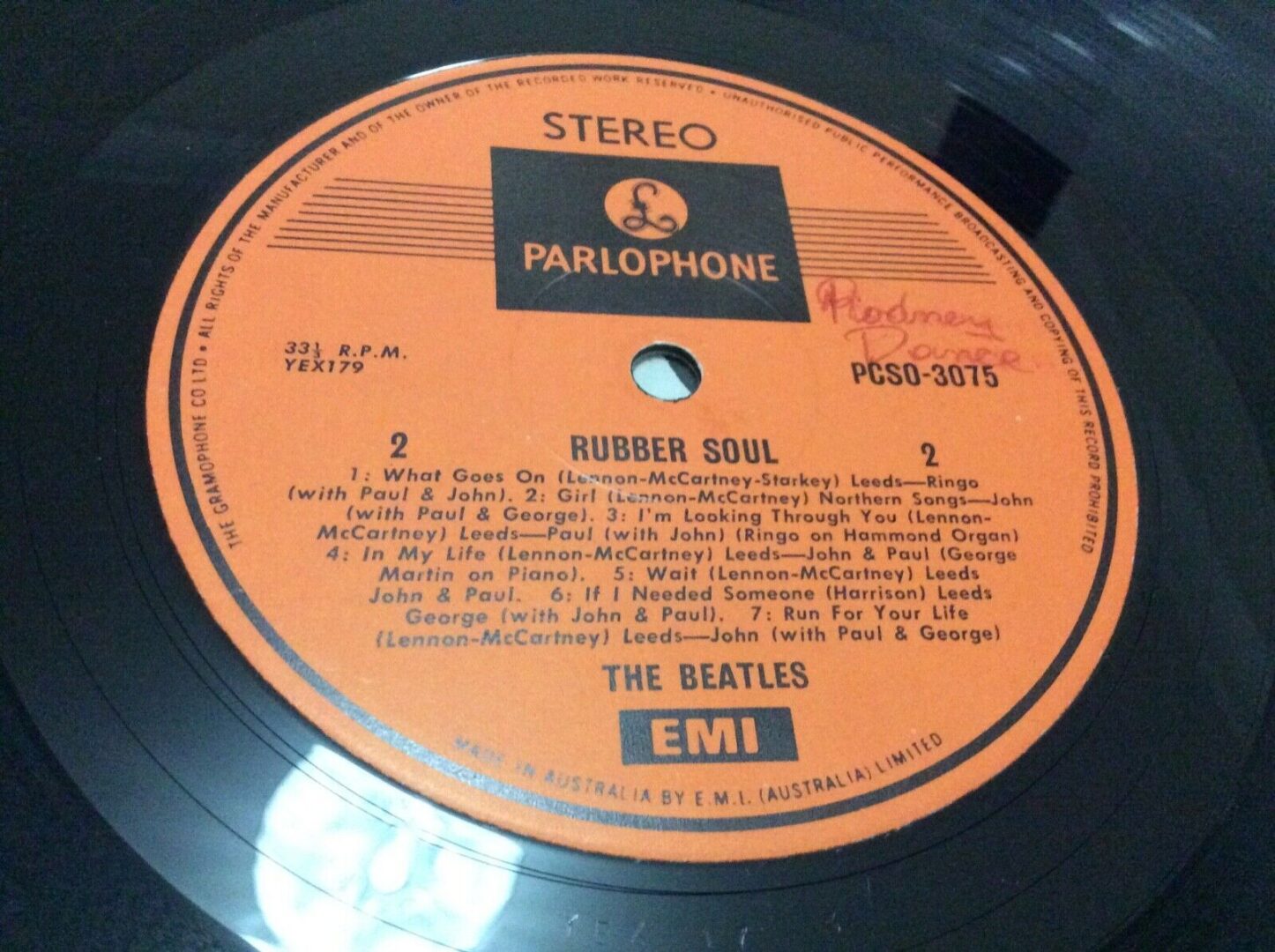
If a Beatles collector ever discovers Australia, it tends to be late in the game. Most of us start with the British originals, then drift towards the American pressings, the German ones, the Japanese editions. There may come a time, eventually, for the fascinating issues from behind the Iron Curtain, with their almost invariably extraordinary backstories. Australia tends to land on the radar somewhere between the Netherlands and New Zealand, and even then more as a curiosity than a destination. Then you actually look at it, and discover one of the most labyrinthine markets on which the Liverpool Four ever appeared.
I only got drawn into Australian pressings myself when I started adding Antipodean records (and not just by The Beatles) to Vinyl ID. It turned out to be a publishing maze considerably more tangled than it first appears, and pinning down individual pressings and their variants will give you a serious headache. Matrix numbers alone will not get you there. You need a magnifying glass and, among other things, a careful look at the label. The label is what dates a copy to within a few months. The rest of the markers (matrices, vinyl weight, inner sleeves, cover printers) take more finesse, but that is a topic for the next article.
The base reference for this guide is the I Am The Platypus site (beatlesaustralia.com), which has assembled a complete archive of 1,588 Australian Beatles labels grounded in original EMI Australia documentation. It is the absolute taxonomic standard, and I lean on it at every stage of identifying Australian pressings.
Three imprints, one catalogue: Parlophone, Apple, EMI
The entire Beatles run on the Australian market took place under one company, EMI (Australia) Limited, which merged with EMI New Zealand in July 1987 to form a single entity called EMI Music Group Australasia. Across all those years, three main imprints appeared on the labels: Parlophone (1963 to 1968 and again from 1982), Apple (1968 to 1982), and occasionally EMI without an imprint prefix. A handful of exceptional cases sit alongside, which I will get to. Across that span, the label rotated through colours (the famous gold and black, then yellow and black, then the so-called „Banner”, then orange, then black), but the Parlophone logo accompanied the Beatles uninterrupted throughout.
The label as a date-stamp
Once you know which label EMI Australia was running in a given window, the style alone will tell you the release date to within a few months. One rule worth keeping in mind: the age of the label is always equal to or later than the actual pressing date, never earlier. Put differently, if a copy carries a label introduced in July 1969, it cannot be a 1965 pressing of Help!, however convincing the cover and catalogue number may look, and however confidently the eBay seller talks up his „first pressing”.
One exception is worth flagging: mismatched labels, copies with two different labels on side A and side B. They turn up at transition points, when the factory was burning through old label stock alongside the new style. The classic case is Sgt. Pepper’s from October 1978, where side one already carries the distinctive orange Style B (a smaller „STEREO” sitting just above the catalogue number on the right) and side two still has the older Style A (the word „STEREO” up top, centred above the Parlophone logo). Not a misprint, just authentic factory crossover from the changeover between the two label variants. Copies like that are dated to the introduction of the later one.
Gold and black Parlophone (1963 to March 1964), the first Beatles label
A black-and-gold label with white „33 1/3 R.P.M.” text above the logo, modelled on UK Gold Parlophone, which the British were already using only sporadically by the time Australia adopted it. The first pressings of Please Please Me (PMCO 1202) and With The Beatles (PMCO 1206) came out on Gold. A detail worth filing away: in the UK, Gold had vanished almost a year earlier, but in Australia it held on until March 1964. That delay in implementing label changes on peripheral EMI markets is a recurring theme right across the Australian Beatles run.
Gold comes in two rim text variants. First pressings of Please Please Me (Gold A) read „MADE IN AUSTRALIA FOR THE PARLOPHONE CO. LTD. SYDNEY, NSW” around the perimeter. In January 1964, EMI Australia revised the wording to „MADE IN AUSTRALIA BY E.M.I. (AUST.) LIMITED”, relocating it from the perimeter to a horizontal line either side of the spindle hole. That gives you Gold B. The practical takeaway: rim text running around the perimeter means a copy from before January 1964; rim text running horizontally next to the centre puts you in January-March 1964. Only Please Please Me exists in both variants. With The Beatles appears only on Gold B.
In parallel, on the seven-inch side, EPs were running on the green Parlophone label (in service until end of March 1964, the first three Beatles EPs), and singles on the pink-and-black Pink Parlophone until October 1963, when Australia switched to S/B (silver-and-black) Parlophone in step with the UK, which had made the same move some nine months earlier.
Yellow Parlophone Mono and „Banner” Stereo (March 1964 to February 1969), five years of two parallel labels
In March 1964, EMI Australia moved to the new Yellow Parlophone label (black base, yellow logo, silver text), modelled on the contemporary British design but applied exclusively to mono editions. Stereo issues received their own parallel label, „Banner” Stereo, a silver-and-dark-blue design loosely based on the discontinued UK Gold Stereo Parlophone. These two labels, Yellow Parlophone and „Banner” Stereo, ran in parallel for nearly five years.
Beatles For Sale, Help!, Rubber Soul, Revolver, Sgt. Pepper’s and the original A Collection of Beatles Oldies all received their first Australian pressings between 1964 and 1968 on these two labels, depending on whether the copy is mono (PMCO) or stereo (PCSO). The catalogue numbers differ across formats, even though the album is physically the same as the UK release.
Every label from this period carries royalty stamps (publisher names) to the left of the spindle hole. These stamps were dropped at the turn of June and July 1969, making them one of the most reliable dating markers across the entire Australian catalogue.
Yellow Parlophone Stereo (February to July 1969)
Before Australia introduced its iconic orange label, something unusual happened across five short months in 1969. EMI Australia began using existing Yellow Parlophone label stock on stereo pressings as well, presumably to clear warehouse supplies before the new design came in. This unusual Yellow Parlophone Stereo was in circulation from February to July 1969, and turns up on a handful of titles, including reissues of Beatles For Sale, Rubber Soul, Greatest Hits Volume 2 and Sgt. Pepper’s. Not every album from that window received it, which complicates the picture further.
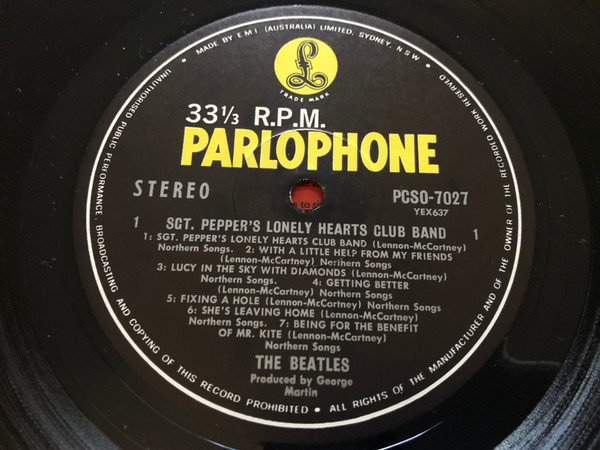
Identification is relatively straightforward. Yellow Parlophone Stereo is the standard yellow-and-black label with a grey rectangular box containing „STEREO”, positioned at the top right above the Parlophone logo. For Sgt. Pepper’s there is an additional variant (the so-called variant B) where „STEREO” was printed to the left of the spindle hole, in the space previously occupied by the publisher stamps. A very characteristic layout, easy to spot on first sight.
Yellow Parlophone Stereo is something of a curiosity, found on small numbers of copies across a very brief window. For meticulous collectors, however, it is significant as a crossover variant. Prices on the market remain reasonable when copies surface, but availability in Europe or North America is another matter entirely.
Apple (December 1968 to April 1982), nearly fourteen years of the Apple era
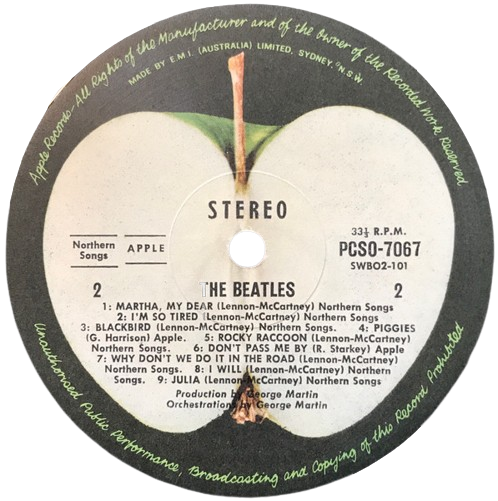
Apple Records arrived on the Australian market with the White Album in December 1968, a delay of barely a month behind the UK. The labels on that album are essentially identical to the British versions (whole apple on side A, sliced apple on side B, both with black backgrounds and white text). The differences come in the perimeter rim text and local references to EMI Australia: MADE BY E.M.I. (AUSTRALIA) LIMITED. SYDNEY.
The first Apple pressings, up to July 1969, still carry royalty stamps to the left of the spindle hole, but in July 1969 these were finally dropped and replaced with „33 1/3 R.P.M.” and the matrix number for that side. That is the single biggest change within the Apple run in Australia.
In July 1973, for the double albums The Beatles 1962-1966 (the Red Album) and The Beatles 1967-1970 (the Blue Album), Apple introduced colour-distinct labels with red and blue backgrounds respectively (in place of the standard black). This variant remained in use until 1979, when later reissues reverted to standard labels.
Records on the Apple imprint were issued in Australia for considerably longer than in the UK, where EMI revived Parlophone in 1980 for new releases. In Australia, the apple held on right up to April 1982, when Black One-Box took over. Once again, the peripheral-market effect at work: changes arrived on a delay.
Orange One-Box (April 1969 to March 1982), unmistakably the loudest Australian Beatles label
Here we arrive at the label most people instinctively associate with Australian Beatles. Orange One-Box is a bright orange label with black text and a layout based on the British EMI One-Box, but with a prominent „STEREO” at the top. „Very loud”, as Jaesen Jones puts it, and hard to disagree. It catches the eye immediately and prompts a closer look. It was in service from April 1969 to March 1982, just shy of thirteen years. Across that span, the Orange One-Box design changed three times, with the changes turning chiefly on the position of the word STEREO.
Style A „Top STEREO” (from April 1969). The word STEREO is printed in large type at the top of the label, above the Parlophone logo. This is the original and most common version, in use for nearly ten years across most albums of the period. Pictured above on the left.
Style B „Side STEREO” (from October 1978). STEREO was moved over to the right, in smaller type, ending up above the PCSO catalogue number. This design was used on only a handful of titles for a short window of about half a year.
Style C „No STEREO” (from early 1979). The word STEREO disappeared from the label entirely. This design ran through to the end of the Orange period (March 1982). Pictured above on the right.
Not every title received all three sub-styles. Some albums have only Style A, others A and B, still others A and C without B, and a few the full run of A, B, C. The title-by-title map is on Jones’s site (link at the foot of the article); my table here gives only the broad picture, with the per-album breakdown reserved for the dedicated articles on each title.
One striking detail: in the United Kingdom, Beatles records never appeared on an orange label at all. The orange Beatles label is an Australian specific, and for European collectors meeting an Australian copy for the first time, the colour is often the very first thing that registers.
The orange-purple-teal-cream aberrations
Within the Orange era there were several label aberrations, short-lived and confined to small numbers of titles. Each has its own niche in the collector canon.
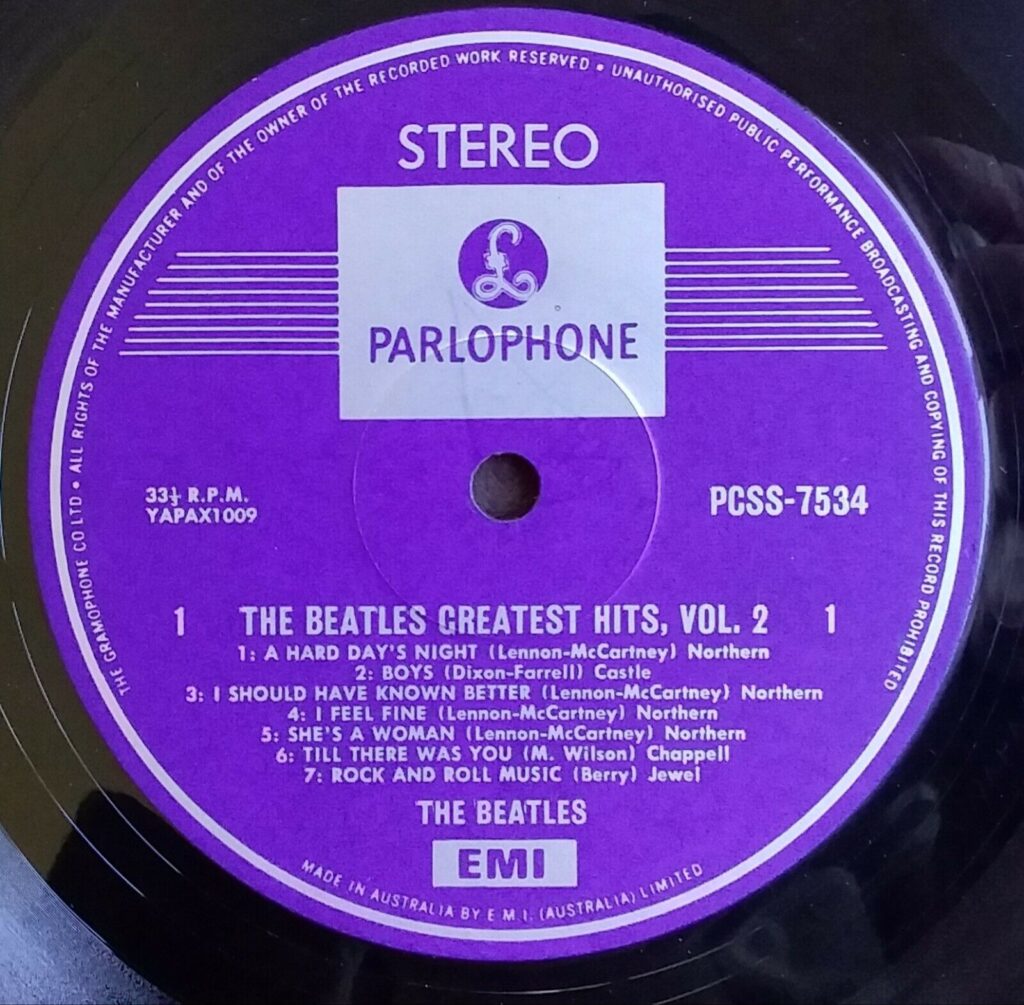
Purple One-Box (February to May 1973). Identical layout to Orange One-Box, but with a purple background. The design was used exclusively for the special release Australian 10th Anniversary 1963-1973 Souvenir Presentation, a TV-promoted double-LP Beatles compilation. After the album was deleted from the catalogue three months in, leftover purple label stock at the pressing plant was used on individual issues of Greatest Hits Volume 1 and Greatest Hits Volume 2, retaining the PCSS 7533/7534 catalogue numbers from the 10th Anniversary compilation (instead of the standard PCSO numbers). For collectors, the purple Greatest Hits is actually the more interesting variant of the two, simply because its existence is less widely known.
Teal One-Box (around late 1979). A label normally reserved for popular reissues from EMI’s Encore and Drum series, issued under imprints associated with EMI (including Capitol and Columbia). It surfaced on Greatest Hits Volume 1 and Volume 2, for reasons that remain unclear. Jones flatly calls it an „aberration”. A small print run, with low market awareness.
Generic EMI (1978-1979). A cream EMI label without an imprint prefix. Used exclusively on the earliest copies of Rarities (UK), found almost entirely in the first 2,000 The Beatles Collection box sets (with UK-made boxes, distributed in Australia).
Orange Columbia (1979). One of the strangest rarities in the entire Australian Beatles discography. Around 300 copies of With The Beatles pressed in 1979 were given the orange Columbia label by mistake, in place of the orange Parlophone label. As both labels were in use at EMI Australia at the time in very similar colours, the most likely explanation is a simple production-line mix-up. Copies also exist with Parlophone on one side and Columbia on the other. A textbook case of a peripheral factory where things did not always go exactly to plan.
Black One-Box (April 1982 to November 1990)
In April 1982, EMI Australia took a decisive cosmetic turn. The orange Parlophone label and the Apple „apple” were both replaced by Black One-Box, a design based on the briefly-used UK One-Box label but in a different palette. The new colour scheme was meant to give the label a considerably more contemporary look, which mattered by the mid-1980s, with CDs entering the market and beginning to threaten vinyl’s standing.
Black One-Box went through some evolution, and the appearance and arrangement of certain details can vary noticeably from one title to another. In November 1988, the labels for Rubber Soul and Past Masters received an additional facelift, ending up with a uniquely modern look within the Black One-Box catalogue.
November 1990 marks the end of vinyl production in Australia. Black One-Box was therefore the final Beatles vinyl label produced in the country during the period when the catalogue was still actively being issued.
Contract and club pressings
EMI Australia, in certain periods, simply could not press all titles on its own production lines. Standard industry practice in such situations was to outsource pressing work to subcontractors, both domestic and foreign. EMI Australia did this consistently, most often with HMV New Zealand (renamed EMI New Zealand in May 1972). These were not isolated copies but full pressing runs, sometimes tens of thousands of units for a single title.
New Zealand pressings break down into three periods.
1965-1967, on the Blue HMV NZ label. Greatest Hits Volume 1 was among the titles pressed there during this window.
1968-1969, on the Yellow Parlophone label. After the release of Sgt. Pepper’s Lonely Hearts Club Band in mid-1967 and the production of the Stones’ Their Satanic Majesties Request (in early 1968), EMI Australia shifted the responsibility of pressing the back catalogue of Beatles albums and most of the compilations across to New Zealand. The number of titles produced there is estimated at around 30. New Zealand pressings used local stampers and labels modelled on the Australian Yellow Parlophone, with minor differences in typography and rim text content.
1981-1987, on the Dark Grey EMI 1-Box label. John Lennon’s death on 8 December 1980 triggered such a sales surge that, even with a fully automated pressing line newly commissioned during this period, the EMI plant in Australia could not keep up with the wave of incoming orders. Practically every Beatles album, and the band members’ solo titles too, were pressed in New Zealand throughout 1981 and into early 1982. Critically, the label used in NZ during this window was a One-Box EMI design in dark grey, not the black one Australia was running at the time (Black One-Box). So a dark grey label on a 1980s Beatles copy is most likely a contract pressing from New Zealand, not an Australian press. A very practical identification rule.
World Record Club (WRC) is a separate chapter. In 1969, the Australian arm of WRC entered the popular music market, and chose the American Magical Mystery Tour album as its first Beatles release, issued under the title Magical Mystery Tour and Other Splendid Hits. That made it the long-playing version six years ahead of the UK, which made do with the double EP until 1976. WRC appeared on two labels: first with a large „S” on a blue-green base (the classic WRC stereo design), then from August 1972 with an eighteenth-century trumpeter in green on a blue base. Only this single Beatles title appeared on WRC, although in the early 1980s many „stock” copies of other Beatles albums found their way to WRC for sale, marked only by a small WRC sticker on the rear sleeve, with no label change.
Axis, launched in May 1972, was EMI Australia’s budget imprint for back-catalogue reissues. Four Beatles titles appeared on Axis: Rock 'N’ Roll Music Volume 1, Rock 'N’ Roll Music Volume 2 (in 1981, 1982 and again in 1987), A Collection of Beatles Oldies (1985) and At The Hollywood Bowl (1990). Two label styles: black-and-white (until March 1982) and yellow (from April 1982 after the Axis rebrand), with the appropriate rim text variants for EMI Australia and EMI Music Group Australasia.
Custom Apple for At The Hollywood Bowl (1977) is the only Australian Beatles release with an entirely custom label, replicating the UK design. A single instance worth flagging, because in the Beatles catalogue it is unusual for EMI Australia to set its standard label aside in favour of a UK replica.
A practical dating cheat-sheet
For anyone after the short version, it runs roughly like this.
Gold Parlophone: 1963 to March 1964, Please Please Me and With The Beatles only.
Yellow Parlophone Mono: March 1964 to end of mono era (around end of 1968 for most titles, with selected reissues running into February 1969).
„Banner” Stereo: March 1964 to February 1969, silver and dark blue, stereo only.
Yellow Parlophone Stereo: February to July 1969, short transitional window, grey STEREO box at the top.
Apple: December 1968 to April 1982, royalty stamps until July 1969.
Orange One-Box A: April 1969 to October 1978, „Top STEREO”.
Orange One-Box B: October 1978 to early 1979, „Side STEREO”.
Orange One-Box C: early 1979 to March 1982, „No STEREO”.
Black One-Box A: April 1982 to July 1987, „EMI (AUSTRALIA) LIMITED”.
Black One-Box B: July 1987 to November 1990, „EMI MUSIC GROUP AUSTRALASIA”.
Two key additional markers. Royalty stamps to the left of the spindle hole indicate a pre-July 1969 pressing (a useful identifier across all formats). A dark grey One-Box on a 1980s copy indicates a contract pressing from New Zealand, not an Australian press. With those two rules and the list above in mind, most Australian Beatles copies can be dated to within roughly a quarter.
What comes next
The label is the starting point for identification, not the whole story. Full analysis of an Australian pressing also takes in the tax stamp (usually on the rear sleeve, sometimes on a separate sticker), the cover printer (Garrod & Lofthouse, Ernest J. Day, local Australian suppliers), inner sleeves (factory EMI sleeves, Apple Records sleeves in various variants), matrix numbers and additional dead-wax markings (Australian convention numbers, stamper codes, lacquer numbers), vinyl weight (differences between early 1960s pressings and later 1970s and 1980s pressings), the catalogue numbering system (PMCO, PCSO, PSLP, SOEX and their chronological logic), and various other physical features.
All of that goes in the next article. For today, the label alone is enough to walk into a record shop in Sydney, pick up Rubber Soul, and know whether you have landed on a 1966 first pressing or a 1981 reissue. Everything else is detail.
| Label | Period | Format | Identifying features | Notes |
|---|---|---|---|---|
| Gold A mono | 1963 to January 1964 | LP | Black base, gold text, perimeter rim text „MADE IN AUSTRALIA FOR THE PARLOPHONE CO. LTD. SYDNEY, NSW” | *Please Please Me* (PMCO 1202) only |
| Gold B mono | January to March 1964 | LP | Black base, gold text, horizontal rim text „MADE IN AUSTRALIA BY E.M.I. (AUST.) LIMITED” beside spindle hole | *Please Please Me* (PMCO 1202) and *With The Beatles* (PMCO 1206) |
| Y/B Mono mono | March 1964 to end of mono era | LP | Yellow and black, „TRADE MARK” beneath Parlophone logo, white „33 1/3 R.P.M.”, royalty stamps to left (until June 1969) | Australia, unlike the UK, used Y/B for mono only |
| „Banner” Stereo stereo | March 1964 to February 1969 | LP | Silver and dark blue base with silver text, modelled on the discontinued UK Gold Stereo, royalty stamps to left | Ran in parallel with Y/B Mono for nearly 5 years |
| Y/B Stereo stereo | February to July 1969 | LP | Yellow and black with grey STEREO box at top right next to logo (Style A) or unboxed STEREO beside spindle (Style B, *Sgt. Pepper’s* only) | Short transitional period, few titles, used to burn through Y/B stock |
| Apple mono and stereo | December 1968 to April 1982 | LP | Granny Smith apple (side A), sliced apple (side B), royalty stamps to left until June 1969, then „33 1/3 R.P.M.” and matrix number | Custom Apple red (*1962-1966*) and blue (*1967-1970*) in use July 1973 to 1979 |
| Orange One-Box Style A stereo | April 1969 to October 1978 | LP | Orange base, black text, „STEREO” in large type at top, boxed Parlophone logo | Longest stretch of the Orange era, most common in circulation |
| Orange One-Box Style B stereo | October 1978 to early 1979 | LP | Orange base, „STEREO” in smaller type to the right of spindle, above PCSO catalogue number | Short window, few titles |
| Orange One-Box Style C stereo | early 1979 to March 1982 | LP | Orange base, „STEREO” absent from label entirely | Final stretch of the Orange era |
| Black One-Box Style A stereo | April 1982 to July 1987 | LP | Black base, silver text, rim text „EMI (AUSTRALIA) LIMITED” | Replaced both Orange Parlophone and Apple simultaneously |
| Black One-Box Style B stereo | July 1987 to November 1990 | LP | Black base, silver text, rim text „EMI MUSIC GROUP AUSTRALASIA” | Following EMI Australia/EMI NZ merger; transition mid-pressing of red-vinyl *Sgt. Pepper’s* |
Quick check:
Source notes: Dates are drawn from EMI Australia Acceptance Sheets as compiled by Jaesen Jones (beatlesaustralia.com). Cross-checks against Discogs, beatlesblogger.com and thebeatles-collection.com show no contradictions within the scope reviewed. The „RECORDING FIRST PUBLISHED 1963” rim text known from UK Y/B has not been confirmed by Jones for Australian pressings, so it is omitted from this guide pending separate verification.
|
||||
Primary factual source: Jaesen Jones, „I Am The Platypus, The Beatles Australian Records Labelography”, beatlesaustralia.com.
Share Your Opinion